Chronicle Editor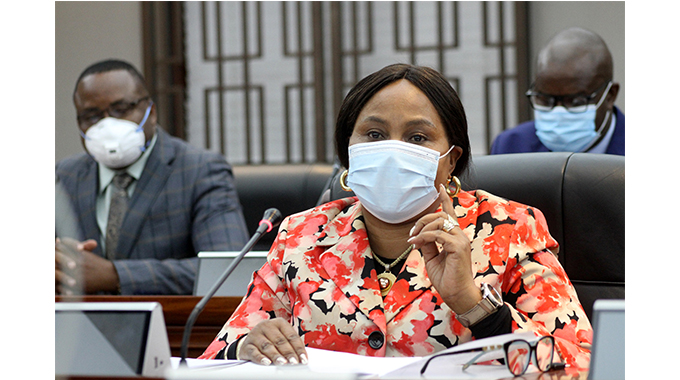
Mashudu Netsianda, Senior Reporter
GOVERNMENT has approved the adoption of the new guidelines set by the World Health Organisation (WHO), which regulate the discharge of Covid-19 patients from isolation centres and this will result in reduction in the number of days people will spend in the quarantine and isolation facilities and the number of re-tests to be conducted.
According to the new guidelines, people with symptoms will now spend a minimum of 13 days in isolation and a minimum of 10 days for asymptomatic patients instead of the 21 days following two consecutive negative PCR results that are 24 hours apart.
Information, Publicity and Broadcasting Services Minister Monica Mutsvangwa said this while briefing journalists on the 18th Cabinet meeting decision matrix in Harare last night
She said the implementation of the new guidelines will ease the situation in the quarantine and isolation centres.
Minister Mutsvangwa said the new guidelines will lead to a reduction in the number of re-tests to be conducted.
Patients who continue to test positive are presently not being discharged. “The new WHO criteria for discharging patients from isolation are as follows: for symptomatic patients, they should be discharged after a minimum of 13 days. The days include a minimum of 10 days after symptom onset and that is fever and respiratory symptoms and an additional three days without symptoms,” she said.
“For asymptomatic cases these can be discharged 10 days after testing positive for Covid-19.
Minister Mutsvangwa said the cumulative rapid screening and PCR tests conducted as of 6 July stands at 80 654 (47 086 RDT and 33 568 PCR) and these also include tests done at private laboratories.
The country has now recorded 734 Covid-19 confirmed cases of which 528 are active cases, with 197 recoveries and nine deaths.
The eighth death is of a 21-year-old female with no travel history but with co-morbidities (leukaemia), while the ninth death is of a 54-year-old male with co-morbidities (underlying medical conditions).
Of the 734 confirmed cases, 113 are local cases of which 88 of those local cases can be linked to known confirmed cases, while the other 25 cannot be immediately linked to a confirmed case.
Minister Mutsvangwa said investigations are underway to establish the sources of infection.
Harare has the highest number with 245 cases which are mainly imported cases while Bulawayo has recorded the highest number of local cases which stand at 50.
Local transmissions in the country stand at 16 percent of the total cases recorded. The cases so far recorded in the country, however, do not have a specific trend and are largely influenced by the volumes of returnees. There are no cases admitted to High Dependency Unit (HDU) and Intensive Care Unit (ICU).
Minister Mutsvangwa said Cabinet was updated on the gastrointestinal disease outbreak in Luveve, Bulawayo where a total of 1 798 cases had been attended to both at home and clinic. A total of 13 deaths have been recorded.
Government is carrying out a number of interventions which include waiving of water shedding in the affected area, risk communication and community engagement and distribution of oral rehydration salts as well as placing neighbouring health facilities on high alert.
Bulawayo City Council (BCC) has also exempted all residents with diarrhoea from paying user fees at the local authority’s clinics as long as water shedding subsists.
BCC is also conducting house-to-house surveys to actively find more diarrhoeal cases and collecting water samples for analysis.
Minister Mutsvangwa said under the cash transfers to the informal sector members affected by Covid-19, a total of 202 077 people had been paid cushioning allowances. She said the provinces have been asked to provide more names to reach the targeted one million beneficiaries.
Cabinet also approved the 2020 winter maize production programme, which is targeting to put 4 000 hectares under winter maize in Zimbabwe’s low-lying areas of Masvingo, Matabeleland North and Mashonaland West.
“A cost-benefit analysis of the programme reveals that it will result in substantial savings in comparison to importing the same amount of maize. Other benefits of the programme include maximisation of land use, ensuring food supply sufficiency as most countries are not likely to export due to the Covid-19 pandemic and employment creation for locals,” said Minister Mutsvangwa.
She said the programme will also reduce the burden of support on Treasury since the programme is run on a cost-recovery basis.
Cabinet approved the plan on the Tourism Recovery and Growth Strategy, which seeks to revive and grow the tourism sector into a US$5 billion industry by 2023.
Government also approved the erection of a statue of heroine of the First Umvukela/Chimurenga, Mbuya Nehanda.
The monument will be located at the intersection of Samora Machel Avenue and Julius Nyerere Way.
Work has already started and is being implemented by an inter-agency team which is supervised by Vice President Dr Constantino Chiwenga. — @mashnets



 Online Reporter