admin
admin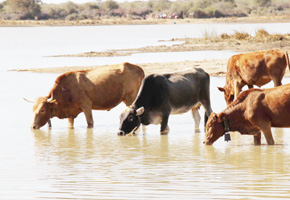
Last year, it was reported that the total population of cattle in the country had gone down from more than seven million to about 5 156 753 and the Government is now worried that the shortage of pastures owing to poor rains this year could hit the entire herd in drought prone areas.
In an interview from Mutare yesterday, the Deputy Minister of Agriculture, Mechanisation Irrigation Development, Seiso Moyo, said the Government was concerned about the drought facing livestock hence the need for an assessment to come up with intervention measures.
Deputy Minister Moyo said a team has been dispatched to visit all affected areas and had already covered Matabeleland North and South, parts of Midlands and yesterday started in Manicaland Province.
He said although they were yet to release a report of findings, the situation was critical in most parts of the country.
“We are monitoring the situation to establish the worst affected areas. The Government has a scheme to assist farmers, both crop growers and cattle ranchers, which is why we now want to establish the state of the situation on the ground to come up with intervention measures. We are still assessing and will give a report of our findings after we finish,” said Deputy Minister Moyo.
He said preliminary findings were that most farmers from drought affected areas had moved their livestock to areas less affected in search of better pastures.
However, he said such a move could also strain available resources in those areas.
“We have noted that farmers have moved their cattle mostly in Matabeleland South. In the area around Jopembe in Beitbridge there are now about 40 000 that have been moved to the area while the area around Matopo Research Centre in Matobo is accommodating cattle from the southern parts of the district.
“A lot of cattle from Mangwe district are now in Marula while some from parts of Beitbridge and Gwanda are in West Nicholson. Filabusi, Esigodini and areas around Plumtree in Matabeleland South are not as bad as other areas,” said Deputy Minister Moyo.
He said it was critical now for the Government to come up with measures to prevent veld fires from destroying the available pastures.
“The major worry now is veld fires, we might have all intervention measures but because people would burn grass we might end up with no pastures even in areas where cattle have been moved to. As Government we have to see how this can be prevented,” said Deputy Minister Moyo.
He said the other challenge was disease control, shortage of water and other facilities like dip tanks in areas where cattle have been moved to.
“There is a high risk of diseases and water supply which should be addressed as a matter of urgency. Some of the areas where cattle have been moved to have no dip tanks or water supply facilities and we would want the Department of Veterinary Services to work on that and see how diseases could be handled,” said Deputy Minister Moyo.
He urged farmers to start looking at other alternatives of preserving their livestock like offloading oxen so that the little pastures available could be used for breeding animals.
Farmers in Matabeleland South recently appealed to the Government to declare the province a disaster area and harness funds to help them save their animals.
There have been concerns from the country’s traditional cattle area of the Matabeleland region for the Government to speed up the release of the $6.5 million loan meant to revive the country’s national herd.
Agribank signed a Memorandum of Understanding with the Cold Storage Company to disburse the funds.



 Online Reporter