Online Reporter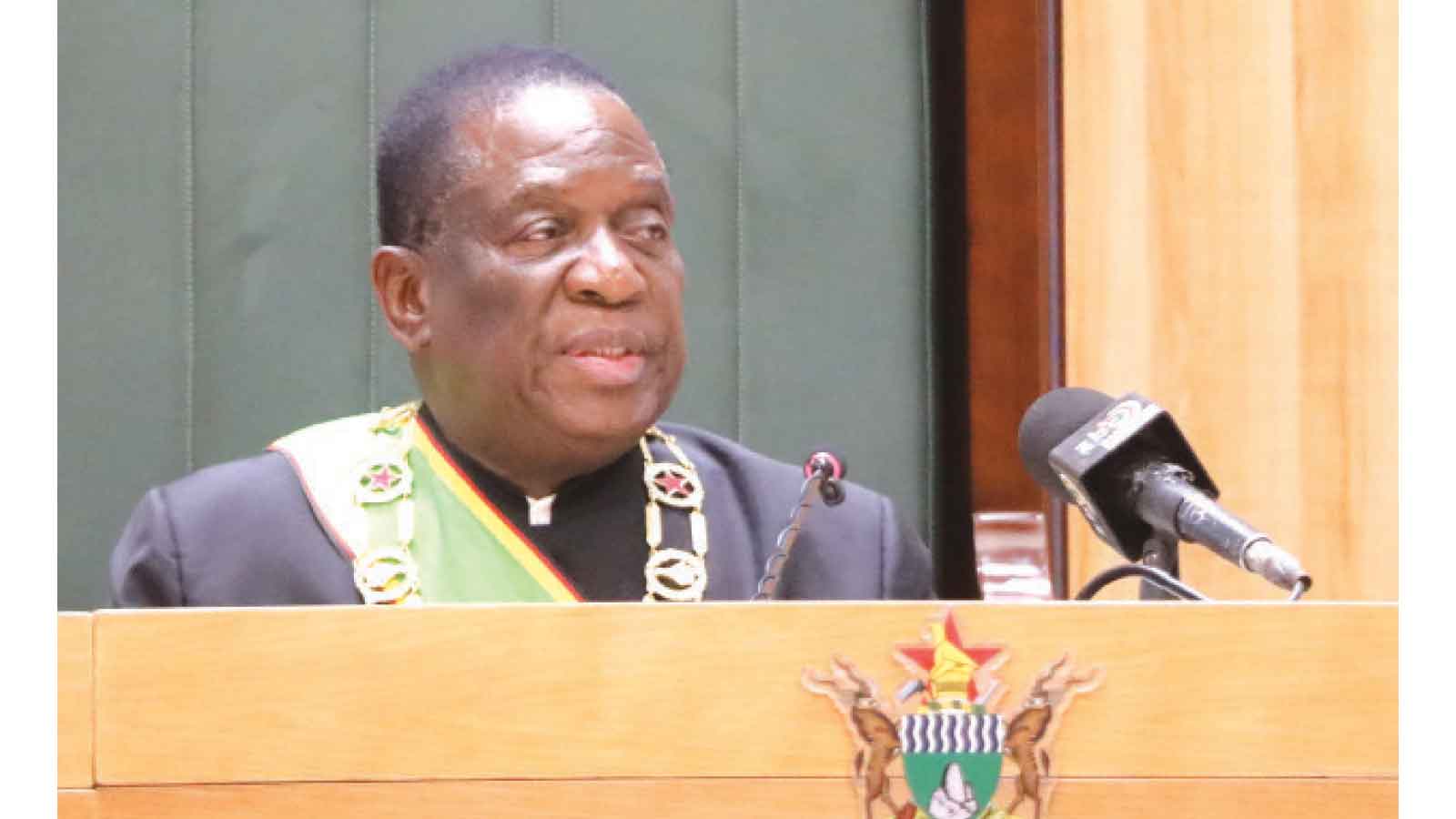
Below is the speech delivered by His Excellency the President and Commander-in-Chief of the Zimbabwe Defence Forces, Cde Emmerson Mnangagwa, at the official opening of the Fourth Session of the Tenth Parliament of Zimbabwe at the New Parliament Building in Mt Hampden yesterday
Vice President, Hon. Gen. (Rtd.) Dr C. G. D. N. Chiwenga;
Vice President, Hon. Col. (Rtd.) Dr K. C. D. Mohadi;
Speaker of Parliament, Honourable Advocate J. F. N. Mudenda;
President of the Senate, Honourable M. M. Chinomona;
Chief Justice, Honourable E. Gwaunza;
Honourable Ministers;
President of the Chief’s Council, Chief M. Khumalo,
and other Traditional Leaders here present;
Honourable Members of Parliament and the Senate;
Senior Government Officials;
Service Chiefs;
Fellow Zimbabweans here at home and in the Diaspora;
Ladies and Gentlemen;
Comrades and Friends.
It is my singular honour and privilege, once again, to address this August House, as our great nation marks the Opening of the Fourth Session of the 10th Parliament of Zimbabwe.
Since last year, we have registered a remarkable impact on the lives and livelihoods of communities in both our urban and rural areas.
True to our ethos as the Second Republic, we are leaving no one and no place behind.
Mr Speaker Sir, Madame President;
Zimbabwe is open for business. The country has achieved sustained macro-economic stability over a considerable period of time.
My Government has consolidated gains in price, currency and exchange rate stability. Inflation has been reduced to single-digit levels since January 2026.
The positive out turn has been supported by strong foreign currency inflows, which amounted to US$10,7 billion for the first half of 2026 and are expected to reach about US$20 billion by year-end.
The macro-economic gains were achieved through deepening the financial sector institutional framework and, henceforth, ensure continued confidence in the country’s macro-economic environment.
The agriculture sector recorded a phenomenal 27,9 percent growth and contributed 2,2 percentage points to the country’s 8,3 percent GDP growth.
The 2026/2027 outlook for our SADC sub-region is regrettably projected to be characterised by unfavourable weather patterns with below normal rainfall. So far, my Government has put in place a Six Pillar Plan for resilience.
This incorporates an Enhanced Strategic Grain Reserve; Accelerated Climate-Smart Production; Integrated Financing Architecture; Livestock Drought Mitigation; and Co-ordination as well as an Early Warning and Capacity Building mechanism.
Through our Chiefs, Headmen and Village Heads, communities are being prepared to withstand future shocks.
The mining sector remains a key anchor of Zimbabwe’s economic development.
To further develop the sector, my Government is capacitating the Mining Promotion Corporation and the Zimbabwe Geological Society to undertake systematic exploration, while also developing bankable projects for investment.
In line with our thrust on mineral beneficiation and value addition, we take pride in that we recently recorded the first locally-produced lithium sulphate from Africa. Additional lithium sulphate plants are being established around the country.
Investments in iron and steel are re-shaping our industrial base and opening downstream and supply chain opportunities in Zimbabwe and across the SADC region.
With regards to Gold and Platinum Group Metals, various expansion works are being undertaken by sector players. Formalisation, financing and equipping of small-scale gold mining and other minerals will remain a priority for Government.
Mr Speaker Sir, Madame President;
The manufacturing sector continues to register growth, underpinned by value chain development increases, capacity utilisation and overall productivity.
These encompass iron and steel, cement and clinker, as well as pharmaceuticals, among other sub-sectors.
To further spur growth, Government has reviewed numerous licences, permits, levies and fees in 13 sectors as well as multiple regulatory requirements.
This will further enhance the ease of doing business environment and improve the competitiveness of local industry.
Coherent legislative and institutional parameters are set to catalyse provincial industrialisation, attract a wider range of investments and achieve inclusive development at every level of our economy.
Tourism has continued on its upward trajectory.
Strong sectoral growth has been recorded during the first half of 2026.
Remarkable improvements are evident in the Energy Sector.
Frequent load shedding is now a thing of the past. Supplies from Kariba Hydro and Hwange Thermal power stations are being augmented through Independent Power Producers and Captive Power plants as well as net-metering and rooftop solar.
The rural electrification programme is accelerating through grid extension and mini-grids, and is targeting to electrify all public institutions.
Fuel supplies have remained stable and adequate to support the country’s socio-economic activities.
This is despite global market disruptions and other shocks.
In the transport and infrastructural development sector, the country continues to record significant progress in road rehabilitation, modernisation and construction.
The following roadworks are targeted during the 4th Session of the 10th Parliament: completion of the Harare-Beitbridge Road; 30 kilometres of the Harare-Kanyemba highway; 30 kilometres of the
Harare-Nyamapanda highway; 50KM of the Bulawayo-Victoria Falls highway; 20KM of the Harare-Chirundu highway; and 40KM of the Kwekwe-Nkayi-Lupane Road.
Government aims to complete the Mabvuku Interchange project, along with other interchanges designed to facilitate efficient movement along strategic traffic nodes.
Successful refurbishment was undertaken at the Masvingo Airport, while the Kariba Airport upgrade is scheduled during this Fourth Session.
Two additional international airlines are expected to fly into Zimbabwe in 2027. Cargo facilities will be expanded at the Victoria Falls and J. M. Nkomo International Airports.
I have also directed that all requisite ancillary services be modernised and availed for airlines servicing our routes.
Attention to railway development continues to be upscaled, with new and refurbished wagons recently purchased for the National Railways of Zimbabwe.
In April 2026, Zimbabwe and Zambia signed a Memorandum of Understanding for the development of a 311-kilometre railway link between Kafue and Lion’s Den. In progress is the rehabilitation of the 614-kilometre rail line from Chicualacuala to Plumtree, due to be completed by August 2027.
This project is under the US$12 billion Tripartite Agreement between the Railway Administrations of Zimbabwe, Mozambique and Botswana.
Mr Speaker Sir, Madame President;
Government has continued rolling out the Presidential Title Deeds Programme in urban and peri-urban areas in order to formalise land and property ownership.
A comprehensive revision of building by-laws into modern harmonised building codes is also underway.
Our robust social protection framework is having positive impacts through community outreach, symposiums and expos which are helping to conscientise persons with disabilities on available support programmes.
As the reintegration of returnees from South Africa remains ongoing, we are utilising skills data to guide reskilling, upskilling and job placement for returning citizens. In October this year, our country is set to host the African union Skills Week.
The event is expected to position Zimbabwe as a hub for skills excellence towards consolidating Africa’s human capital.
Mr Speaker Sir, Madame President;
Access to essential health services has continued to improve through capacitation of public health institutions and expansion of primary healthcare services, including availability of essential medicines.
Digital health is being strengthened through the rollout of ICT connectivity to health facilities across the country.
Drafting of the Small and Medium Enterprises, Amendment Bill is in progress to strengthen the development of MSMEs, accelerate formalisation, broaden access to finance and markets, as well as enhance institutional coordination.
Reforms are underway to reinforce workplace culture based on dignity, respect, fairness, responsiveness and accountability. Government is continually improving public sector performance.
A centralised Citizen Engagement Platform will see regular interface to capture the views of citizens on policy, reform and the overall performance of the public sector.
Meanwhile, the welfare of our public sector workers remains a key cog to efficient service delivery.
I am pleased to note that beyond their working life, public servants are being prepared for retirement.
In view of the critical role of sport in socio-economic development, Zimbabwe is celebrating the return of international football to the National Sports Stadium.
This follows a sustained programme of refurbishment, rehabilitation and modernisation, undertaken in partnership with the private sector and the football fraternity.
The requirement for municipalities to use part of their budgets for the rehabilitation of sport and recreational facilities has resulted in visible progress at Masvingo’s Mucheke Stadium and Mutare’s Sakubva Stadium.
Such initiatives take our sport-talent identification and development to higher levels.
The construction of Mosi-oa-Tunya International Cricket Stadium in Victoria Falls is on course for hosting the 2027 ICC Men’s Cricket World Cup Tournament, alongside Harare Sports Club, and Queens Sports Club in Bulawayo.
Mr Speaker Sir, Madame President;
We shall assume the United Nations Security Council Non-Permanent Seat for the 2027 to 2028 term, in January 2027. Our country’s tenure will be guided by our philosophy that we are “A Friend to All and an Enemy to None”.
We look forward to hosting the 25th COMESA Heads of State and Government on 21 October 2026, where Zimbabwe will assume the COMESA Chairmanship.
These are heartening achievements which demonstrate the faith and confidence the international community has in our great motherland, Zimbabwe.
Mr Speaker Sir, Madame President;
My Government is unwavering in its commitment to the rule of law, access to justice, constitutionalism, good governance, and public accountability.
Allow me, therefore, to now turn to the legislative programme.
Following the successful enactment of Constitutional Amendment Act No. 3, there is need to undertake consequential amendments to ensure that various pieces of legislation are aligned with the Constitution.
In particular, the Ministry of Justice, Legal and Parliamentary Affairs will facilitate the following:
• Amendment of the Electoral Act;
• Amendment of the Constitutional Court Act; and
• Enactment of a new Delimitation Commission Act.
In order to promote access to justice as well as socio-economic opportunities, the following Bills will be processed:
• the Child Justice Bill.
• the Whistle Blowers and Witness Protection Bill.
• the Legal Aid Bill.
• the Legal Practitioners Amendment Bill; and
• the Chartered Secretaries Amendment Bill.
It is imperative to ensure that our fiscal instruments remain robust and responsive to contemporary economic realities.
As such, the Fourth Session will be seized with the Finance Bill which will, among other issues, modernise and strengthen the legislative framework governing revenue mobilisation.
To formally codify trade and investment promotion into the statutory mandate of Zimbabwe’s diplomatic missions abroad, the Foreign Affairs and International Trade Bill will be presented for consideration.
The Bill will, among other aspects, enhance inter-agency synergies across Government, for the coordinated global projection of “Brand Zimbabwe.”
Mr Speaker Sir, Madame President;
A responsive regulatory foundation is essential for sustainable water resources management, agricultural marketing and value chain development.
Accordingly, the following agriculture sector legislative items will be brought before the August House:
• the Water Act.
• the Zimbabwe National Water Authority Act.
• the Tobacco Industry and Marketing Board Act; and
• the Tobacco Research Board Act.
Environmental protection will be bolstered through amendments to the Forest Act and the Communal Land Forest Produce Act for a more robust piece of legislation.
The 2nd Republic continues to strengthen the integrity, quality and professionalism of our world-renowned education system.
To this end, the Zimbabwe School Examinations Council Amendment Bill has been recommitted to Parliament for reconsideration to ensure constitutional process alignment.
The National Healthcare Provision Bill, which seeks to strengthen healthcare delivery and promote equitable access will be tabled in Parliament.
The Zimbabwe National Family Planning Council Bill will review the current Act to strengthen governance around reproductive health issues, in line with prevailing population and development priorities.
The Medicines and Allied Substances Control Bill will focus on regulating medicines, medical products and allied substances as well as pharmaceutical sector development and patient safety.
Other Bills that will be submitted for deliberation are the Medical Research Bill; the Food and Food Safety Bill; and the Mental Health Bill. The Red Cross Society Amendment Bill should be accorded due attention and synced with current national realities.
The Road Accident Fund Bill will be tabled in Parliament during this Session.
Other transport sector Bills, intended for presentation in the 4th Session are the Merchant Shipping Bill; the Road Traffic Authority Bill; and the National Roads Authority Bill.
Government is aware of the need to respond to emerging criminal justice trends as well as public security and regulatory challenges.
In this regard, the Fourth Session is expected to finalise the Police Amendment Bill.
The National Drug and Substance Abuse Control and Enforcement Agency Bill awaits formal introduction in Parliament.
These are intended to tackle the undesirable scourge threatening our nation through appropriate prevention, control, enforcement and coordination.
Of equal significance is the Trafficking in Persons Bill, which seeks to protect innocent citizens from transnational syndicates advertising non-existent jobs abroad.
Mr Speaker Sir, Madame President;
As we continue to reform our systems and in line with our national priorities and compliance with global best practice, the Fourth Session will consider the Biological Weapons and Toxins Crimes Bill; the Defence Amendment Bill; the Arms Trade Treaty; the Treaty on the Prohibition of Nuclear Weapons; and the Cluster Arms and Munitions Convention.
Similarly, the Session should speed up processing of the Firearms Amendment Bill to tighten possession and usage of firearms in the country.
Veterans of the Armed Liberation Struggle continue to be a valuable part of our country’s rich history. To ensure their decent livelihoods, three Amendment Bills will require speedy conclusion during this Fourth Session.
The Bills seek, among other issues, to ensure continuous improvement of statutory benefits for Veterans, heroes’ dependants together with war victims; and to strengthen the memorialisation framework for the identification,exhumation, repatriation and reburial of fallen heroes and heroines.
Mr Speaker Sir, Madame President;
With less than four years remaining, until 2030, we have achieved unprecedented milestones as the united, peace-loving and hardworking people.
Together, from Zambezi to Limpopo, Plumtree to Chirundu, we are building our motherland and transforming the quality of life of communities.
The policies we have adopted, as enacted by this esteemed Parliament are unlocking investments, accelerating economic growth and creating vital jobs.
Empowerment opportunities, especially for women and young people, are being broadened. We have every reason to be proud.
However, the journey continues, much work lies ahead.
Let us leverage this Fourth Session of the 10th Parliament to reaffirm our commitment to scale up transformational results in all sectors of the economy and levels of society.
The Legislature is assured that my Administration shall continue to facilitate an environment that is responsive to current realities, yet predictable and transparent.
The bold decisions and disposition of my Government to guarantee that our country’s wealth delivers sustainable prosperity for all, and development that leaves no one and no place behind, are here to stay.
I call upon all of us; the elected leaders of our nation, along with players across sectors of the economy, entrepreneurs, women, young people, Chiefs, traditional leaders and communities at large, to confidently march on, shoulder-to-shoulder, towards realising the Zimbabwe we all want and indeed deserve. Forward ever, backward never.
Nyika inovakwa, inotongwa, inonamatirwa nevene vayo/Ilizwe lakhiwa libuswe, likhu-le-ke-lwe ngabanikazi balo.
With these remarks and in terms of our Constitution of Zimbabwe, I now table this State of the Nation Address and declare the Fourth Session of the Tenth Parliament of Zimbabwe officially open.
God bless you.
God bless Zimbabwe.
I thank you.