admin
admin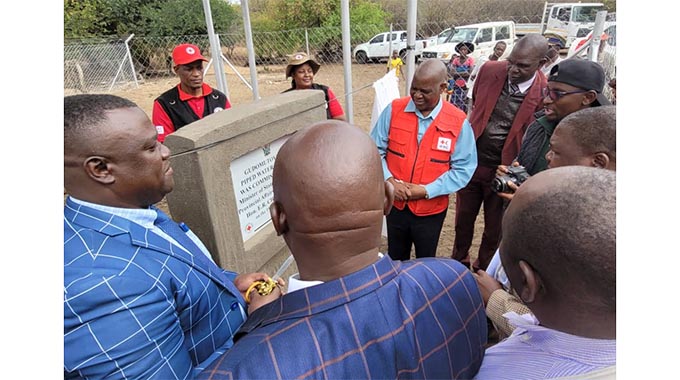
Phyllis Kachere Deputy News Editor (Convergence)
A collaborative effort between Government’s auxiliary, the Zimbabwe Red Cross Society (ZRCS) and the International Federation of Red Cross and Red Crescent Societies to address the pervasive issues of hunger and water scarcity in Mwenezi has resulted in the establishment of the Gudomutovhoti Piped Water Scheme through the Zero Hunger Project implemented in the district.
Officially launched on Tuesday, the piped water scheme that is in Ward 14 under Chief Neshuro the Zero Hunger Project was designed to alleviate hunger and malnutrition, particularly among vulnerable populations such as children under five through sustainable solutions to water scarcity through the establishment of the Gudomutovhoti Piped Water Scheme.
Speaking at the commissioning ceremony, Minister of State for Masvingo Provincial Affairs and Devolution Ezra Chadzamira reiterated Government’s commitment to addressing water scarcity and emphasized the project’s alignment with national development goals.
“By reducing the distance to access water—currently up to 7km—residents will save valuable time for productive activities. With the 8,000L per hour pump, more than 8 000 households and 1 000 cattle will benefit. The three 10-cubic-metre water storage tanks installed at the borehole, school, and community centre will further enhance access to clean water,” said Minister Chadzamira.
The pipeline network spans 2km and includes additional infrastructure such as a cattle trough, pump house, guard house, and three taps at each standpipe.
“This comprehensive setup will particularly benefit women and girls, who are often most impacted by water scarcity, as they will no longer need to travel long distances for water,” he said.
He said that the project was in line with Government’s efforts of achieving zero hunger in the country despite the El-Nino-induced drought.

“Government has drilled a total of 1 231 boreholes as part of its commitment to addressing water scarcity in Zimbabwe to ensure a healthy and nutritional Zimbabwe. Plans are underway to increase this number by 37 percent by the end of the year, contributing to the NDS1 – Food and Nutrition security pillar,” said Minister Chadzamira.
Since inception, the Gudomutovhoti Piped Water Scheme now supports a 1-hectare garden, which is fully planted with tomatoes, onions, spinach, and rape.
This garden not only provides food security for the community but also serves as a source of income generation. The water scheme, powered by solar energy, ensures clean water supply for domestic use, agricultural activities, and livestock rearing, benefiting approximately 1 700 cattle and other livestock.
Additionally, the scheme provides water to Takura Primary School, located approximately 2kilometers from the pump house for the school children and teachers.
Various stakeholders including representatives from the Office of the Minister of State for Masvingo Provincial Affairs and Devolution, Mr Clorence Matewe who represented him, Mr Albert Tafura and IFRC officials, local government representatives, Mr Albert Chivanga from the Mwenezi Rural District Council and Chief Negari attended the commissioning
.
In his closing remarks, Chief Neshuro pledged to protect the Water Scheme project from potential threats or interference, underscoring the community’s dedication to safeguarding this vital resource.
“We are committed as the owners and beneficiaries of this project to protecting it from vandalism. We will guard this infrastructure jealously,” said Chief Neshuro.
The ZRCS secretary general Mr Elias Hwenga said:
“We are currently implementing the ZERO Hunger project in Mwenezi District. This project was initiated in response to severe hunger and critical water challenges faced by the community and aims to provide urgent and substantial assistance to address acute food insecurity in Zimbabwe.
“The Zimbabwe Red Cross Society is implementing this project with technical and financial support from the International Federation of Red Cross and Red Crescent Societies. The project focuses on Food Security and Livelihoods, Health and Nutrition. Water, Sanitation, and Hygiene (WASH) also form the third pillar,” said Mr Hwenga.
He said the project focused on three wards, targeting 850 households.



 Online Reporter