Online Reporter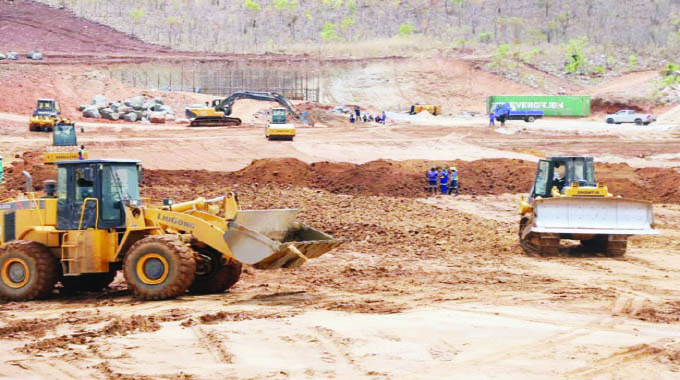
Precious Manomano
GOVERNMENT is accelerating the construction of major dams across the country, with Gwayi-Shangani and Kunzvi now more than 70 percent complete as part of efforts to improve water security, expand irrigation and stimulate economic growth.
Gwayi-Shangani Dam in Matabeleland North has reached 82 percent completion and is expected to be finished by the end of the year, while Kunzvi Dam, being built on the Nyagui River along the Murewa-
Goromonzi border in Mashonaland East, is now 74 percent complete.
The two projects are among Government’s flagship water infrastructure developments and are expected to ease long-standing water shortages in Bulawayo and Harare while supporting agriculture, industry and power generation.
Speaking in an interview on Friday, Permanent Secretary in the Ministry of Agriculture, Mechanisation and Water Resources Development Professor Obert Jiri said Treasury support had enabled Government to prioritise the completion of the two dams.
“There are 12 dams that were active in the last two or three years. Over the last two years, we have really been focusing on two major dams, which is Gwayi-Shangani Dam and Kunzvi Dam. Those two dams have been the particular focus of the Government over the last two years. For Gwayi-Shangani, we are now over 80 percent in terms of its progression. We expect that with the current support from Treasury, we should be able to complete this dam at the end of 2026,” he said.
Gwayi-Shangani is central to Government’s long-term strategy to end Bulawayo’s perennial water shortages while creating opportunities in irrigation, power generation and industrial development.
The project includes six pump stations that will convey water to Bulawayo, while a water treatment plant is planned for Cowdray Park.
Irrigation schemes are also set to be developed along the 256-kilometre pipeline corridor, creating opportunities for increased agricultural production.
In addition, the dam is expected to generate 10MW of electricity, adding to its economic significance.
Prof Jiri said installation of the pipeline to Bulawayo was already underway.
“We expect that Gwayi-Shangani will feed into Bulawayo and already the pipeline from the dam into the city is being installed. So, we expect that the next rainy season, once the dam wall is complete, water will be impounded,” he said.
He said the project would also unlock irrigation potential from existing dams such as Upper Ncema, Lower Ncema and Insiza as demand for potable water shifts to Gwayi-Shangani.
Kunzvi Dam is also progressing steadily, with Prof Jiri expressing confidence that it will be completed by the end of next year.
“For Kunzvi Dam, it’s also progressing very well, now also over 75 percent in terms of completion. It will be able to support Harare in terms of water requirements and already pipeline development from Kunzvi to
Harare is already underway. We expect the dam to also be able to be completed by end of 2026,” he said.
The dam has already started impounding water as final construction works continue.
According to the Zimbabwe National Water Authority (Zinwa), significant progress has been made on the dam wall, spillway, intake tower and other critical infrastructure.
More than 1,2 million cubic metres of core material and 1,4 million cubic metres of fill material have been placed on the dam wall, while nearly 58 000 cubic metres of rip-rap has been installed to protect the structure from erosion.
Once completed, Kunzvi Dam is expected to improve water supplies for Harare and surrounding communities, while also providing potable water to Juru Growth Point, Cross and Musami business centres, as well as Majuru Business Centre in Goromonzi.
The project will also support irrigation on at least 500 hectares, boosting year-round agricultural production.
Construction of the Juru-Kunzvi Road is progressing alongside the dam project, improving access to the area and surrounding communities.
The resettlement programme for families affected by the development is also advancing.
A total of 278 houses have been completed, while another 95 are under construction. In Goromonzi, 120 of the planned 177 houses have been completed, while 158 of the 258 houses earmarked for Murewa are ready for occupation.
Prof Jiri said Government’s broader dam construction programme was focused on turning water bodies into centres of economic activity.
“For us to put it into perspective, we have more than 10 600 water bodies. A lot of these are actually large dams with the capacity to irrigate more than two million hectares. If you look at Tugwi-Mukosi Dam, it has the capacity to irrigate over 40 000 hectares, Marovanyati Dam can irrigate more than 5 000 hectares and Gwayi-Shangani Dam, which is coming up, can irrigate up to 10 000 hectares,” he said.
Zimbabwe requires at least 350 000 hectares under irrigation to guarantee cereal self-sufficiency, he added.
“Constructing the dam wall is the easier part. The important thing is converting every water body into an economy that supports irrigation development, fisheries, hydropower generation, livestock production and water reticulation for surrounding communities. If we do that, we improve livelihoods around the dam. We develop industries around the dam and create centres of economic activity, employment and prosperity.”
Beyond Gwayi-Shangani and Kunzvi, Government is advancing several other major projects. Vungu Dam in Lower Gweru is now more than 60 percent complete, while Sengwa Dam has passed the 50 percent mark.
Dande, Mbada, Bindura, Defe, Tuli-Manyange and Semwa are among other dams currently under construction.
Completed projects include Tugwi-Mukosi, Muchekeranwa, Marovanyati and Chivhu dams, which are already supporting irrigation, water supply and other economic activities.
Government is targeting the completion of 12 high-impact dams by 2027 as part of efforts to increase water storage capacity, expand irrigation, strengthen drought resilience and drive rural industrialisation.
The dam construction programme is being complemented by plans to drill 35 000 boreholes in villages countrywide to improve access to clean water.
The infrastructure drive is expected to unlock opportunities in agriculture, fisheries, energy, construction and related sectors while supporting Zimbabwe’s goal of attaining upper-middle-income status by 2030.