Online Reporter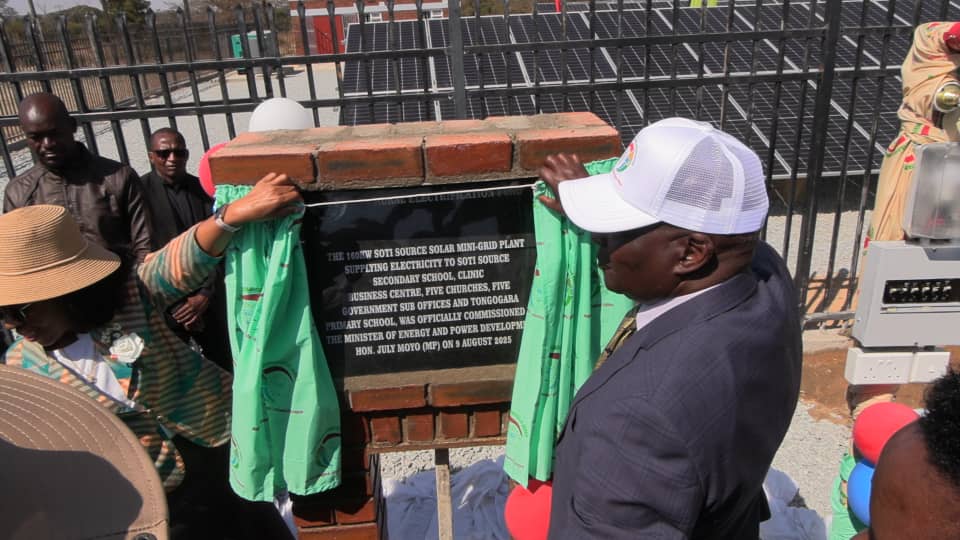
George Maponga-Masvingo Bureau
The Government is intensifying efforts to expand power generation to cover at least 600 000 houses in urban areas
The development aligns with the country’s goal of achieving an empowered upper-middle-income status by 2030.
Speaking after commissioning a 160-kilowatt solar power plant at Soti-Source business centre in Gutu recently, Energy and Power Development Minister July Moyo said there was a need to enhance clean energy production.
Presently, Zimbabwe relies heavily on thermal power from Hwange Power Station, while low water levels in Lake Kariba have limited hydroelectric output from the shared dam with Zambia.
To address the electricity deficit, Minister Moyo announced an ambitious programme aimed at increasing power generation through partnerships with independent power producers (IPPs).
The commissioning of the solar plant in Gutu and others across the country is part of a broader strategy to diversify energy sources and meet the increasing demand for electricity across the nation.
Minister Moyo called for private sector participation to help alleviate the power challenge.
To increase the number of urban houses on the grid, he invited private investors to apply for licences to establish power generation plants.
The Zimbabwe Energy Regulatory Authority (ZERA) is prepared to grant these licenses to companies looking to venture into electricity generation.
Private sector participation in the energy sector is seen as a critical step towards closing the gap in power supply.
Minister Moyo highlighted the potential profitability of investing in power generation, noting that many customers are willing to pay for electricity.
Government is ready to support investors interested in thermal, geothermal, wind or solar power initiatives.
The Presidential Solarisation Scheme is yet another project aimed at exploiting Zimbabwe’s vast solar potential, which is abundant in many regions of the country.
Further, construction is ongoing for hydro power plants at major dams, including a 5MW plant at Lake Mutirikwi, which is already feeding power into the grid, and a 17MW plant at Tugwi-Mukosi Dam, which has a budget of US$40 million.
Future plans also include building a hydro power plant at Gwayi-Shangani Dam in Matabeleland North.
The diversification into renewable energy sources is critical for ensuring sustainable electricity access for all Zimbabweans.