Online Reporter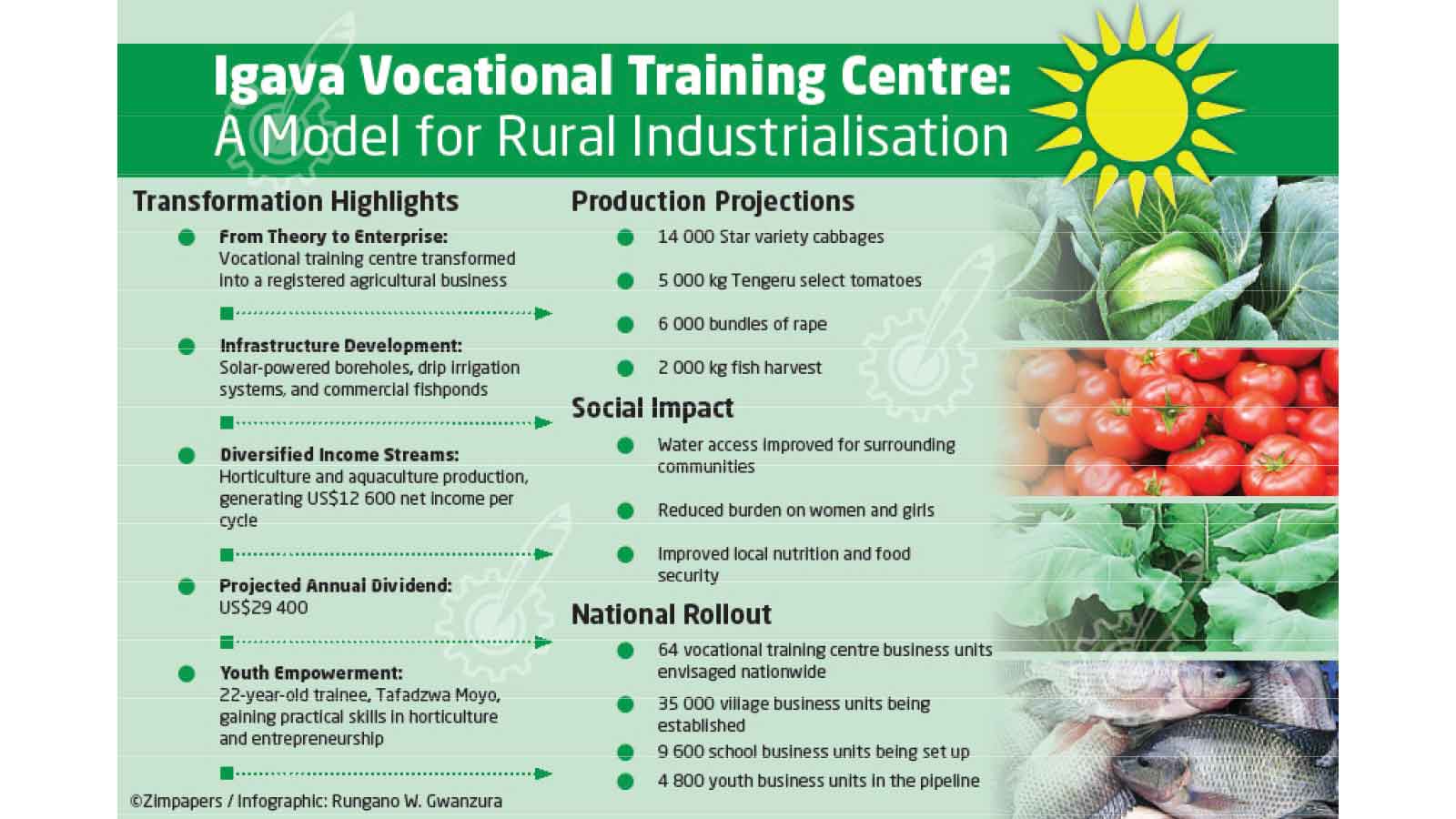
Theseus Shambare
Features Writer
FOR decades, vocational training centres used to produce graduates who were well-versed in theory but woefully lacked entrepreneurial skills.
Most of these centres, which solely relied on funding from Treasury, struggled with outdated infrastructure and lack of integration with industry and the market.
At Igava Business Centre in Marondera, Mashonaland East province, the script is being rewritten. The institution has since been transformed into a registered agricultural business that boasts of solar-powered boreholes, drip irrigation systems and commercial fishponds.
The projected annual dividend from the planned ventures is nearly US$30 000.
What was once a demonstration of classroom instruction has become a living laboratory of rural industrialisation, blending vocational education with disciplined enterprise practice.
This year’s National Youth Day theme, “Youth Agenda for Transformation”, found practical expression at the recent ground-breaking ceremony presided over by President Mnangagwa.
The President planted a commemorative tree and commissioned a tractor for the Emmerson Dambudzo Mnangagwa Youth Service and Vocational Training Centre, strengthening mechanised training capacity.
For the young men and women enrolled at Igava, the tractor represents a productive asset embedded within a structured business model — a tool for cultivation, training and revenue generation.
Igava represents a deliberate break from legacy structures.
The Emmerson Dambudzo Mnangagwa Vocational Training Centre Business Unit is registered under the Companies and Other Business Entities Act.
It operates as a professional agricultural entity with its own balance sheet.
It is a component of the Presidential Rural Development Programme, under the Rural Development 8.0 framework, and functions in technical partnership with the Agricultural and Rural Development Authority (ARDA).
Strategic partners include Prevail Group, which drilled and equipped three solar-powered boreholes and installed irrigation systems, and AFC, which is providing financing, insurance and equipment leasing support.
Together, these partnerships ensure infrastructure development is directly linked to productivity and financial sustainability.
Integrated design, diversified income
The physical layout reflects integration and intent. Three boreholes feed a central reservoir connected to drip irrigation lines that maximise water efficiency across horticultural plots.
Four fishponds operate alongside crop production, creating a diversified revenue stream anchored in both plant and animal enterprises.
Mechanisation has been enhanced through the commissioned tractor, enabling trainees to acquire modern cultivation skills aligned with a mechanised agricultural sector.
Across 1,1 hectares, high-yield cabbage, tomato and rape varieties are cultivated under supervised agronomic protocols: 0,5 hectares host 14 000 Star variety cabbages projected to yield an equal number of heads within the production cycle.
On the other hand, 0,2 hectares are under Tengeru select tomatoes with a projected yield of 5 000 kilogrammes.
In addition, 0,4 hectares carry 13 000 rape plants expected to produce 6 000 bundles.
The aquaculture component comprises four ponds stocked with 8 000 fingerlings, contributing to a projected harvest of approximately 2 000 kilogrammes of fish. This integration reduces production risk, stabilises revenue streams and enhances nutritional impact.
Numbers behind the model
Horticulture is expected to generate gross income of US$12 000 per cycle against variable costs of US$3 600, resulting in net income of US$8 400.
Aquaculture is projected to yield US$6 000 in gross revenue at an estimated US$3 per kilogramme, with variable costs of US$1 800 and net returns of US$4 200.
Combined, both enterprises produce US$18 000 in gross revenue against US$5 400 in costs, leaving US$12 600 net income per cycle.
With two production cycles annually, dividends are projected at US$29 400.
ARDA chief executive officer Mr Tinotenda Mhiko describes the model as commercially viable and socially transformative.
“The Emmerson Dambudzo Mnangagwa Vocational Training Centre Business Unit demonstrates how integrated agriculture and aquaculture can deliver employment, nutrition and youth empowerment,” he said.
“We have a resident ARDA business unit manager ensuring strict adherence to agronomic practices and financial controls so that operations remain disciplined and sustainable.”
Beneficiaries, he emphasised, are both employees and shareholders — strengthening accountability and embedding ownership of outcomes.
At trainee level, the shift from theory to enterprise is tangible.
Twenty-two-year-old horticulture student Tafadzwa Moyo said the centre has reshaped his understanding of farming.
“I am eager to learn how to calculate input costs, forecast yields and understand market pricing, which means we can start viable enterprises after graduation,” he said.
Centre head Mr Thomas Kunaka noted that the transformation extends beyond crops and fish.
“This facility teaches budgeting, procurement, marketing, cash-flow management and profit-sharing so that trainees understand how to convert productivity into income,” he
said.
Relief for surrounding communities
Water access has altered social dynamics in surrounding communities.
Solar-powered boreholes supply irrigation while also providing piped water, reducing the burden on women and girls who previously travelled long distances to fetch water.
The combined horticulture and aquaculture model improves local nutrition through access to vitamin-rich vegetables and protein from fish.
Thus, the centre also produces dignity, food security and local resilience. The Emmerson Dambudzo Mnangagwa Vocational Training Centre is among a new generation of modernised institutions being developed under the Vocational Training Transformation Roadmap.
In Matobo, the Joshua Mqabuko Nyongolo Nkomo Youth Service and Vocational Training Centre is being established under the same reform thrust.
Together, these flagship institutions signal a deliberate shift from outdated training centres to modern, production-oriented youth service hubs.
Under this framework, 64 vocational training centre business units are envisaged nationwide, while 35 000 village business units are being established.
In addition, 9 600 school business units are being set up, while a further 4 800 youth business units are in the pipeline.
Experts note that disciplined management will determine long-term viability of the units.
Vocational education specialist Mr Philip Dube said registering centres as companies introduces accountability mechanisms essential for sustainability.
However, risks remain.
These include crop diseases, climate variability, fluctuating market prices and rising feed costs.
Sustained dividends therefore depend on strict adherence to enterprise protocols and responsive management.
According to Mr Mhiko, professional oversight mitigates these challenges and embeds resilience within the model.
“With structured supervision and compliance systems, these risks are manageable and provide lessons for replication,” he said.
So, Igava is no longer a conventional training centre.
It is a commercial enterprise embedded within a national reform agenda.
At Igava, vocational education has shifted from theory to enterprise, from dependence to dividends and from promise to measurable impact.