Chronicle Editor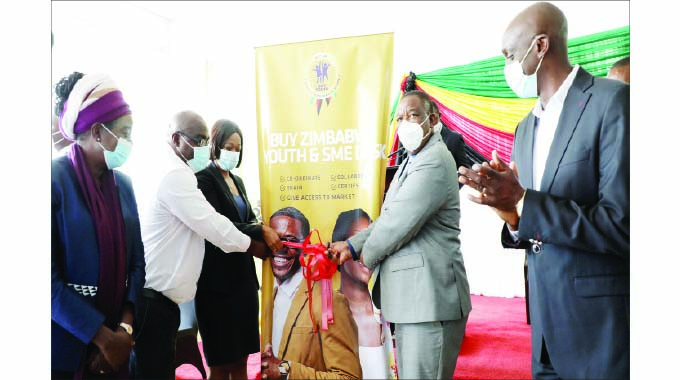
Harare Bureau
GOVERNMENT is tackling decisively bottlenecks in the business environment to ensure the private sector operates effectively and efficiently in an effort to turnaround the economy, Vice President Constantino Chiwenga has said.
Officially opening the Buy Zimbabwe-Buy Local Summit in Harare yesterday, VP Chiwenga said the Government was implementing ease of doing business reforms, which seek to improve the business operating environment to positively impact on the country’s global competitiveness.
“The economy of Zimbabwe will be led by the private sector. The role of the Government is to pronounce and make policies, which will enable the private sector to carry out their business activities well,” he said.
“When President Emmerson Mnangagwa said Zimbabwe was open for business, he meant for Zimbabweans first and others can come in.
“Therefore, everything which will make our people grow this economy will be done.”
The Buy Zimbabwe Summit was held under the theme ‘Anchoring Economic Growth on Local Content’, a thrust VP Chiwenga said seeks to promote domestic production and consumption in line with the Local Content Strategy and the Zimbabwe National Industrial Development Policy 2019-2023.
The documents spell out the policies and strategies to drive the country’s industrialisation agenda for the five-year period.
VP Chiwenga said that the Government acknowledged that increased domestic quality goods and consumption could facilitate the expansion of the Zimbabwean industrial sector and increase exports.
“The implementation of the Local Content Strategy, in partnership with the private sector, stimulates and propels development of value chains as well as strengthening local linkages amongst the agricultural, extractive, industrial and service sectors,” he said.
“It is common cause that the continuous drive of the “Produce Local-Buy Local” campaign, the localisation of domestic markets, and the domestication of value and supply chains, is central to driving economic growth, in line with the National Development Strategy 1.”
VP Chiwenga said under the pillar on moving the economy up the value chain and structural transformation, the private sector is collaborating with the Government in implementing sector specific strategies, which seek to prioritise key value chain growth.
“These include, among others, the leather and pharmaceutical strategies that I launched in April and June 2021 respectively,” he said.
“This is further supported by the 2022 National Budget, which is putting a thrust on enhancing local production and productivity, through the domestication of value chains,” the VP noted.
The Government has also come up with interim measures aimed at promoting local industries at the backdrop of imported products, which had taken centre stage in the past decade.
He said some of the measures include the removal of a number of locally produced goods from the Open General Import Licence (OGIL), by way of gazetting statutory instruments, such as SI 122 of 2017, following recommendations and extensive consultations with industry and other key stakeholders.
Prior to the promulgation of the aforementioned instruments, there was a massive displacement of locally produced goods from the domestic market, as a result of an influx of cheap imported products.
The VP also highlighted that the Government was implementing a number of key projects, notably road construction, where the bulk of the cement being used is produced by local industries.
“We cannot be seen importing inputs when we have capacity to produce and support the projects being implemented. The private sector should, therefore, come on board in support of the Government to build the Zimbabwe we all want for our people.
“The next generation of our children is looking to us and let us leave them with a legacy of a Zimbabwe that is counted among other countries,” VP Chiwenga said.
The VP highlighted that developing a robust industrial and commercial sector is vital for import substitution and crucial, following Zimbabwe’s ratification of the Africa Continental Free Trade Area (AFCFTA) in 2019.
“In essence, we need to invest in efficient manufacturing processes that will give us a competitive edge over the rest of the continent. Once we become competitive, the opportunities for our manufacturing sector are endless,” he said.
Industry and Commerce Minister Sekai Nzenza said the shared vision between the Government and BUY Zimbabwe is a culmination of a relationship spanning from 2012 when Buy Zimbabwe Trust came into being, after realising that the country was incurring a huge import bill on products that are locally available.
“There is empirical evidence of a successive growth trajectory in Zimbabwe’s manufacturing sector in the past year stemming internationally; from the World Bank report, IMF projections and domestically from the CZI
Manufacturing Sector Survey Report,” she said.
“The Ministry of Industry and Commerce is strategically working to consolidate the gains of the New Dispensation’s private sector led economic growth strategy by pursuing various initiatives like the BUY Zimbabwe Campaign.”
Munyaradzi Hwengwere, Buy Zimbabwe Trust chairman, said: “Buy Zimbabwe exists at the unique shift where the government, consumers and businesses converge and each of these entities are long term partners.
“We believe in the next five years, we should be at least 80 percent local content on an annual basis as Buy Zimbabwe, if possible, to save and create three hundred thousand jobs by 2023,” he said.



 Online Reporter