admin
admin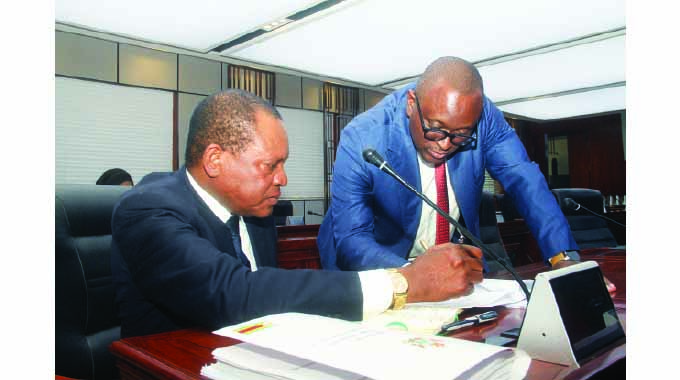
Zvamaida Murwira
Senior Reporter
THE Government has unveiled the 2024/2025 Crops, Horticulture, Fisheries and Livestock summer plan, which will be implemented to the tune of US$1,6 billion and financed by both the Government and the private sector focusing on various food and feed crops.
Speaking after yesterday’s Cabinet meet- ing, Information, Publicity and Broadcasting Services Minister, Dr Jenfan Muswere, said Cabinet had received and noted the 2024/2025 plan that was presented by Lands, Agriculture, Fisheries, Water and Rural Development Minister, Dr Anxious Masuka.
Responding to questions from journalists, Minister Masuka said the budget for the plan was ZiG22 billion, which was equivalent to US$1,6 billion.
“The budget is ZiG22 billion, or US$1,6 billion. That is the grand plan financed 40 percent by the Government through the Presidential Inputs Programme and 60 percent by the private sector and self financed farmers and all the other Government guaranteed schemes,” he said.
Minister Masuka said seed houses had since assured the Government of seed avail- ability.
“The seed houses we have surveyed have indicated availability of 59 336 tonnes, so we do have surpluses although there are short- ages in terms of traditional grains and sun- flowers. Government has a robust plan to
ensure that by 2027 we will have hybrid seed of traditional grains and we will be able to supply sufficient seed from tertiary institutions, ARDA and the Department of Research and Specialist Services.”
Minister Masuka said it was possible to achieve better yields through harnessing water.
“The biggest problem we have in the country is that rainfall is linked to production. We need to de-link rainfall and production. Plants do not need rainfall to grow, they need water, so that water has to be harnessed and be utilised when we want it. This is why we are accelerating irrigation rehabilitation.”
Earlier on, Dr Muswere said implementation of the summer plan was consistent with the Agriculture, Food Systems and Rural Transformation Strategy and it was coming on the back drop of an El Nino-ravaged 2023/2024 summer season and prediction of better rainfall, given the increasing probability for a La Nina phenomenon in the 2024/2025 summer season.
“The 2024/2025 summer season produc- tion plan focuses on food and feed crops, oilseeds and industrial crops, for both local consumption and export. The target is to increase production of cereals from about 750 000 tonnes produced during the 2023/2024 summer season to over 3.2 million tonnes.
“The area under cereals is also expected to increase from about 2.3 million hectares during the 2023/2024 summer season to 2.5 million hectares,” he said.
It was noted that the yield for traditional grains was expected to increase from an aver- age of 180kg per hectare during the 2023/2024 summer season to 800kg per hectare.
“The 2024/2025 Summer Plan also targets to produce 97 700 mega litres of oil, from cotton, sunflower and soyabean, with the climate-proofed Presidential Input Support Scheme (Pfumvudza/Intwasa) targeting to support 1.8 million households from communal, A1, small-scale commercial farming, old resettlement and peri-rural households for the production of cereals, oilseeds and legumes.
“The total number of beneficiaries for the Pfumvudza/Intwasa programme will be 3,5 million,” Dr Muswere said.
“The distribution of inputs under the Pfumvudza/Intwasa Programme will strictly target households that would have prepared a minimum of 3 plots, each measuring 39 metres x 16 metres (0.0624 hectares); liming and organic matter placement; and mulch collection for at least one plot.
“Regarding developing the fisheries value chain, Government is establishing five fingerling production centres across the coun- try to produce 60 percent of the fingerling requirement for the Presidential Community Fisheries Programme.
“In respect of livestock value-chain development, the target for the 2024/2025 summer plan is to increase the beef cattle herd from 5 718 523 in 2023/2024 to 5 798 582. Goat numbers would increase from 5 087 155 in 2023/2024 to 5 239 769. Milk production is also expected to increase from 99 821 752 litres in 2023/2024 to 115 000 000 litres.”
He said the Grain Marketing Board (GMB) will buy all summer crops financed under the Presidential Inputs Programme and ARDA Scheme as well as those by self-financed farmers, and would be the buyer of last resort.
Dr Muswere said Cabinet received the Zimbabwe Livelihoods Assessment Committee (ZimLAC) 2024 Rural Livelihoods Assessment Report, as presented by Minister Masuka on behalf of the chairman of the Cabinet Committee on Food Security and Nutrition, Vice President Constantino Chiwenga.
“The 2024 Rural Livelihoods Assessment established that the total cereal requirements from the National Strategic Grain Reserve for the period July 2024 to March 2025 would be 448 350 tonnes, broken down as follows; 45 750 tonnes per month for July to September 2024; and 51 850 tonnes per month for October 2024 to March 2025.
“The food-insecure people will receive 7.5kg/person/month for the period July to September 2024, and 8,5kg/person/month from October 2024 to March 2025,” he said.
“The report noted that 121 482.6 tonnes will be required for the school feeding programme from July 2024 to April 2025. Government will avail the requisite quantities for the school feeding programme and will prioritise payment of BEAM.”
Speaking at the same occasion, Public Service, Labour and Social Welfare Acting Minister, Dr Tatenda Mavetera, said those who abuse food meant for vulnerable people will face the full wrath of the law.


 Online Reporter