Chronicle Editor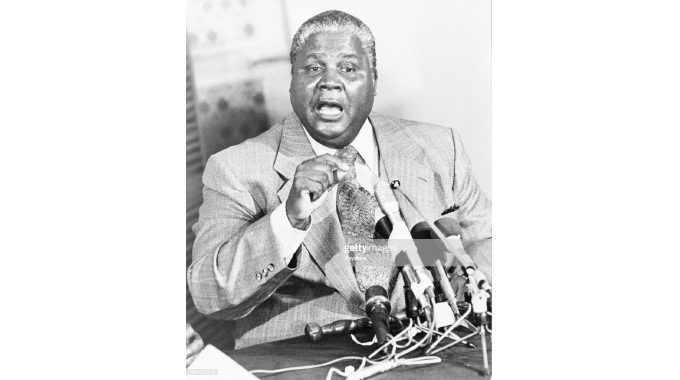
Ricky Zililo, Senior Sports Reporter
A larger than life character, the late Vice-President Joshua Mqabuko Nkomo, fondly known as Father Zimbabwe, holds a special place in Highlanders’ supporters’ hearts for the advisory role he played in helping shaping the club.
Umdala Wethu died on July 1, 1999 and Zimbabweans celebrate the life of Umdala Wethu every July.
Nehemiah Nyathi, who served as head of security for the late VP from May 1980 until July 1, 1999, made startling revelations that Nkomo was a staunch Dynamos fan.
It’s hard to believe that Father Zimbabwe had a soft spot for Dynamos as the revered nationalist always brought “goosebumps” to Bosso players every time he was guest of honour when they played in cup games.
Unfortunately, Highlanders struggled with their performances when Nkomo was in attendance but his presence at the stadium was greeted with frenzy by multitudes of Bosso fans.
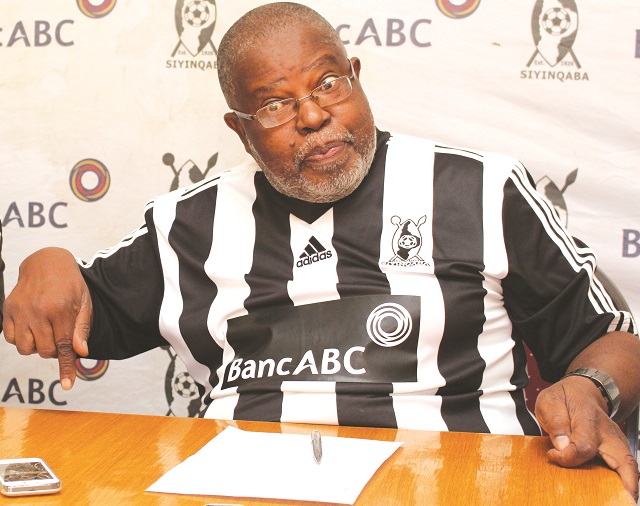
“Unfortunately every time he was present, the team would not do well hence that assertion yokuthi wayesinda ithimu,” said Highlanders president Ndumiso Gumede, who was literally forced back to the club’s chairmanship by the late VP in 1985.
Gumede vividly remembers the day he was summoned by Nkomo to his Pelandaba residence in 1985 via a telephone call made to Mzilikazi High School headmaster’s office.
Gumede taught Mathematics and Science at Mzilikazi High at that time.
The reason Umdala Wethu summoned Gumede to his house was that he had turned down a request by some Highlanders’ members to complete Malcolm King’s tenure as club chairman.
“That is a long story. The incumbent chairman then was Malcolm King and he decided to throw in the towel mid-term of his chairmanship. Bosso then had two-year terms and not the current three-year term for office bearers.
Members decided to appoint me to complete Malcom’s term in 1985. Many people approached me, but I refused.
These included my mentor, the late Chief Ngungumbane (Douglas Mkhwananzi), the late Mackenzie Sibanda, Alderman Pheneas Ndlovu, my friends Nivathi Songo, Henry Dube and the late Victor Mthimkhulu, among many others,” said Gumede.
“Then a call came through the headmaster’s office that I was required to be at Nkomo’s Pelandaba home. I was quickly excused by the head and drove there. After exchanges of pleasantries, the big man went straight to the point in a language I couldn’t claim I didn’t understand. After explaining why I was reluctant to take up the position, the big man, holding his traditional knobkerrie, then made a statement.
“It went something like this: ‘So who do you think you are, people fight for positions in institutions and you refuse to lead when people want you. You will take up the position’.
“He immediately phoned the Chronicle sports editor to announce the decision. We had some tea before I went back to school. I must confess that I was not a stranger at the Nkomo residence as my friend John Ndlovu was dating one of the big man’s daughters and I occasionally accompanied him there,” recalls Gumede.
He said the reason he had been reluctant to lead Bosso again was that he had been hurt by how he was chucked out of Zifa.
He had previously served as Bosso chairman from 1978 to 1980 after taking over from Landcart Gumpo.
“I had been snubbed by Zifa where I had held the position of committee member, albeit on an interim basis. A queer resolution was taken prior to an election meeting held at a Harare hotel which resolved that there were too many people from the southern region on the committee when, in fact, it was just me and Mkhwananzi. So I got ditched and Gibson Homela got the position. I stayed out of football for the whole of 1984 except for some stints as a referee,” said Gumede.
He had been appointed to the Zifa post by the then Minister of Youth, Sport and Culture Joice Mujuru in November 1980.
He was in the Zifa executive led by Nelson Chirwa, with Frank Valdemerca, Ismael Mussa, Clifford Chiripamberi and Mkhwananzi.
Just how was it being summoned by the late VP?
“The meeting with Big Josh was intimidating once he explained why he had invited me. But we met many times as we also needed him to support football and frequently invited him as a guest of honour for some of our special games such as cup finals.
“He was an approachable and jovial man. He always threw in some advice and jokes in his conversations,” said Gumede.
After completing King’s term in 1985, Gumede sought to walk away but he was re-elected chairman for the 1986/ 87 tenure.
It was during this time that Gumede and his executive managed to acquire properties for Bosso.
They bought the club offices along Robert Mugabe Way, the Luveve camping house, popularly known as Hotel California and also got a lease for the club house.
“Having travelled early after our independence to Egypt and saw the infrastructure at Zamalek and other clubs, I was impressed and thought that Bosso could emulate that. I think you notice the club house is called Highlanders Sports Club, not football club. Our vision then was for Bosso to spread to other disciplines and indeed we had boxing, volleyball, rugby, basketball, netball, chess, darts and table tennis.
“All three pitches at the club were grassed and player friendly way back. But through neglect and vandalism, they were left to rot so to speak. It was not meant to be used by juniors only but by all teams. Further the grounds were open for hire to other clubs, particularly social clubs.
“I really hope future administrators of the club will improve on the vision and complete projects that were planned way back. Hotel California is a good case of a vision jettisoned. By now the club would not be “camping” at hotels at exorbitant costs. Perhaps if they can go to Naturana they may begin to see the possibility of fulfilling the original vision,” Gumede said.
He said he would have stayed longer at Highlanders but was asked by the then Zifa patron Canaan Banana to serve the national association.
“Unfortunately there were problems of financial mismanagement at Zifa and the then Zifa patron Banana took a stand to save our football. He criss-crossed the country meeting Zifa councillors before calling for a meeting at the National Sports Stadium.
“When councillors had gathered, Banana had been given names by councillors during his visits but then Fifa wanted elections to be held and councillors stuck to the people they gave to Banana and I was back at Zifa as the vice-chairman,” said Gumede.
He deputised Nelson Chirwa, with Julius Chifokoyo as the secretary-general and Frank Valdemerca as treasurer.
The legendary George Shaya, businessman Hasamals, who was into uniform supplies and one Zimondi, who was in the Air Force of Zimbabwe, completed the team that helped save football in 1987. – @ZililoR


 Online Reporter