Chronicle Editor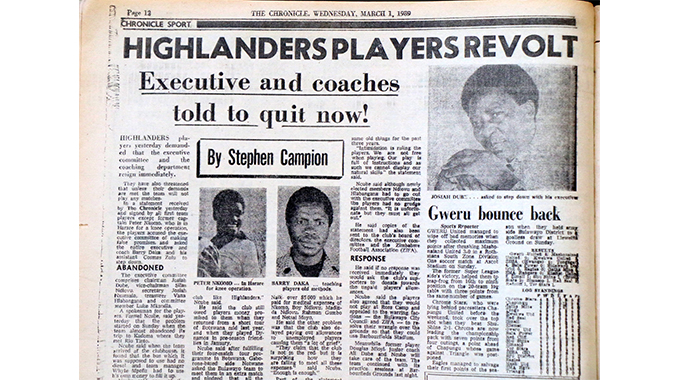
Sikhumbuzo Moyo, Senior Sports Reporter
THERE is a mysterious farm in Esigodini allegedly bought using Highlanders’ funds in 1988 by the then club treasurer Micah Gumpo.
The treasurer’s suspension was secret, with members not being informed.
Highlanders’ cheques and payments were being authorised by just two people, the club chairman and secretary and this finally led to a vote of no confidence on three executive committee members at McDonalds Hall in Mzilikazi Suburb on March 19, 1988.
This sums up the turbulent tenure of Josiah Dube’s executive committee, which holds the record of being booted out of office before the end of their tenure on allegations of financial irregularities.
Other members of the ousted executive were secretary Josiah Nxumalo and committee member Luke Mnkandla (the current board chairman).
There were two survivors, vice-chairman and club legend Silas Ndlovu as well as treasurer Vina Hlabangana after members, in a heated extraordinary meeting that lasted close to four hours, felt the duo had no hand in the poor handling of the finances since they had been elected just two months before the extraordinary meeting.
Dube had taken over from Ndumiso Gumede, who had left the club.
During the tense meeting, there was a heated debate over the more than $6 000 that could not be accounted for, with the executive committee admitting that the money was mismanaged and they were prepared to repay it.
Members would have none of it and decided to boot the trio out, with the board, then chaired by William Ngwenya, immediately endorsing the decision of the members.
Ngwenya told members that the board together with Ndlovu and Hlabangana would run the affairs of the club until elections were held.
The executive committee was later reconstituted, with Njini Moyo coming in as secretary, Hlabangana continuing as treasurer while Illan Ekaim and Landgurd Gumbo were appointed committee members.

The whole movie had started in early January 1988 when it was revealed that club treasurer Gumpo had bought a farm in Esigodini with suspected club funds and the executive secretly suspended him resulting in Highlanders going for the better part of the 1988 season without a treasurer.
The farm and suspension matters were revealed by Dube, whose executive was already under fire, in an exclusive interview with Chronicle Sport published on January 18, 1989.
Dube told Chronicle Sport that Gumpo had been relieved of his duties soon after the last (1988) annual general meeting when “some people” queried the purchase of a farm in Esigodini by him (Gumpo), with allegations that he had illegally used club funds to buy the property.
Upon being quizzed, Gumpo told his colleagues that the farm was owned by a group of “persons” and he was one of them.
To raise his share, Gumpo alleged he’d sold his house.
During the interview, the former chairman admitted that there had been allegations that the farm belonged to Highlanders and people were surprised when they heard that the farm did not belong to the club.
Dube said the connection between “Gumpo’s farm” and Highlanders arose from the fact that when the club visited West Germany in 1987, it had been urged to form some income-generating projects to help employ its unemployed players and supporters.
“Quite a few people were under the impression that this was the farm the Germans were helping to set up,” Dube was quoted saying then.
What remains a mystery is why Gumpo took the Germans on a tour of the farm before treating them to a braai when they paid a reciprocal visit to Highlanders in 1988.
Part of the entourage that toured the farm included the entire Highlanders’ executive committee.
Surprisingly Dube said he was not sure whether the Germans had been told who the owner of the farm was, but admitted that he’d “heard rumours” that the visitors had been led to believe that the farm belonged to Highlanders and was being managed by the treasurer on behalf of the club.
On March 1, 1989, Highlanders’ first team players staged a revolt and demanded that the executive and coaches resign immediately.
The late Barry Daka and Cosmas Zulu were the head coach and assistant respectively.
The petition was signed by all the players except goalkeeper Peter Nkomo, who was in Harare for a knee operation.
Speaking on behalf of the players, the late Fanuel Ncube laid a cocktail of charges against the executive, claiming that the coaches had run out of new ideas.
The impasse continued for more than two weeks and the team found itself at the bottom of the league table after three rounds of matches with zero points, but the executive refused to budge.
Results were faltering and members were increasingly being angered by how club finances were being handled, leaving March 19, 1989, as a significant part of the Bosso history when members ousted the executive committee.



 Online Reporter