Chronicle Editor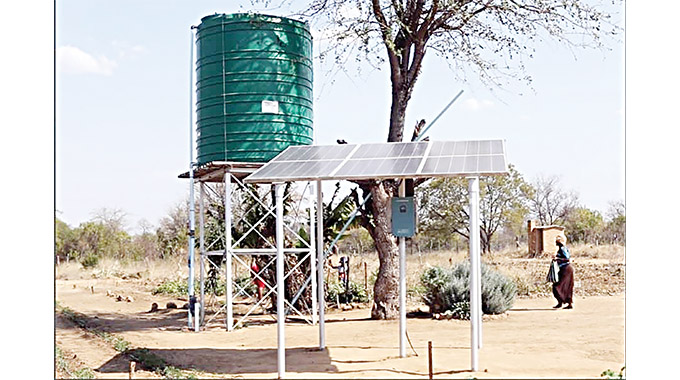
Lungelo Ndhlovu
Farmers in Matabeleland South’s dry Gwanda District use solar-powered boreholes to grow food.
They have also built sand dams to store water for longer periods of time to mitigate and adapt to the adverse effects of recurring droughts and erratic rainfall patterns caused by climate change in the area.
According to the Meteorological Services Department (MSD), Gwanda is located in the country’s dry natural region five and receives very little rainfall of 450 to 650 millilitres annually.
Severe dry spells during the rainy season and frequent seasonal droughts make its agricultural crops more prone to failure.
“The construction of sand dams with the assistance of Practical Action has been beneficial to the villagers of Ward 24 in Bulobelo Village,” said Ward Four Councillor Bonang Mukwena.
A sand dam, according to Clr Mukwena, consists of a wall built of stones and reinforced cement that spans across a seasonal sandy river.
“It’s a simple, low cost, low maintenance system that collects rainfall water and tops off the ground water table. Building sand dams is the most practical approach to conserve water in dry land settings such as ours.”
Akinyi Walendar, Director of Practical Action in Africa, said prior to the Covid-19 pandemic in 2019, her organisation sought sponsorship from people in Britain to partner with locals on developmental initiatives, one in Sudan and the other in Zimbabwe, to help turn the tide on climate change in Africa.
“Their generosity enabled Practical Action to raise over £1.48 million for Zimbabwean farmers,” she said.
Walendar said the UK Government matched this money Pound for Pound, bringing the grand amount for this project to £3.14 million.
“The Covid-19 pandemic presented us with a challenge, but we worked hard to ensure that our research did not become derailed as a result of the coronavirus’ pandemonium. The money raised has had a tremendous impact.
“Our approach has assisted Zimbabwean farmers in doubling their food output and improving their livelihoods. We are grateful for our donors’ assistance, and we hope that they will continue to do so in the future so that we can continue to reap these benefits,” she said.
Practical Action Senior Communications Officer Mr Steve Kubate Salifu said they embarked on a project called Planting for Progress (P4P) which worked with hundreds of women farmers in some of Zimbabwe’s driest areas, such as Gwanda and Bulilima districts.
“The farmers have adopted solar-powered irrigation in their nutrition gardens and sand dams to store precious water. Many also adopted chickens, used new seed varieties and better adapted to the local weather conditions and new regenerative farming methods. The result is that many families with small farms in their area have doubled their food production,” he said.
Ms Sukoluhle Nleya, one of the beneficiaries of the Manake Garden project established by Practical Action in Bulilima District said, “The problem we were facing here is water, we had to travel more than four kilometres to get it.”
Water scarcity, according to Ms Nleya, is now a thing of the past, thanks to the piped water system which was introduced by the project.
“We used to fetch water from a hand-operated well, but with this solar-powered borehole in the irrigation scheme, that is no longer necessary. We just open the taps, making our lives easier. We intend to grow crops throughout the year, and we are being assisted in using the calendar to decide the best crops to cultivate at any given time,” she said.
At the project’s conclusion this year, all of the solar gardens had produced and begun selling products such as cabbage, rape, carrots, choumoellier, and onions, according to Mr Salifu.
“This is bringing income to the farmers and sustaining their livelihoods. Over the last three years, the project benefited nearly 6 500 people from over 1 000 households. We managed to reach over 1 200 farmers despite the impact of the Covid-19 pandemic,” he said.
Mr Salifu said 14 irrigation gardens were established with seven per district in the project implementation areas.
“Six of the irrigation gardens draw water from boreholes and one draws water from a river. We constructed two sand dams to improve the storage of precious water and established 12 solar-powered egg incubators to improve chicken rearing and adoption,” Mr Salifu added.
Ms Progress Tlou, a beneficiary of the Madida chicken rearing project in Gwanda District said Practical Action taught them about chicken rearing before they gave them the chickens.
“We always had chickens at our homes before their arrival, but I used to throw away the eggs because they got spoiled. So, to avoid this, I used to sell some of the chickens and eat the eggs. I am happy that with the solar-powered egg incubator, it helps us with hatching more eggs, growing our chicken numbers and earning us income,” she said.
According to Mr Salifu, his organisation set up a system for continuing the projects even after the implementation stage.
“The development of all project infrastructure, including borehole drilling, irrigated garden setup, indigenous hens, and solar-powered egg incubators, includes a 10 percent community contribution. In order to prevent installations from becoming white elephants after the project, this maintained community ownership,” he said.
Local farmers are also sharing knowledge through training in various sustainable farming techniques, marketing their produce, and responsible financial management, said Mr Salifu, who also revealed the project’s long-term effects. “The farmers are also effectively managing post-harvest losses through practices taught during the implementation phase of the projects,” he added.


 Online Reporter