

 admin
admin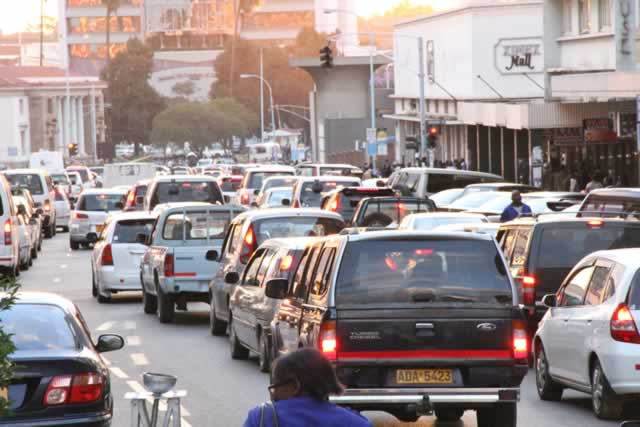
Traffic Friday Gerald Magurayanga
The rather speedy deterioration of the (once) world-famous City of Harare – distinctively christened Sunshine City by the city’s many admirers, local and international – into something quite unrecognisable from the sparkle of the 80s and 90s, is, to use kind words, painful and sad.
A great deal about Harare is no longer the same.
Granted, life is about change, and more change, but Harare’s hasty transformation has been quite undesirable, nay depressing for those of us born-and-bred in the once speck-and-span city.
What largely remains for my generation and those older, are fantastic memories of a by-gone era and a once-unmatched African metropolis.
The distressing decay can be noticed in virtually all the city’s sub-sectors; housing, education, health etc.
This writer though strongly feels the messy chaos of the city’s poorly policed traffic is utterly frustrating to motorists and pedestrians – and to think that all that gloominess seems to be getting worse by the day!
Evidence abounds that the city has been lackadaisical in its administration and policing of vital sectors. In recent years, many (maybe most) traffic lights have gone dead, aggravating the already bad traffic movement situation.
To be a little fair to the city authorities though, the electricity supply situation remains, at best, erratic. The now-on, now-off status of electricity supply means that many traffic light-controlled intersections stay without power, particularly where there is no energy back-up plan.
All we have heard over the years is just idle promises by the authorities to install, citywide, a modern traffic light signal system, with an in-built, solar-powered back-up design.
A few years ago, a dozen or so intersections were updated with what seemed modern, power-saving and brighter LED-lit traffic signals, but that apparently error-prone signalling system was abandoned for no clear reasons.
It seems the city authorities suffer from an African challenge wherein elected leaders major in talk-talk and more unproductive talk-talk, with far less matching, walk-the-talk action.
In addition to the deficiency of the normal function of traffic control signals, other critical traffic control mechanisms such as carriageway markings that demarcate lanes, have largely disappeared over the years.
It is nightmarish driving on many Harare road sections, worse at night, as a driver has to constantly stay on-toes, driving in what used to be a marked lane.
This situation rapidly deteriorates and assumes more dangerous proportions at unmarked intersections as opposing traffic straddles poorly-marked lanes, creating clear head-on collisions and other grave dangers, even for pedestrians.
City fathers, most of them practising politicians, were bound to tell feeble lies; but some lies just do not wash. You cannot convince anyone that the reason why year-in, year-out roadside grass is left to grow several metres tall and end up obstructing traffic at many Harare intersections is because we were under sanctions, or because the economy was performing poorly! Surely, residents deserve a little more respect than such cheap talk.
To give an example, exiting Herbert Chitepo onto Enterprise Road is a nightmare for traffic turning right as a result of impeding tall grass. Needless to say, such mini-forests further encumber smooth traffic flow and seriously endanger road users.
Potholes, particularly in the rainy season, amplify the traffic movement challenge as potholed roads become a tricky maze drivers gingerly negotiate.
That hugely slows down traffic, helping to create artificial bottlenecks. Whenever they can, motorists avoid the worst-of-the-roads, resulting in the better roads chocking with slow-moving vehicles.
For some irrational reason, over the years, too many commuter omnibuses were licensed with seemingly no requisite planning for desirable and manageable numbers.
Omnibuses pose a particularly severe challenge for Harare City as the drivers are mostly excitable young men with a zero appreciation of any road rule.
The fact remains though that it is the city’s challenge to resolve and improve traffic flow in the city and reduce the traffic frustrations of long-suffering residents.
The apparent lack of cohesion between city police and the Zimbabwe Republic Police is quite evident. Maybe this is because Harare City police have no arresting powers.
In many cities around the world, Metropolitan Police services police traffic backed by full arresting powers superintendent traffic in their precinct.
The long-standing argument rages whether our city police should be given arresting powers or not.
Some arguments should not even be arguments in the first place.
The simple question is, what is best-practice worldwide? Traffic Friday supposes the city police should enjoy full arresting authority and fully enforce city bye-laws.
Can someone please tell us what is going on with city residents; I mean every second household in the suburbs has gone a little mad!
What is this insupportable business of laying-up stones, some quite huge, on the tarmac edge adjacent to one’s wall?
It is a diabolical habit which is now quite common.
We urge the city to please stop that behaviour before it really gets out of hand; it is exceedingly dangerous to road traffic.
Sadly, the not-many city police have a notorious reputation. They are unmistakably quite infamous; it’s a toss-up between them and the ZRP traffic cops as to who takes the cup in the sleaze stakes!
Some passionately point out city cops as champions of rottenness.
The city can charge an arm-and-a-leg for infractions to their traffic bye-laws, but for as long as their small, inefficient traffic control department is riddled with corruption, then not much good may come out of it.
It’s back-to- school; please keep the driving “happy, happy; happy-happy-happy!”
Gerald Maguranyanga moderates Road Safety Africa, on www.facebook.com/RoadSafetyAfrica, an interactive community page that solicits ideas to curb road traffic accidents in Zimbabwe and Africa. Contacts: WhatsApp only – +263 772 205 300; email: [email protected]



 Online Reporter