Online Reporter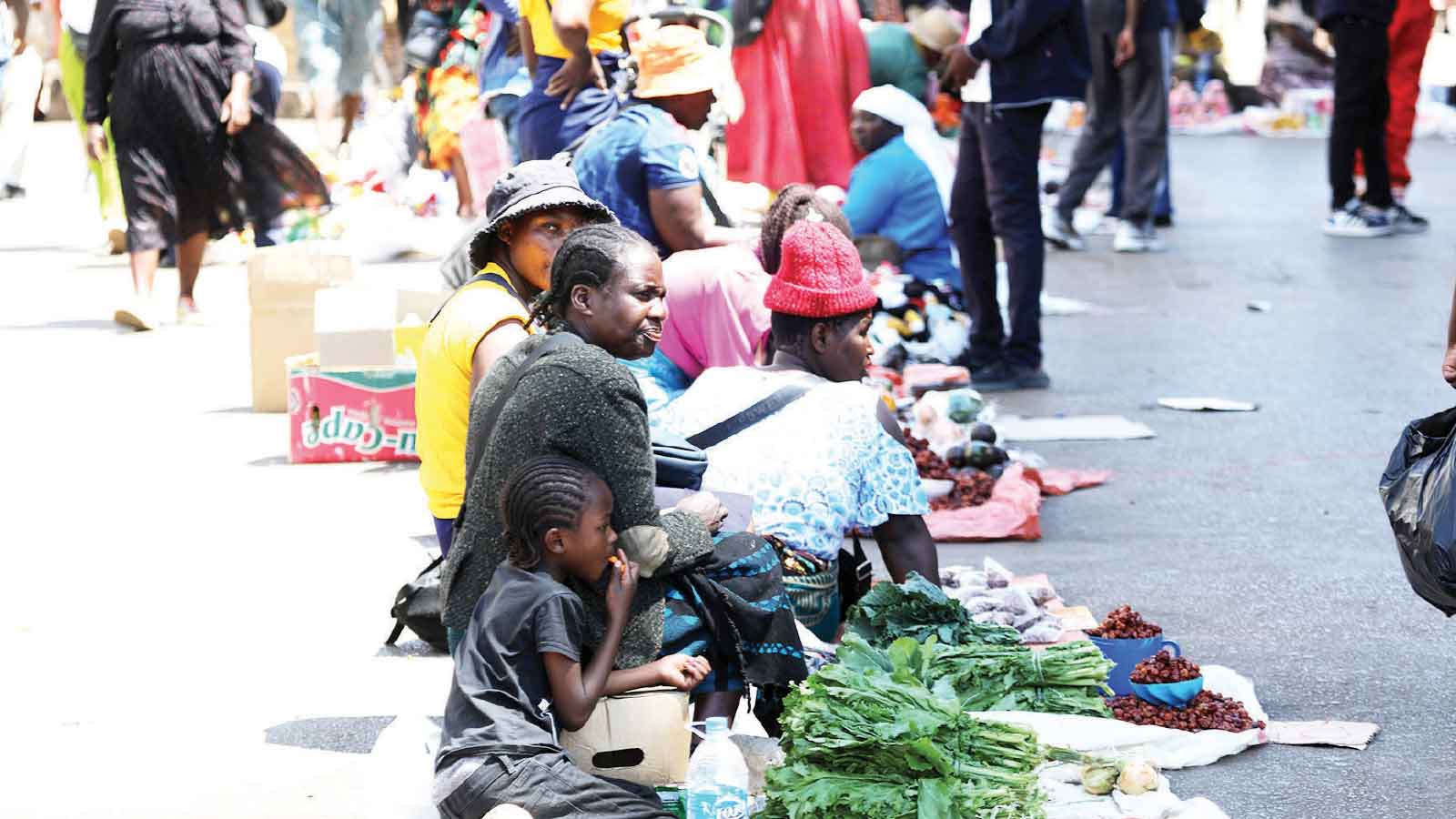
Remember Deketeke
Municipal Correspondent
TOMATOES are stacked in little pyramids.
Five or six of them usually cost US$1.
Charlene Hukutwa (not her real name) arranges them the same way every morning on a stretch of pavement along George Silundika Avenue.
She has done this so many times that her hands know the motion before she does — set the crate down, smooth the plastic sheet, build the pyramids and wait.
By 7am, the street around her is already thick with people walking to work, and that, more than any market stall the city could offer her, is the whole of her business plan.
She is not supposed to be here.
The Harare City Council (HCC) has spent months trying to clear pavements like this one, insisting that vendors move into designated markets where trading is legal, regulated and, in theory, orderly.
Hukutwa knows the rules.
She also knows what happens to her income the moment she follows them.
“Personally, I do not like coming here,” she said, glancing up and down the pavement as if the admission itself were a small risk.
“But if the council can fully pay my child’s school fees, I will completely stop vending, stay at home and never bother anyone. As long as they fail to do that, this will remain my home until my child finishes school.”
What is a legal vendor?
But there is a question the City of Harare cannot seem to answer cleanly: Who exactly counts as a legal vendor and is there actually room for everyone else to become one?
By the council’s own definition, legality is specific and demanding.
In responses to questions by The Sunday Mail, HCC acting town clerk Advocate Warren Chiwawa said a legal vendor must operate from a council-designated vending zone or market, hold an active municipal trading permit, pay the prescribed charges and meet public health and environmental standards.
Food vendors face an additional layer — registration with the City Health Department and compliance with food safety rules.
“Council’s approach is not to prevent people from earning a living, but to create an orderly, safe and sustainable trading environment that benefits vendors, consumers, residents and businesses alike,” Adv Chiwawa said.
It is a tidy sentence to describe an untidy problem.
The council’s own database lists 947 licensed traders operating in the central business district (CBD).
Outside that list, by the council’s own estimate, are somewhere between 20 000 and 30 000 vendors trading illegally on pavements, at intersections and along the city’s busiest streets.
Whatever “orderly” means in Harare, it currently describes a small fraction of the people actually making a living from vending.
That gap might make sense if there was simply nowhere else for people to go.
But the numbers tell a stranger story.
The council says it has enough space for 17 660 stalls.
However, only 8 545 of them are occupied.
More than 9 150 stalls sit vacant, unusable, undeveloped or simply abandoned.
Inside the CBD itself, where the pressure to clear pavements is most intense, there are eight primary market sites offering 933 stalls.
Just 207 are occupied.
Of the 726 sitting empty, 720 are at a single site — the Seke Road/Dieppe Road intersection.
So, Harare is left with two facts that should not both be true: Thousands of vendors trading illegally and thousands of legal stalls sitting empty.
Adv Chiwawa said the contradiction is not as simple as it looks.
“The available infrastructure, however, is not yet sufficient to accommodate every person currently engaged in informal trading, particularly in areas where demand for trading space is highest,” he said.
Water and sanitation remain strained at the busiest markets, and the council acknowledges some sites still need rehabilitation and investment.
Most high-density areas only receive water five days a week.
But the deeper explanation lies in the economics, not the plumbing.
A stall at the Seke Road/Dieppe Road intersection may be legal, clean and cheap.
It may also be useless if no one walks past it.
A vegetable seller on a CBD pavement has access to thousands of potential customers every single day.
If she is moved three kilometres away, the business she built around foot traffic simply stops existing.
For someone like Hukutwa, the question was never whether a legal stall was available somewhere in the city.
It was whether that stall could still put a child through school.
That is the argument the National Vendors Union of Zimbabwe (NAVUZ) has been making for years, and its chairperson, Mr Sten Zvorwadza, said the country needs to stop treating the standoff as a legality question.
“This is not a defence of disorder,” he said.
“NAVUZ recognises the city’s legitimate authority to regulate public health, safety, traffic and planning.
“But decades of enforcement operations followed by the return of vendors demonstrate that the underlying economics of the crisis have never been addressed.”
He pointed to sites like the Coventry Road bay and a vending location in Warren Park, which he said failed simply because too few customers ever passed through them.
“A trading bay without customers is not economic infrastructure,” he said.
“A site may be legally designated but economically useless. A pavement may be legally prohibited but economically attractive precisely because of the customer traffic passing through that space.”
Mr Zvorwadza also argued that the city’s planning has fallen behind the economy it is meant to serve.
He cited the 2023 Economic Census, which found that 76,1 percent of operational establishments in Zimbabwe were informal, and 87,9 percent were micro-enterprises.
“Zimbabwe’s economy informalised faster than Harare’s spatial planning adapted,” he said.
He, however, insisted that vendors should never block roads, obstruct emergency access, mishandle food or trade over sewer lines.
NAVUZ is now pushing for a full vendor workspace and economic infrastructure audit, bringing together the city, the Central Government, vendor groups, planners and public health authorities to map out where vendors actually are, where commuters actually walk and where new markets could realistically work.
The union also wants a negotiated social compact where vendors follow registration, licensing and sanitation rules while the Government and council provide safe workspaces, fair stall allocation and protection from unfair seizures, along with more transparency to root out the informal “space barons” who profit from the chaos.
The council, for its part, says it has already reduced some vending charges in the 2026 budget. Whether that is enough to make legality competitive with the street remains an open question.
“Formalisation without infrastructure is merely registration,” Mr Zvorwadza said.
“Relocation without commercial viability is displacement.”
The goal, he said, was never to squeeze every vendor into the CBD, but to build a real network of markets closer to where people already live and travel.
“The future choice is not vendors versus a clean city — it is between unplanned informality and planned informality. A well-governed Harare can protect pedestrian movement, sanitation, traffic, businesses and public infrastructure while simultaneously protecting livelihoods.”
None of that changes what happens on George Silundika Avenue tomorrow morning.
Hukutwa will be back before 7am, stacking tomatoes into small pyramids, watching the same river of commuters flow past her stall.
She has heard the council’s plans and the union’s proposals. She has her own plan, and it has nothing to do with stalls or permits.