Online Reporter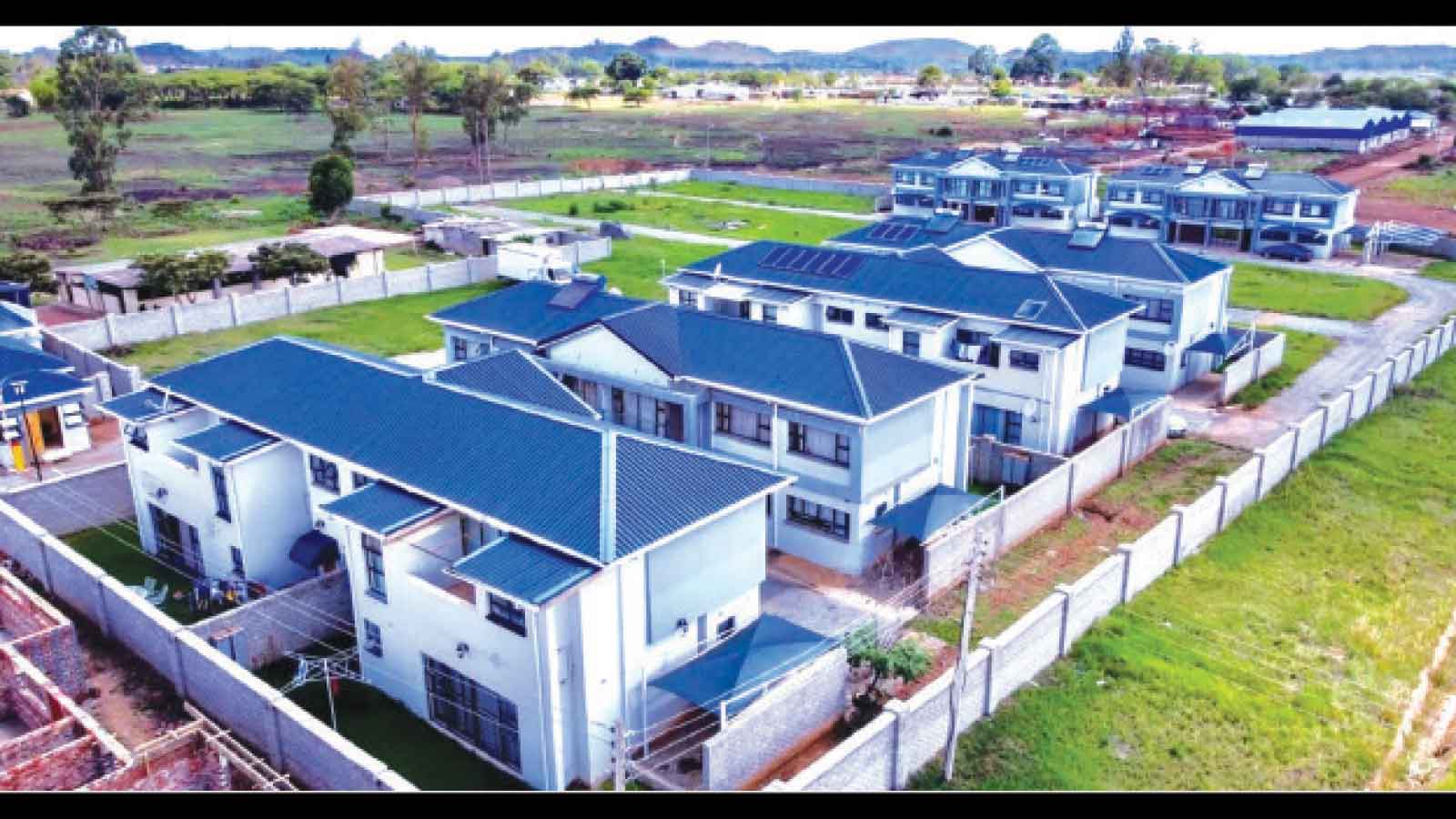
Remember Deketeke-Municipal Correspondent
THE number of homeseekers on Harare’s housing waiting list has doubled to 300 000 over the last decade, with the local authority managing to deliver just 3 897 housing units over the same period.
The figures, contained in the proposed Harare Master Plan 2024-2045, expose a widening gulf between the demand for formal housing and the city’s capacity to provide it, raising fresh questions about how Harare will accommodate a rapidly growing population.
The master plan describes the situation as a “huge mismatch” between housing demand and supply.
“The housing waiting list in the city has been growing, against an erratic and limited council housing supply,” reads the document.
“There is an increase in people registering on the waiting list against council-delivered houses for high-, medium- and low-density stands. There is a huge variance between housing delivery and the number of people on the waiting list.”
The numbers tell the story.
According to the master plan, Harare’s housing waiting list stood at 150 855 in 2014 before increasing to 171 303 in 2015 and 190 752 in 2016.
It rose to 210 046 in 2017 and 216 502 in 2018, before climbing to 224 003 in 2019.
The number of registered homeseekers continued rising despite the Covid-19 pandemic, reaching 230 133 in 2020 and 239 228 in 2021.
By 2022, the waiting list had grown to 254 265, before jumping to 281 563 in 2023.
It reached a record 300 000 in 2024, nearly double the number recorded a decade earlier.
Over that same 11-year period, the council delivered only 3 897 units — 34 in 2014; 84 in 2015; and none in 2016.
In 2017, it managed 328 housing units and 1 458 in 2018.
No units were recorded in 2019, while 237 were delivered in 2020; 109 in 2021; 161 in 2022; 1 274 in 2023 and 212 in 2024.
In other words, for every housing unit delivered by the council during the period, dozens more people were joining the waiting list.
It is believed that even the 300 000 figure may not capture the full scale of the problem.
A separate assessment in the master plan puts the waiting list at 288 885 as at May 31, 2024, comprising 185 000 dormant and 103 885 active applicants.
The document estimates potential housing demand at more than 500 000 people.
This does not necessarily mean 500 000 people are literally homeless. Rather, the figures point to a large population living in inadequate, overcrowded, rented, informal or otherwise unsuitable accommodation while seeking formal housing.
Informal settlements
As formal municipal housing delivery has slowed, informal and semi-formal settlements have expanded across the metropolitan area.
The master plan identified about 300 000 informal residential developments around the city that need to be planned and provided with basic infrastructure such as water, sewage system and roads.
These include those in Harare South, Hatcliffe North, Caledonia and Dzivaresekwa Extension.
Experts say this means Harare’s housing crisis is no longer simply about people waiting for the council to sell them a residential stand.
It is increasingly about where people live while they wait.
The city itself acknowledges that much of the housing being created is coming from the private sector and informal arrangements rather than direct municipal delivery.
The master plan says housing demand is highest in high-density areas because of affordability concerns, while cluster housing is mainly being developed in low-density areas by individuals and private players. The development has raised questions from residents who want to know how a city that built major residential areas in the past is now struggling to produce housing at anything close to the required scale today.
Harare has never had a perfect housing system.
The city already had a housing shortage at independence. Historical research shows that Harare already had a substantial housing waiting list in 1980.
But the city and the Government nevertheless embarked on major housing programmes that created some of the suburbs that are now synonymous with Harare.
One of the approaches was the provision of serviced plots, allowing residents to progressively build their own homes rather than waiting for the public sector to construct complete houses.
At the beginning of 1980, for example, more than 7 000 plots were allocated in Glen View under an aided self-help programme.
Beneficiaries were expected to progressively construct their houses, with the programme providing the serviced land and support mechanisms.
Similar approaches were used in Warren Park, Hatcliffe, Kuwadzana and other areas.
A model that is no longer working?
Combined Harare Residents Association chairperson Mr Reuben Akili said the latest figures show that the city’s existing housing delivery models are failing to keep pace with demand.
“These figures clearly indicate that the local authority does not have capacity to deliver houses,” he said.
“The local authority needs to explore other models because the current models they are employing, when you look at them, seem that they have not been ensuring that people have houses.”
Mr Akili said partnerships with banks and developers had not been sufficient to close the gap.
He also warned that some developments could end up being unaffordable to ordinary residents.
“We have seen the local authority partnering other banks, but again, it’s not sufficient,” he said.
“Even sometimes when they give banks land or other developers land to develop for houses, you actually see that the stands or the housing stands become even very, very expensive for an ordinary resident to be able to fork out money to purchase.”
The council, he said, also needed to make its land bank information publicly available so residents could understand how much land remained available for housing.
“At this moment, this should tell us that the local authority should be able to review how much land is now left within the local authority area so that at the end of the day you can ascertain whether there is still space to construct houses,” he said.