admin
admin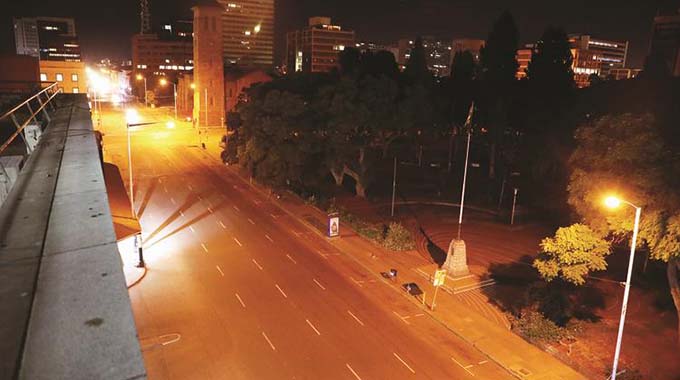
Isdore Guvamombe Assistant Editor
It is a rare mid-week night and Harare’s Central Business District streets are empty, for, maybe the first time since the city was established as Salisbury in 1890.
The hullaballoo of human and vehicular traffic is absent. Gone is the screeching of vehicle tyres, hooters, discography from cars and pubs and, gone too, is the vending that defined Harare’s beehive activity life.
The coronavirus lockdown has brought a first to Harare’s night life, reducing the city to the deathly silence of a cemetery.
The night is fresh and a twinkle of lights brightly defines the grid-lined streets, undisturbed by human presence.
Even traffic control lights have become mere ceremonial regalia, adding colour to the streets and not controlling traffic. But their presence in successive flashes of green, amber and red, are a reminder of a busy past.
There are neither cars nor people on the streets of Harare and guess what, fresh air wafts from even the alleyways, previously known for the stink from human excreta, rotten fruits and vegetables.
Even the street kids and vendors are nowhere to been seen. It is fiercely refreshing. Only security guards form ghostly figures in strategic corners. There is deathly silence, that one security guard’s cough, can be heard far and wide, ricocheting on buildings.
It is even scary to drive on the streets for, you will be alone.
Even ladies of the night, who used to colour the streets bright with their extravagant plumage of face powders and skimpy dresses are off the streets.
The discos in the night clubs have been strangled. They are dead silent.
For the first time Harare is sleeping.
Established in 1890 by the settler colonial regime, Harare became a city in 1935. Its first years where busy day and night as builders put up a buffet of structures.
Named Harare in 1982 after Chief Neharava, who was known for his nocturnal escapades, which earned him the sobriquet “Haarare”, the one who does not sleep, the city has never quietened until the coronavirus came and the Government declared a lockdown.
Even the high density suburbs, known for their late night life, are going to sleep early.
The ghetto is known for not sleeping has been forced to sleep early. By 7pm everyone is indoors.
The commuter omnibuses that ply high density suburbs routes are nowhere to be seen.
Harare is a metropolitan, which also incorporates the municipality of Chitungwiza and Epworth and the lockdown has helped reduce the spread of coronavirus which has killed hundreds of thousands of people the world over.
The city was founded in 1890 by the Pioneer Column, a small military force of the British South Africa Company, and named Fort Salisbury after the UK Prime Minister Lord Salisbury.
The administrators demarcated the city and ran it until Southern Rhodesia achieved responsible government in 1923. Salisbury was thereafter the City of the Southern Rhodesian, later Rhodesia and, between 1953–63, the capital of the Central African Federation.
It retained the name Salisbury until 1982, when it was renamed Harare on the second anniversary of Zimbabwean independence from the United Kingdom. This place, where they never sleep, is now sleeping.



 Online Reporter