


 Tinaye Agere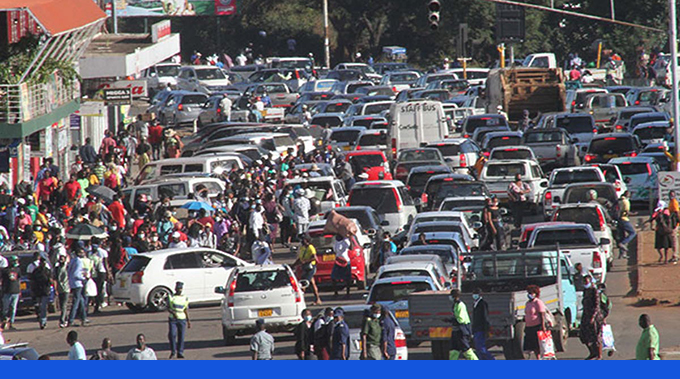
Theseus Shambare
UP until the turn of the new millennium, Harare was a clean and orderly metropolis.
For Zimbabweans living in rural areas and other places, the thought of coming to visit, let alone stay in Harare, elicited some anxious moments and even sleepless nights.
By then, the capital city’s roads were smart and uncongested — and so were the suburbs.
However, in recent times, Harare has become a shadow of its former self, with the Central Business District (CBD) battling a litany of challenges, among them traffic congestion.
The city is now a perennial traffic jungle in which motorists break traffic laws with reckless abandon. Traffic jams in the city centre and feeder roads have reached proportions that now demand attention from the relevant authorities.
From as early as 6am, almost all the roads leading to the city centre will be congested, with impatient and agitated drivers occasionally blowing their cars’ horns.
The exchange of nasty words — and even altercations — are common as the frustrated motorists negotiate their way amid the confusion.
Transformation
Over the years, the number of people who travel into and outside the city centre daily for one reason or the other has tremendously increased. In fact, the capital’s population has swelled through the creation of new — both planned and irregular — settlements.
Each day, there are people who travel into Harare from places like Domboshava, Ruwa, Marondera, Southlea Park, Mazowe, Marondera, Norton and Bindura.
With most families now owning a car, this has naturally led to increased traffic flow.
Motorists in Harare have now become synonymous with reckless and dangerous driving. Flagrant disregard for basic road rules and regulations is now the order of the day.
Malfunctioning traffic lights do not make the situation any better.
During peak hours, major roads such as Fidel Castro Road (formerly Charter Road), Chinhoyi Street and Julius Nyerere Way are always virtually impassable.
Rehabilitation work on some roads in the city centre has further compounded motorists’ woes as they are forced to find alternative routes. Those driving from the southern side are experiencing slow traffic flow due to construction work being carried out at the new Mbudzi Traffic Interchange.
Regis Mbodza, a motorist, said congestion is expensive.
“They say time is money and valuable time is lost when motorists are stuck in traffic jams. Vehicles also consume a lot of fuel during congestion,” he said.
Some feel the influx of second-hand cars, mainly from Japan, is one of the major drivers of congestion in Harare as the increased volume does not match the current road infrastructure.

However, urban planning experts dismiss the notion.
“The problem of Harare is not about whether it has narrow roads and streets, as I have heard some people purport. They have said, unlike Bulawayo that has wide streets and roads everywhere, Harare’s narrow streets are its problem.
“I have seen narrower streets in Accra, Ghana, but traffic flow is relatively better. For Harare, the problem is largely behavioural,” argues Professor Innocent Chirisa, an urban and regional planning expert.
Desperate proposals to end the Harare traffic chaos that have been tabled before include the setting up of tollgates into the city centre; introducing cable cars and train buses; and the installation of traffic cameras.
The commuter omnibus holding bays created near the Kopje area were also aimed at decongesting the city centre, but the idea suffered a stillbirth.
“In Cape Town, there is a defined bus lane in the thoroughfares. Someone is already informed by the nature of the roads whether to use his/her private car and go slower or go by public transport — the bus — and go faster,” said Prof Chirisa.
“A private car attempting to use the bus lane is immediately fined and everything is captured on camera. The rules are very well-defined. All major roads, whether far into the countryside are on camera and any nuances and distractions are immediately attended to when they happen.”
Bribes
At the bustling intersection of Robert Mugabe Road and Rezende Street in Harare, a Zimbabwe Republic Police (ZRP) officer was caught on camera accepting a wad of bribe money from a “mushikashika” driver.
The officer, whose badge number was clearly visible, nonchalantly stuffed the cash into his pocket as he chatted with the driver, seemingly oblivious to the passing pedestrians and vehicles.
Eyewitness Takudzwa Mazhambe described the scene as “business as usual” in a city where corruption has become entrenched.
Our investigation has revealed that this officer is not an isolated case, but rather a symptom of a larger problem within the ZRP, where bribery and extortion have become a lucrative sideline for some officers.
As we probe deeper, we are uncovering a web of corruption that threatens to undermine the very fabric of law enforcement in Zimbabwe.
“This is not the first time we heard about that.
“We are looking into the matter and whoever is caught offside the stipulated code of conduct will be brought to book,” said ZRP spokesperson Assistant Commissioner Paul Nyathi in an interview.
Harare Residents Trust director Precious Shumba said the Harare City Council does not have the willpower to decongest the city.
He further notes lack of traffic rules enforcement also contributes to the chaos on the roads.
“We are well-informed that all the illegal taxis and kombis pay bribes every morning to the municipal officials for free passage.
“Whenever you see them battling with these mushikashika during peak hours, the council officers will be only following up on those who might have evaded them in the morning,” said Shumba.
Calls have been made for the council to use the holding bay on Coventry Road to ease congestion in the city.
“Some corrupt council officials do not want the holding bay to be operational. If the bay becomes operational, the officials will not be able to collect bribes.
“The Zimbabwe Anti-Corruption Commission need to step up efforts,” said Shumba.
Harare City Council spokesperson Stanley Gama admitted of elements of corruption within the council workforce.
“Reports frequently come pertaining that but no significant evidence have been brought forward to implicate anyone,” said Gama
However, he attributed the congestion to the current rehabilitation of roads in the city centre.
The exercise is being spearheaded by the Ministry of Transport and Infrastructural Development and will see 40 Greater Harare roads getting a facelift ahead of the Southern African Development Community summit.
He urged residents to exercise patience as the road rehabilitation is underway.
A number of measures, he added, are being put in place to minimise congestion.
“We are currently recruiting more municipal officers who will be deployed for night duties. Currently, we are only operating during the day and this leaves motorists to do as they please,” he said.
According to Gama, plans are underway for commuter omnibus operators to revert to the Coventry Road holding bay.
But traffic congestion has existed long before the ongoing road works in the capital.
Investigations by this publication have revealed that the city’s traffic woes are further compounded by the lack of a functional public transport system.
Sources within the Harare City Council have disclosed that the city’s fleet of buses has been reduced to a mere estimated 100 vehicles, down from a peak of 1 000 in the 1990s.
This has led to an over-reliance on private vehicles, exacerbating congestion on the city’s roads.
Further probing has also exposed a lack of coordination between the city’s traffic management authorities and the Zimbabwe National Road Administration (ZINARA).
Insiders claim that ZINARA’s focus on collecting toll fees has diverted attention away from critical road maintenance and expansion projects, resulting in the city’s crumbling infrastructure struggling to cope with the sheer volume of traffic.
As the situation continues to deteriorate, residents and commuters are left to bear the brunt of the city’s suffocating traffic volumes.
Apart from congestion and lawlessness, the Harare CBD has also been literally invaded by vendors. Liquor centres, some of which are reportedly being illegally run, are mushrooming at an alarming rate.
Uncollected garbage is a common feature on the streets.
The chaos on Harare’s streets is happening at a time when the capital is working towards achieving world class city status by 2025.
Liquor centres
There has been an increase in the number of liquor stores that are being opened in the Harare CBD.
Imbibers who frequent these places are notorious for disturbing traffic flow as they block roads, among them Angwa Street (close to the former Ximex Mall area), Chinhoyi Street (Copacabana area), Julius Nyerere Way and Nelson Mandela Avenue.
Some of the liquor centres are said to be operating illegally. Others defy the stipulated operating times.
Those who drink from the mushrooming liquor stores are being accused of relieving themselves in alleys and also harassing women and girls.
Drug peddlers have allegedly set base at the liquor stores. The dealers even sell dangerous drugs in broad daylight.
Public fighting is also very common at these drinking places, which are mostly frequented by touts.
“As council, we only step in when some of the liquor centres are operating after the stipulated times or when we receive complaints about noise or littering,” said Gama.
“We have an acute shortage of public toilets in the city centre. We are exploring ways of increasing the numbers to be able to meet demand. It is already work in progress. I do not have the figures but we are working on the issue.”
The Government has since stepped in to bring sanity.
“We are currently finalising the liquor licence renewal process as all liquor licences are expiring on June 30, 2024. However, specifically for the Harare CBD, we have flagged all bottle stores and all their licences will not be renewed.
“Only bottle stores in large supermarkets will be allowed to operate in the city centre post-June 30, 2024,” revealed Gabriel Masvora, the director of communications and advocacy in the Ministry of Local Government and Public Works.
Harare police provincial spokesperson Inspector Luckmore Chakanza said: “We have liquor stores that are operating after stipulated times. We also have reckless and dangerous drivers. As police, we are aware of this and those who are committing crimes will face the full wrath of the law.”
He added that relieving oneself in public is classified as a criminal nuisance under the Codification Act.
The offence attracts a fine of US$30 or equivalent and failure to pay, one can be taken to court and slapped with a jail term.
“We do record a number of such cases almost every day and the public should be made aware that this is an offence that can get them arrested,” he said.
Refuse/vending
The council is failing to collect refuse. Heaps of garbage have become a common sight all over the city. Harare residents are also being exposed to noise pollution mostly from those who drink in public spaces.

According to city by-laws, it is an offence to make noise in public.
A section of the by-laws states that no person shall “operate, or cause, or permit to be operated, any wireless, loudspeaker, gramophone, record player, amplifier, musical instrument or similar device in the neighbourhood in or adjacent to any public street or public place without the prior written consent of the council”.
Apart from failing to collect the ever-mounting rubbish, the council is also failing to rein in vendors, who have since illegally turned the capital’s pavements into vending spaces.
Vendors roasting maize cobs and meat are a common feature in the city centre.
Littering is also a serious problem.
“There are no rubbish bins in the city and I wonder where the council wants us to throw litter. The council cannot arrest us for littering when it cannot provide bins,” argued Mavis Mamvura, a vendor.
The majority of public toilets in the city are not functional. Also, the toilets are closed by 6pm, leaving people with no choice but to relieve themselves in alleys. Others urinate in soft drink containers, which they will then throw around.
The chaos in the city is forcing businesses to migrate to outlying areas — mainly Belvedere, Eastlea and Braeside.



 Online Reporter
 Bongani Ndlovu