admin
admin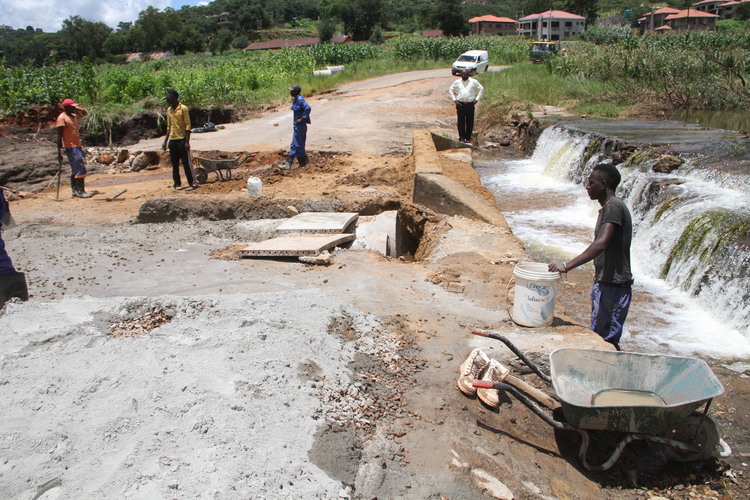
Features Writers
Rain is an important resource to life on earth. It gives life by supporting plants and crops and fills water bodies which in turn supply the precious liquid to people and animals. But in the same fashion that water gives life it can also take it. Heavy rain can be dangerous and cause destruction and despair. Residents across Harare were victims to the destructive nature of water when floods hit various parts of the city last week.
Mr Enoch Gede, a resident of Carrick Creagh Estate in Borrowdale was marooned with his family and lost his vehicle to the high waters. “It started raining around 8pm on Thursday. I was in the house with my four children who were getting ready for bed.
“Nothing seemed out of the ordinary and around 10pm I was preparing myself for bed, checking to see if all the doors were locked and switching off the lights. “It was then that I heard my gardener calling out saying the yard was flooding and that the car was being carried away,” he said.
Mr Gede then peeped through the window to see what was happening. He was shocked to find that the water had risen to knee level and his car was floating away. “When I looked out I couldn’t believe what I was seeing. The water level was so high that it began to seep into the house through the bathroom piping.
“My car was floating away, but there was nothing I could do because I feared that I would be taken by the water if I had gone outside. “I called my gardener to come into the main house because I thought the room he slept in would collapse on him. He had to enter through the window because we were scared that if we opened the door water would come in and flood the house,” he said.
Unfortunately for Mr Gede and his family, the glass door leading out from their living room broke and water began flowing into their house. They scrambled to remove whatever electronics they could in order to save them from the rising water levels.
“As water was flowing into the house I was scared for my children. The water level had reached thigh level when my eldest son suggested we climb into the ceiling and stay there till the rain ended.
“All six of us including the gardener stayed in the ceiling until 5am the next morning. When we came down, the whole house was full of water and mud. “I quickly went in search of my vehicle and found it some 500m from my house wedged between trees across the small stream,” he said.
With the help of his neighbours it took them four days to clean his home and salvage whatever they could. Not only did the floods damage residential property, but it destroyed two bridges on the estate.
According to Mr Muronzi a resident of Carrick Creagh Estate part of the problem was that the bridges were not constructed wide enough and were constructed with the wrong material.
“When it rained on Thursday the water level rose higher than the height of the bridges. The force of the flowing water then collapsed the bridge and eroded part of the sides.
“We are reconstructing them with concrete and mesh wire which will make them sturdy and make sure that in the event of a similar situation we won’t have problems,” he said
The heavy rainfall did not only affect the Borrowdale neighbourhood, but also caused serious damage in the high density areas of Hopley and Chitungwiza leaving the neighbourhoods in a sorry state.
Vincent Nduna, a resident of Hopley confirmed that the floods had impacted them negatively and made their lives more difficult. “It rained quite heavily on Thursday night into Friday morning and it was difficult for us to sleep because the whole house was rattling.
“Early the next morning as the sun was coming up, one of the two rooms I had just collapsed. Fortunately, there was no one in there at the time, but it is where my two daughters used to sleep.
“Now the whole family has to share a single room and that is not right because I have girls who are grown up and I can’t be sharing a room with my girls,” he said
The makeshift sun dried brick structure that Nduna had erected was now covered with black plastic to try and prevent the remaining building from collapsing.
“Not only did the rain damage one of the rooms, but it also damaged the toilet that we used to use. Now we are forced to go and relieve ourselves in the fields across the road. We also have to bath inside the one room that remains,” Nduna explained
He bemoaned the fact that sources of clean and safe water to consume were now limited in Hopley as many of the wells were not constructed properly and had collapsed.
“Most wells have been destroyed by the rains. This has affected a lot of people because we used to share the wells.
“The water is now contaminated and we have to travel long distances to get it where we can for consumption.”
“I fear that the destroyed wells, which are now open pools, pose a threat to our lives especially those of our children who could drown or contract diseases from the murky water,” he said.
The floods affected more than just the homes, outdoor toilets and wells. They caused damage to graves in Hopley and Chitungwiza which collapsed under the weight of the water.
A graveyard worker in the area speaking on condition of anonymity said some of the graves had not been dug deep enough and did not have anything to support the structure.
“Many of the graves here are shallow and the soil is quite loose. When it rains the soil underneath can collapse because of the weight of the water and mud on top.
“There are some graves which have collapsed now which we are trying to repair and make look presentable again. The risk though is that with more heavy rain the soil can be washed away,” he said.
Harare City Council has attributed the destruction of property and flooding of homes in parts of Borrowdale and Glen Lorne on Thursday to pre-cast walls, “that disturb the natural flow of water”
Many of the newer developments in the area such as Carrick Creagh Estate lie in the valleys of the hilly terrain. These gated communities have few access roads and few roads leading directly to the Mbunze/Umwindzi river and stream beds.
This then blocks water from the hillside to drain out as it accumulates on the roads and in yards which subsequently cannot cope with the load.
In other parts of the city such as Hopley and Chitungwiza, many of the residents had erected makeshift properties without sound foundations.
Harare City Council spokesperson Mr Michael Chideme said it was important for residents to seek approval from the city’s building inspectorate before constructing perimeter walls.
“This message is coming to you in the wake of preliminary findings on why there was extensive damage following the heavy rains and floods. The perimeter walls in brick and mortar created a buffer that disturbed the natural flow of run-off water leading to flooding and overpowering of the perimeter walls.
“The flow thereon was so intense that it tore into houses, breaking windowpanes and doors and in some instances washing away property such as refrigerators, couches and television sets,” he said
Mr Chideme implored Harare residents to be on high alert and to be mindful of the fact that any amount of rain could cause flooding.
“Always ensure that windows and doors are properly secured and that keys to the doors are accessible. Residents should park their vehicles properly to avoid them being swept away and safe from trees that can fall in the event of a storm.
“It is important to keep communication links with neighbours in the event of a disaster. They can be the first port of help,” he said.
Speaking from Cape Town, Urban Planning practitioner Mr Percy Toriro said the development of neighbourhoods must be a well thought process to avoid natural disasters affecting residents.
“Planning authorities should first determine as part of a scientific and objective urban planning process, which areas can be developed and for what type of development.
“When development is introduced, it means the ecosystem has been altered and new challenges emerge and these must be taken care of.
“For example, the amount of run-off increases and this must be catered for. At the implementation stage, attendant infrastructure such as appropriate size drains have to be designed and built.
“Natural water courses as determined by water flow must be provided for. If there is a boundary wall, a provision must be made to allow water to flow through. As a general rule of the thumb, no development should take place in the flood plains,” he said.
With regards to the challenges in Hopley relating to water and sanitation Mr Toriro said authorities should be adequately prepared to respond to such situations.
“Portable water should be immediately made available to avert communicable diseases. This is a public health time bomb. Proper planning will ensure there are less of downstream effects of crowding our hospitals with more patients.
“Cemetery sites should also be very carefully chosen. It is not a secret that Hopley cemetery for example was never an ideal site. The soils are sandy and quite inappropriate. The site is also dangerously close to Manyame River,” he said
One of the hallmarks of a safe city is the speed with which it reacts in times of disasters. Mr Toriro said there is a need to build resilient cities that are not only swift in reacting, but also robust in assisting victims quickly recover.
“Sadly our emergency services do not have capacity to be that responsive leaving residents very exposed when there is a disaster. We must invest in disaster-preparedness and this is a multi-agency challenge.
“Climate change is a reality of our time. Floods, droughts and unpredictable weather will always be with us so let us prepare,” he said



 Online Reporter