Vusumuzi Dube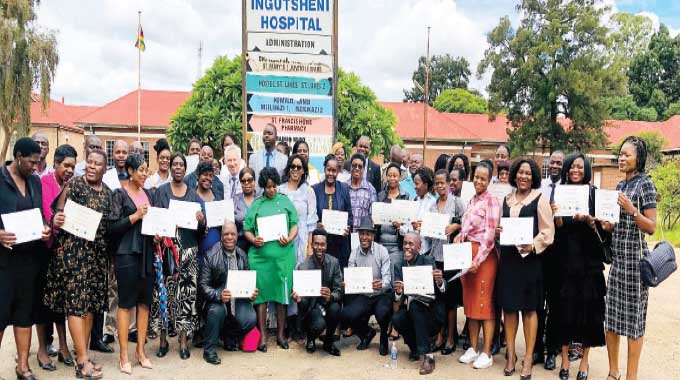
Michelle Musandinyoze, [email protected]
A TOTAL of 48 health workers in Bulawayo have graduated under the World Health Organisation’s Mental Health Gap Action Programme (mhGAP).
The certification programme, which was held at Ingutsheni Central Hospital on Monday, is a joint venture between the hospital and East London Foundation Trust, a charity organisation based in the United Kingdom.
The programme, inspired by initiatives in Kenya and Uganda, aims to incorporate mental health into other aspects of healthcare, hence the need to scale it up to other parts of the country.
Sixteen health workers graduated as trainers of trainers, while 32 graduated as frontline workers, drawn from various departments such as Zimbabwe Prisons Correctional Services and United Bulawayo Hospital (UBH).
Key discussions at the event focused on decongesting hospitals and improving community care, with emphasis on families not neglecting their loved ones.
Discussions also centred on the need to address mental health stigma, as people have limited knowledge about what it is.
Ingutsheni Central Hospital chief medical officer Dr Nemache Mawere said the programme is critical in addressing mental health and attributed the success of this year’s mhGAP to the strong component of continuous support and supervision.
“The previous initiative failed to yield results because the component of continuous support and supervision was not strong enough. However, the current model involves training of faculty trainers using virtual or face-to-face platforms, and these trainers of trainers in turn trained frontline workers in three cohorts, which are Harare, Masvingo and Bulawayo,” he said.
“These frontline health care workers are people who have had minimal training in mental health due to the limited capacity of our current registered general nurse, medical school, or other areas of health care training, hence the gap.”
Dr Mawere said there is a need to capacitate health care workers to be able to assist clients at the primary care level. “Mental health should be incorporated into other aspects of care such as oncology, stroke unit, OPD clinics, maternity care and general medicine,” he said.
Mr Tafadzwa Manyoni, a clinical psychologist at Ingutsheni Central Hospital, said the programme has helped equip them with tools to assess and screen for depression and mental challenges in outpatient departments.
“We used to have limited knowledge, but now we can screen for depression and any mental challenges. My colleagues and I are going to be able to help patients better, especially in therapeutic stunts and first approach skills, as we would rush things and were not good at listening,” he said.
Ingutsheni Central Hospital also established a women’s clinic at their New Outpatients Department and has since collaborated with UBH in training, with 10 workers from the Breast Cancer section at UBH and two from Ingutsheni receiving training in breast cancer awareness.
Director of Global Health at the East London NHS Foundation Trust, Dr Nick Bass, commended the graduates for their commitment to bridging the treatment gap for mental, neurological and substance use disorders. He said their new skills are vital for decentralising care from major institutions to the primary health centre.
Ends CKD


 Online Reporter