admin
admin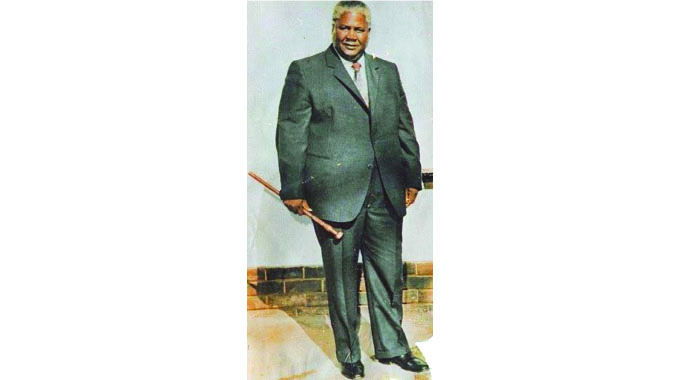
Herald Reporter
As the country moves towards celebrating Heroes Day on August 14, it is time for Zimbabweans to pose and reflect on the selfless sacrifices made by those who fought for the independence.
Each nation has its own heroes, and Zimbabwe has thousands of them who played various roles in its formation and later its development.
Without such heroes, one can shudder to imagine the country being under colonial bondage, with the fate of locals being determined by those who sought to subjugate them.
The nasty experience could have continued even up to today, had it not been for the heroes who gave up everything to fight for the noble cause of ending foreign domination.
Now, Zimbabweans can access their own resources, land included, and use them for their benefit and improve their lives.
One of the outstanding heroes who stood up against colonialism was the late former Vice President Joshua Mqabuko Nyongolo Nkomo, affectionately known as Father Zimbabwe.
He was not called Father Zimbabwe for nothing – he thoroughly deserved the title because of his monumental contribution to the liberation and formation of Zimbabwe.
Cde Nkomo was a towering political figure, not only for Zimbabwe, but other African countries and the oppressed world.
His death on July 1, 1999 from prostate cancer, sent shock waves throughout the continent, with media in various African countries carrying the sad news.
Cde Nkomo was eventually buried at the National Heroes Acre, registering perhaps the largest crowd ever witnessed at the national shrine.
He was very clear on issues of land ownership and land redistribution and black empowerment, such that his speeches were always punctuated by phrases bemoaning the disempowerment of locals by the colonisers.
He never dithered on the cause to return land to the majority as a central theme of the liberation struggle.
Throughout the struggle and even after independence, Cde Nkomo remained vocal on land and black empowerment issues.
This was because the loss of land by the majority of the people was at the centre of the liberation struggle. Land was an emotive issue that forced blacks to take arms to fight for it.
After independence, Cde Nkomo would remind everyone that blood was sacrificed during the liberation struggle for the sake of land.
No one could separate the land with Cde Nkomo and Zimbabweans today enjoy this natural resource courtesy of the liberation icon’s major role in the liberation struggle.
Marking the 24th anniversary of the death of Cde Nkomo this year, who died at the age of 82, President Mnangagwa described him as a “doyen of African liberation” whose footprint would forever be etched in the country’s history.
The President said the contributions to the emancipation of Zimbabwe by Father Zimbabwe, who was also known as Chibwechitedza, would forever remain invaluable.
“Today, 1st July, 2023, our great nation, including our brothers and sisters in the Diaspora, joins the Nkomo family in remembering the late national hero, Dr Joshua Mqabuko Nyongolo Nkomo, on the 24th anniversary of his death,” he said.
“The late former Vice President, affectionately known as “Chibwechitedza”, “Umdala Wethu”, “Father Zimbabwe”, was a trade unionist, a revered nationalist and a Pan-African freedom fighter who committed his entire adult life to the decolonisation and emancipation of the people of Zimbabwe.
“The memories of this doyen of African liberation, a gentle giant and a passionate nation-builder, shall forever be etched in our hearts.”
Here are some of the quotable quotes from Cde Nkomo, as complied by our Bulawayo Bureau recently:
Challenging a Rhodesian government minister, a Mr Bloomberg, over his claim that problems in the country were not political on October 9, 1975, Cde Nkomo said:
“UDI has been a disaster and the country is in this mess because of the political situation. Unless it is straightened out, we are driving to disaster. Give Africans responsibility and they will do the job. ‘African housing’ and ‘African Townships’ must be abolished. Housing estates should be known as merely high density, low density or high budget areas. Workers can be anybody.
“To talk of African workers is nonsense. We have outlived the division of people into races. That is old colonial thinking. We should be thinking these days of low density or high density building, not of the type of person who is going to live in them.”
Reflecting on the 10 years he spent in a Rhodesian prison in the 1970s, on March 9, 1980, he said:
“Without all this suffering, imprisonment and torture, we would not have got where we are.
They were profitable years in that the people who detained us believed they could kill the spirit of nationalism. It did not turn out that way. In spite of the spirit being dampened, it was sharpened.
These people were too stubborn to listen and so without our detention and liberation struggle, we would not be having our long overdue independence.”
Urging youths to engage in agriculture and desist from always looking for jobs on April 12, 1980, he said:
“I want thousands of youths to join in tilling the land so that we can turn this country into a garden. Those who are looking for jobs in factories in town are looking in the wrong places.”
Warning the Ian Smith regime of a war of liberation speaking at Heathrow International Airport, London, en route to Jamaica, he said:
“This is the march of time. Now is the time for a solution to the problem of Rhodesia. If people do not realise this, then inevitably there will be an armed struggle. There can be nothing else.”
“There is no problem that cannot be solved, but what is needed is a recognition of the fact that in Rhodesia, the Africans are in the majority and the Europeans in the minority. If the Europeans accept that all the citizens without discrimination must rule the country and that the Africans are in the majority in the government, we can get the solution. That is the only way.”
Asked about the time limit, he said: “The time is now — right now. I believe the time has come for the Smith regime to resign, because I cannot see us getting anywhere with them.”
No more talks with Smith – May 16, 1975, he said:
“We have discovered that there is no settlement with Smith. He is just an impossible person. We cannot make a constitutional arrangement with Mr Smith because he has no power to do so.
“We have been trying to show Britain (at the Commonwealth conference) that she is responsible for up to six and a half million people of her colony. I repeat, her colony. It can be nothing else. Rhodesia is a colony of Britain, and we are demanding to be freed now from the status of a colonised people.”
Firing an early warning shot at white farmers resisting land reforms on September 18, 1980, he said:
“Farmers must change too and realise that they cannot keep vast areas of unproductive or underutilised land. It is right for the commercial farmer to start thinking of the type of farming you get in Europe. We cannot continue with vast areas of land on which no other development is done than drilling a borehole and piping water, where no effort at intensified ranching is made. Cattle thefts must be stamped out and snaring stopped.
But behind these actions was the situation created by many years of land hunger and the belief of tribal people that they were unjustly treated but now there is majority government, we must get our land back.
What would you do if you were a man with six acres and cattle starving and on the other side of the fence you saw the farmer’s cattle? They snared because no native is allowed a gun. How else could they get meat”
Speaking in unity on September 29, 1980, he said:
“The rulers will go, the parties will go and so will men present and to come, but the independent Zimbabwe will never go … our children will inherit this country and it is our duty to build it in unity and have our children thankful to us for building the country instead of destroying it.
Cde Nkomo was born on June 19, 1917 at Semokwe in Kezi District, Matabeleland South, being a third born child in a family of eight.
His father, Thomas Nyongolo Letswansto Nkomo, was a teacher and lay preacher who was trained and worked for the London Missionary Society.
Cde Nkomo was a founding leader of the Zimbabwe African People’s Union (ZAPU) and worked with numerous other nationalists in the struggle for the liberation of Zimbabwe.
After primary schooling in Rhodesia, he went to South Africa to complete his education in Natal and Johannesburg.
Returning home in 1945, he worked for the Rhodesia Railways and by 1951 had become a leader in the trade union of the black Rhodesian railway workers.
In 1951, he obtained an external BA degree from the University of South Africa, Johannesburg.
Cde Nkomo became increasingly political, and in 1957 he was elected president of the African National Congress (ANC), the leading black nationalist organisation in Rhodesia. When the ANC was banned early in 1959, Cde Nkomo went to England to escape imprisonment.
He returned in 1960 and founded the National Democratic Party (NDP) in 1961, when the NDP was banned in turn, he founded ZAPU.
The white-minority government of Rhodesia held Cde Nkomo in detention from 1964 until 1974. After his release he travelled widely in Africa and Europe to promote ZAPU’s goal of black majority rule in Rhodesia.
Cde Nkomo helped lead the guerrilla war against white rule in Rhodesia alongside Cde Robert Mugabe, who headed the Zimbabwe African National Union (Zanu) after the ouster of Cde Ndabaningi Sithole.
The two groups were joined in an uneasy alliance known as the Patriotic Front after 1976.
After resolving differences between ZAPU and ZANU, Cde Mugabe and Cde Nkomo agreed in 1987 to merge their respective parties to bring unity and peace in Zimbabwe.
In 1990, Cde Nkomo became Vice President of Zimbabwe and played a critical role in shaping the country’s social and economic development.
In 1996, he was diagnosed with prostate cancer. His deteriorating health forced him to retreat from public life, although he continued to hold office until his death in 1999.
He died on July 1, 1999, leaving behind a solid and rich legacy of the nationalist struggle, peace and unity.


 Online Reporter