Chronicle Editor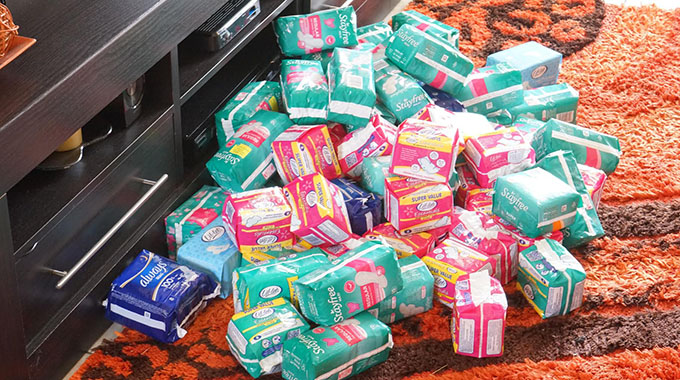
Yoliswa Dube-Moyo
YESTERDAY, a pack of eight sanitary pads cost $84,99 at a local supermarket.
Meanwhile, a normal period which is when the uterus lining is shed through the vagina if pregnancy has not occurred, typically lasts up to five days.
Most women bleed for three to five days every month, but a period lasting only two days to as many as seven days is still considered normal.
So, if a woman is on her period for seven days and uses on average two sanitary pads a day, it means she will require two packs of pads every month amounting to $169,98.
If she has a heavy flow of blood, it follows that she would require even more pads to get through her period hygienically.
Sadly, not all women can afford these prices.
Access to sanitary pads is always a challenge, which has however grown in recent weeks. They have gone beyond the reach of the ordinary woman, forcing some to resort to unhygienic materials to manage their period and exposing themselves to various diseases and infections.
Living in rural Zimbabwe further complicates things as people are already struggling to put food on the table and may not afford buying sanitary wear for their wives, sisters or daughters.
Many women and girls resort to worn out clothes, newspapers, leaves and cow dung to manage their period as a result.
In Zimbabwe, about 72 percent of menstruating rural primary school girls do not use sanitary pads.
Some girls have reportedly had to share the same piece of cloth with their mothers to stem menstrual flows as they cannot afford proper pads.
This has seen most girls missing school or using unhygienic material exposing themselves to urinary tract infections, rashes and bacterial build-ups.
The transition into womanhood is not easy as many girls are afraid to ask for money from their parents or guardians.
The secrecy around the natural biological process has prompted some girl child organisations to come up with innovative measures to improve the situation.
Some celebrities have also embarked on pad drives in order to collect pads from well-wishers and donate them to those most in need. These, however, have been a drop in the ocean, all the more now when the Covid-19 pandemic has brought to a screeching halt most calendar events for the year.
Despite the Government having scrapped duty and Value Added Tax (VAT) on sanitary wear to make it available and to promote hygiene for women, pads still remain beyond the reach of many.
The invention of reusable pads as a means to mitigate the problem has not been entirely successful as some women and girls shun them.
The reusable pads were initially celebrated for obvious reasons; you buy it once and go for months with the same pad, making them cheaper than disposables in the long run.
In terms of the environment, they were preferred because they are reused which means much less waste is thrown away and less waste formed during manufacturing, which is a plus to the effort to reducing carbon emissions.
However, researchers say there is need to rethink and reconsider the use of reusable pads as young women with disabilities do not want to use them, especially those with physical impairments.
Sister Maria from Zimcare Trust said, “We have girls with multiple disabilities and different types of disabilities and reusable pads are a burden for our girls especially those with mental and intellectual impairments.”
Reusable pads require extra effort of hygiene and were a burden to women with disabilities, especially those with visual impairments.
Cultural beliefs have also proven to be one of the reasons there has been not much use of reusable pads.
Nolwazi argued that, “At school it’s better. Imagine when I’m at home and have to wash the pads and hang them outside on the washing line for everybody to see that I’m on my period.”
Menstruation continues to be a private matter in most families. In other instances, some parents are now forcing their children to use contraceptives such as Norplant and Jadelle so that they do not menstruate or fall pregnant, a violation of their sexual reproductive rights.
To mitigate challenges experienced by girls in rural areas during their periods, Minister of Finance and Economic Development Professor Mthuli Ncube last year announced that ZWL$200 million would be allocated for the provision of sanitary pads to all rural schoolgirls who had reached puberty.
Parliamentary Portfolio Committee on Primary and Secondary Education chairperson Mrs Priscilla Misihairabwi-Mushonga, who for many years had passionately lobbied for provision of sanitary pads to school girls and a tax regime that makes sanitary wear affordable to every woman in the country said this was a “life-changing” move.
Sanitary Aid Zimbabwe Trust executive director Theresa Nyava was quoted saying it would go a long way in bringing equity in education.
She said it had been established that 72 percent of school girls in rural areas do not use commercial sanitary wear, desperately resorting to unhygienic means, with 62 percent of them missing school every month.
“A girl who is absent from school due to menstruation for four days every month loses at least 40 learning days, the equivalent of six weeks of learning, per year. It’s like not going to school for half a school term. Equity in education can therefore not be achieved under such a scenario.”
The development, if implemented well, would ensure that girls attend school, concentrate and also participate in sporting activities, improve their mental health and generally be in control of their periods.
“It will also address issues to do with period shaming, as girls are often laughed at when they spoil their school uniform or the school chair, or when walking awkwardly due to use of improper and inconvenient menstrual absorbents such as rags, cow dung, you name it,” said Ms Nyava.
The development meant that Zimbabwe joined other countries like South Africa, Botswana, Lesotho, Zambia and Kenya that are already — or have also resolved to — provide free sanitary towels to school girls who cannot afford to buy their own. Other countries like Ghana, Uganda and Malawi are also under pressure to introduce similar programmes.
A 2015 survey by the Government indicated that 20 percent of girls miss school due to period pain while 67 percent miss school due to lack of pads and 26 percent stay home because of heavy flows during menstruation.
Most sanitary pads in Zimbabwe are imported from South Africa as companies that used to manufacture them have ceased operations owing to foreign currency shortages.
So, more innovative methods to improve women and girls’ menstrual hygiene and health will go a long way for the women of Zimbabwe. — @Yolisswa



 Online Reporter