admin
admin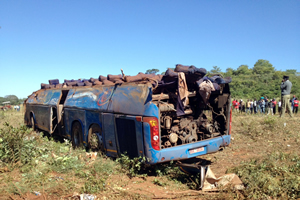
Edmore Mazivofa Correspondent
It is the most direct link between Harare and Pretoria, South Africa, and provides landlocked Zimbabwe and Zambia access to the Indian Ocean ports of Durban and Richards Bay. However, for many years the highway has become a death trap for motorists as hundreds of lives are lost and many more people permanently maimed.
According to a 2012 report by the Traffic Safety Council of Zimbabwe, five people die every day in road accidents in the country and the highway contributes significantly towards this carnage. The road has remained bumpy, narrow and dangerous despite generating the highest toll fees and being the lifeline of this country and others north of the Zambezi.
Being over 40 years old, the highway is rapidly deteriorating under increased heavy vehicle traffic. The surface is now slippery in some places such that it becomes a peril travelling on it in inclement weather. A total of 34 115 haulage trucks ranging from 30 to 56 tonnes enter the country through the Beitbridge and Chirundu Border Posts each month.
Carriageway markings on the highway are hardly visible as drivers ride over them in trying to position their vehicles in the centre to avoid driving off the edge. The road is getting narrower by the day. The average width of these highways should be 11m excluding recovery areas that should be 1,2m but the Masvingo road has been reduced to just 9m.
At some bridges, rails are a thing of the past leading to some vehicles plunging into rivers and streams.
The Harare-Masvingo highway is in a deplorable state and unfortunately has been the scene of numerous fatal accidents since Independence; it has not received the attention it requires.
Some of the most notable accidents are the collision between a Mhunga bus and a haulage truck in August 2009 that killed 40 innocent people.
“The state of this road is so deplorable to the extent that sometimes we think no one is in charge of it. It would seem as though we want to use it to the end, but what about the future generations? What will they use?” asked Mr Mukondi (35), a businessman at Lundi Township along the highway.
Some people consider the road a highway to the grave.
“When the road is this bad, you are assured of one thing, all the way from Bietbridge to Chirundu you will be holding your front row ticket to the grave. You can’t overtake comfortably especially when 17 wheels are rattling on the edges. Imagine a truck passing you on a bridge with a pothole in the middle? It’s a nightmare I tell you,” lamented Nelson Chiriko (40), a truck driver of a local firm.
Government once proposed dualisation of this road soon after resolving a dispute with Zim Highways Consortium, a grouping of local firms that were awarded the tender to commence the refurbishment and dualisation in 2002, but they struggled to secure funding which stalled the project. Because of this, the scheme has stagnated for 12 years and resulted in it being dubbed “the highway of death” due to several fatal accidents that occur every year.
The Government through the Ministry of Transport headed by the then Minister Nicholas Goche once did a feasibility study of the project and it was found that $930 million was needed for the refurbishment of the road, which would involve local subcontractors in line with the government’s indigenous policy.
Due to the impasse between the Government and Zim-Highway, the Plumtree-Bulawayo-Harare-Mutare highway has been refurbished ahead of the Chirundu-Harare-Beitbridge one.
Last November permanent secretary in the Transport Ministry Munashe Munodawafa said the feasibility studies for the Harare-Masvingo-Beitbridge highway had been completed. He said the project would involve dualisation on some sections and establishing four-way tracks on some portions.
“The project is estimated to cost US$928 million and will include the construction of a new Beitbridge border post,” he affirmed.
Many people are agreed on the fact that heavy trucks are the main culprits in the deterioration of the road. Road engineers estimate that a fully loaded truck with five to seven axle assemble weighing 40 tonnes causes more damage to a highway than 5 000 cars put together. When the trucks are overloaded as there are no weight limits followed, the damage is exponentially worse.
While the Zimbabwe National Roads Administration enforces strict weight limits, most trucks continue to barrel along the route with increasingly heavy cargo.
With the nation’s truck traffic expected to increase dramatically over the next decade, the North-South corridor will reach a point of oblivion.
What this road wants is a little recognition so that it will care for us and our offspring. In theory, transport improvements decrease transportation costs, improve access to markets, foster economic integration, stimulate competition, and generate agglomeration economies and a number of other “wider” economic benefits.
This is why, say experts, transport improvements are frequently a strategy for economic growth, integration and local economic development.
However, through Private Public Partnership, the Government has the Chirundu-Harare-Bietbridge road as one of the nation’s highways that have attracted much attention from different contractors who are willing to take up the project.



 Online Reporter