dyton mupawaenda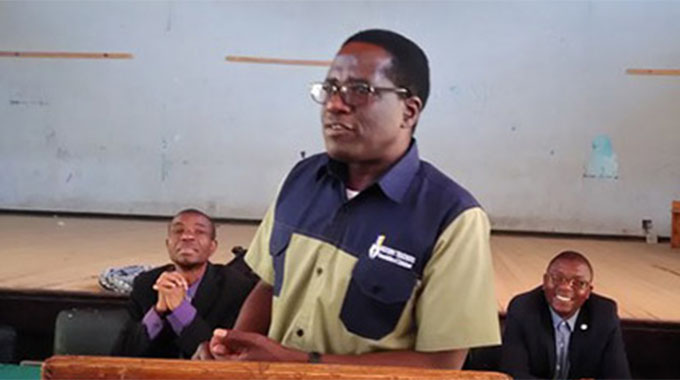
Freedom Mutanda-Herald Correspondent
Those who disdain history are bound to repeat it with disastrous consequences.
For a long time, the history of Zimbabwe has been written by people who claimed to have researched it through oral tradition and archaeology. Thus, the Great Zimbabwe Monument was said to have been built by non-indigenous people.
From this Eurocentric perspective, comes ideas that the Victoria Falls was discovered by David Livingstone. It appeared as if the local Tonga people had not seen the Mosi-oa-Tunya, even though they had been living there for thousands of years.
The power of the pen is in evidence here. As a result, the history of Zimbabwe and Africa has been authored by foreigners, who had, and continue to have their agendas.
Some learners of History in Metropolitan countries claim to know much about Zimbabwe, such that, in various fora, they authoritatively speak for Zimbabweans, yet their jaundiced perceptions about the country are clear for everyone to see.
Therefore, when they write about the country, eyebrows are raised by those patriotic Zimbabweans who have researched about the phenomenon known as Zimbabwe.
It is, thus, important to have History books written by Zimbabweans.
The late national hero, Professor Ngwabi Bhebhe, is one of the early authors on Zimbabwean history, alongside the likes of Dr Misheck Sibanda and Dr Henry Moyana of “The African Heritage” fame.
Since the advent of the updated curriculum, new voices from an upcoming breed of writers have come to the fore. Gone are the days when foreign writers were the in-thing, and learners had to read about the history of America, Europe and Asia, while the Zimbabwean experience was an afterthought.
From these new voices come Anyway Sadziwa, an experienced History teacher, who has been in the teaching profession for close to three decades.
Sadziwa, alongside other Zimbabwean authors such as David Mafara, Josiphat Gwezhira, Lameck Tendengu, and Raymond Damba, has written Heritage Studies, History and Family and Religious Studies books, which cater for Forms One up to Form Six, and some of the Advanced Level textbooks.
Recently, The Herald visited him to get to the bottom of what drives him as an author.
The 54-year-old historian said he had always loved storytelling and reading about what it is to be a Zimbabwean living in the global village.
He said the new curriculum, which is also called the updated curriculum in other quarters, has afforded him the opportunity to rub shoulders with the best in (re)capturing the history of Zimbabwe.
“First, my wife noted that I could relate, account, analyse and narrate social, political and economic issues from national and international arenas. She urged me to try my hand at writing, and initially, I shrugged her off feeling that I was not up to the task,” the soft spoken Sadziwa said.
“Then, Mr Chikuse, the former sales representative for College Press in Manicaland Province, encouraged me to write. Again, I felt that I could not do it. Later, Professor Rungano Zvobgo held regular Principal’s hour every week when I was at college.
“It was during those times that the seed to become an author germinated in me. I decided to try writing, but I never thought I could be a hit in the genre of textbook writing.’’
Having started teaching in 1994 after graduating from Mutare Teachers’ College, Sadziwa taught History at all levels in the rural areas, and his last port of call as a teacher was at Mutare Boys High School, where he held various portfolios in administration.
He is the vice president of the History Teachers Association of Zimbabwe (HITOZA). Therefore, he has been in the trenches for long with the result that he knows what the learner needs for the accomplishment of set objectives. To crow it all, he has been part and parcel of curriculum review for History as a subject.
What makes his books a darling of learners is how they easily attract the reader due to the language used, which does not need any rush to the dictionary to check the meaning. In his words, they are learner-friendly.
“The language we use is simple and straightforward. We use the exercises in the textbooks, which are typical exam questions. The questions are in a chronological order, and we use pictures, which help the learner to understand the textbooks. “We are developing the spiral of development, where we start from the simple to the complex, which helps the learner to understand the concepts,’’ he said.
Sadziwa is one of the architects of the new curriculum, with specific reference to History, as he was one of the designers of the new History syllabus.
“I am the engine behind the crafting of the new History syllabus. I designed the Form Three and Form Four 2167 syllabus. As for the upgraded curriculum, I was responsible for designing the Form One to Form Six Economic History syllabus, and Form One to Form Six History syllabus,” he said.
“Consequently, I can safely say that the current syllabuses are my brainchild. Furthermore, I was invited to be part of the research team assembled by the former Primary and Secondary Education Minister Cain Mathema.”
Sadziwa said he worked with the former Primary and Secondary Education Minister Dr Lazarus Dokora and the ministry’s principal director for Technical Development Services, formerly Curriculum Development Unit, Dr Paul Makanda.
“With that wealth of knowledge, I feel that Zimbabweans should tap from that,’’ he said.
Sadziwa began publishing in 2016, and since then he has not looked back. His primary motivation is to make History simple and attractive to learners. There was a time in the past when the subject attracted a few learners as it was deemed difficult.
Full article on: www.herald.co.zw
At the time, some titles had a reputation of presenting historical facts in jargon, thereby alienating learners from the subject. With the coming in of learner-friendly books, many pupils find History appealing, which ultimately raises the pass rate for the subject.
Sadziwa, who has recently resigned from the Public Service, penned the following titles in collaboration with Mafara, Gwezhira, Tendengu, Mupoga, and Manners Musongelwa: “Focus on History”, for Forms One to Four, “Dynamics of A-Level History: The history of Zimbabwe from pre-colonial era to post-Independence”, “Mastering A-Level Regional and International History”, and “Heritage Studies” Books 1, 3 and 4.
A prolific writer, whose pen is itching to write more books on his preferred areas, History and Heritage Studies, Sadziwa holds a Master’s degree in Development Studies.
Until recently, he taught at Mutare Boys High School, and is due to take up a post as the founding headmaster of Alpha Technical High School in Mutare. His taking up of the headship of the school resonates well with Education 5.0, whose philosophy is that education should empower learners to be entrepreneurs, instead of the current scenario where school leavers queue to be absorbed in the ever-shrinking job market.
As a seasoned educationist and disciplinarian, Sadziwa is at the point of his life where he has to give back to the community that he nurtured with textbooks that enhance the learning of History as a subject.
His former head, Philip Padhuze, said his protégé is a man with a gift for writing.
“Anyway is a rare breed. He is passionate about his work. He loves reading. That is why he managed to author books that cater for learners of History up to A-Level. He is a great leader, counsellor, advisor and mentor. I wish him well in his writing,’’ he said.
There is the age-old question: are writers born or made?
For Sadziwa, who has an unrivalled love for History, the baby steps he made in 1991 when he started his journey in the teaching profession by enrolling at Mutare Teachers’ College, writing has become ingrained, and he is destined to continue on his trajectory.
Maybe, his works will grace university libraries in the future.
Time will tell.


 Online Reporter