Online Reporter
Debra Matabvu
The Harare Institute of Technology (HIT) is anchored on a national mandate to develop, incubate, transfer and commercialise technology in support of Zimbabwe’s industrialisation agenda.
Speaking at HIT’s 17th graduation ceremony in Harare today, the institution’s Vice Chancellor, Professor Quinton Kanhukamwe said the mandate is closely aligned to the Government’s Heritage-Based Education 5.0 philosophy, which emphasises innovation, industrialisation and the practical application of knowledge to address national challenges.
Prof Kanhukamwe said the policy seeks to transform higher and tertiary education institutions into centres of innovation and industrial development by encouraging students to move beyond theoretical learning towards the development and commercialisation of products and solutions.
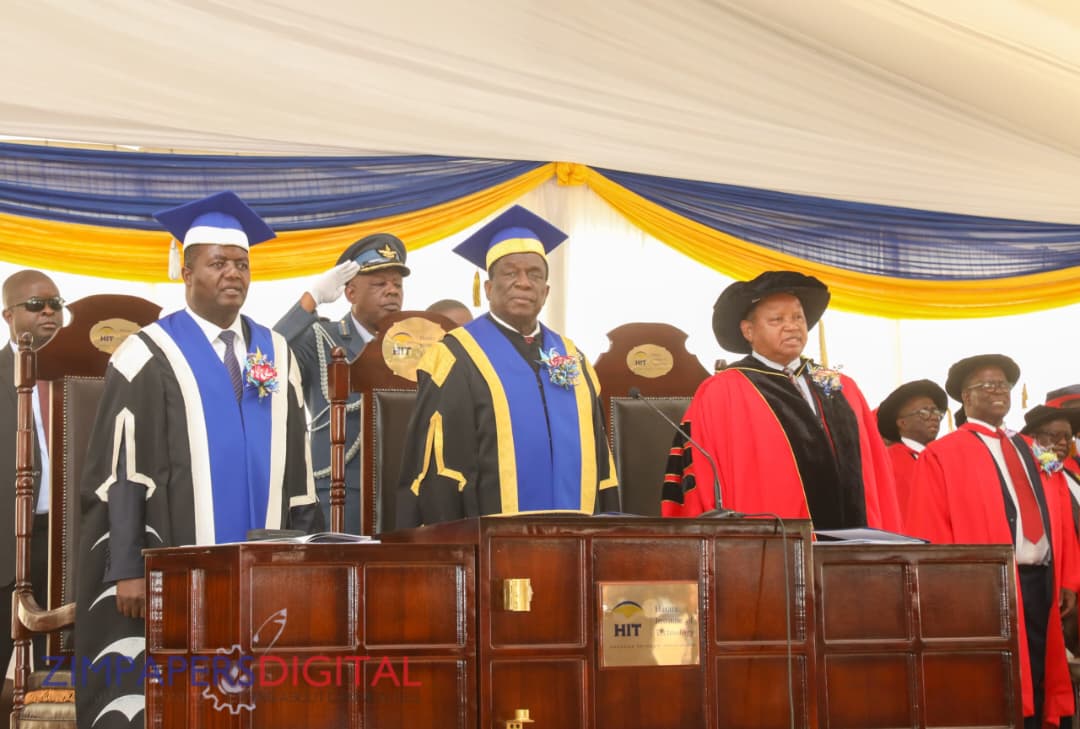
President Mnangagwa is presiding over the graduation ceremony, where 734 graduands will be capped in various Science, Technology, Engineering and Mathematics (STEM) disciplines.
“Harare Institute of Technology exists because of a national mandate: to develop, incubate, transfer and commercialise technology for Zimbabwe’s industrialisation,” Prof Kanhukamwe said.
“That mandate is the anchor of everything I have described so far, and it stands on three pillars – our destiny, to be the stimulant of scholarship in innovation; our cause, to cultivate commitment towards technopreneurial leadership; and our calling, to commercialise technology through professionalism rooted in integrity.
“It is the same mandate that you, Your Excellency and Chancellor, have championed through Heritage-Based Education 5.0—a doctrine rooted in your own words, delivered in your inaugural address to the nation and recorded in the official Hansard of the Parliament of Zimbabwe.”
Prof Kanhukamwe highlighted some of the institution’s various achievements over the past year, including Ndarama Technologies—a digital-sovereignty venture—now running the Ministry of Mines’ Export Permit Management System and the Citizen Engagement and Scoring Platform.
He also cited Matsimba Technologies, an e-ticketing system and the Public Service Commission’s pension platform, as well as a solar panel factory in Belvedere.
The VC noted that other achievements include the Catalysis and Chemical Process Engineering Laboratory (CCPE), the Electronics, Embedded Systems and Cyber-Physical Engineering Laboratory (EEC), and the Artificial Intelligence, Data and Digital Engineering Laboratory (AIDDE).
He also mentioned the Bio-Innovation and Health Technologies Laboratory (BIHT) and the Agri-Food Technology and Bioeconomy Laboratory (AFTB).
Prof Kanhukamwe said going forward, HIT will focus on driving value addition and beneficiation of Zimbabwe’s critical minerals, ensuring the country moves beyond exporting raw minerals to producing higher-value products locally.
He said the National Lithium Study has enabled the institution to establish what critical minerals and rare earth elements Zimbabwe possesses and how they can be beneficiated.
“Our outlook is to carry that knowledge all the way up the value chain: from characterised ore, through battery-grade precursor chemistry in our AMMB laboratory, to mineral value addition in MVANC, to lithium iron phosphate cells, to complete electric-vehicle battery packs, and ultimately to Zimbabwean-assembled electric vehicles and trams rolling out of the Hi-Tech Development Valley itself,” Prof Kanhukamwe said.