Online Reporter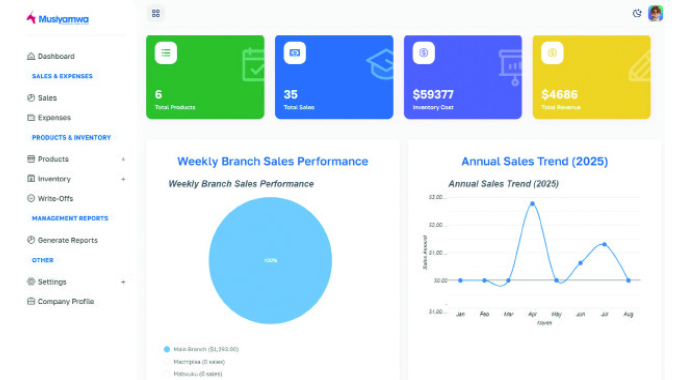
Trust Freddy-Herald Correspondent
IN a country where the informal sector drives over 60 percent of the economy, millions of small-scale traders operate without access to formal banking, credit, or even basic financial tracking.
But a new mobile App, Musiyamwa, developed by the Harare Institute of Technology (HIT), is set to change that — turning informal business data into collateral for loans and bringing financial inclusion to Zimbabwe’s bustling but often overlooked SME sector.
The App, available on Android and iOS, aims to provide small and medium-sized enterprises (SMEs) with the digital tools they need to track their finances, manage inventory, and ultimately, access formal lending opportunities.
This innovative App aims to formalise operations, particularly of vendors and other informal traders, by providing a verifiable performance track record and allowing them to use their business data as collateral for loans.
LADs Africa chief executive officer Engineer Tererai Maposa said the App was born from a deep-seated need to support the country’s hardworking informal sector.

LADs Africa chief executive officer Engineer Tererai Maposa
“More than 60 percent of our economy is informal, and 90 percent of the population is employed in this sector,” he said. “These individuals, despite their hard work, are often unable to get loans because they have no formal business data.
“So Musiyamwa seeks to formalise their operations by allowing them to track sales, expenses, and stock levels.
‘‘The system enables SMEs to capture all their products, input inventory, and start tracking sales and resale and profit, and inventory levels within their stock.”
The App also allows for remote monitoring, giving business owners a new level of control and peace of mind.
“So the system has got what we call multiple branch management, for example if you are a business owner who has got multiple branches, for example in town, you have got one in First Street, another one in Chinhoyi Street, you will be able to monitor what’s happening in all your branches on one dashboard, and you can also move stock around, if one item is being needed in another branch, you can transfer it across your branches, and you can manage your stock in one location, and it allows you to monitor your businesses remotely, in the comfort of your home, probably you have travelled, you can actually see how each branch is operating, and how each employee is also operating.”
Eng Maposa also added that the app simplifies tax compliance through “soft fiscalisation” with the Zimbabwe Revenue Authority (ZIMRA).
“We have done soft fiscalisation with Zimra, so you can use auto fiscalisation, and also this is very affordable, just US$5 per month per business account, because you need to register an account on Museyamwa and with US$5 you can run your multiple branches, and we have got unlimited users of that $5, and it’s just US$5 per month, you get it, it’s renewed every month, so it’s good, and it also runs on your Android device, and it has got a web platform where you can monitor also on your computer, you get what is happening on your branches, on the computer. “
He also said vendors who handle substantial funds and can afford to send their children to higher institutions often find themselves excluded from formal banking services because their financial transactions go undocumented.
However, with the latest software, verifiable data will serve as a transparent track record that financial institutions can trust, making these businesses “bankable.”
The application also extends its functionality to the transport sector, enabling operators to remotely track the money collected per trip, as it automatically records payments made by passengers.
The Musiyamwa app was officially launched by Ambassador Fredrick Shava, Minister of Higher and Tertiary Education, Science and Technology Development, on Thursday, during the opening of the institution’s Technovation Expo 2024. This year’s Expo was themed “Twenty Years of Designing the Future: Celebrating Commercialisation of Research, Development and Innovation Outputs for Zimbabwe’s Modernisation and Industrialisation.”
The Expo brought together academics, industry leaders, students, and government officials to celebrate the institution’s two decades of concerted efforts towards transforming Zimbabwe into a modern, knowledge-driven economy since its inception.
Minister Shava, who was being represented by his Deputy Simelisizwe Sibanda commended HIT, an App that is set to revolutionise the involvement of the informal sector in the mainstream economy.
“I want to express my deep appreciation to HIT for its unwavering dedication to fulfilling its mandate of developing, incubating, transferring, and commercialising technology,” Ambassador Shava said.
As of Thursday, over 700 individuals had registered and are now using the Musiyamwa App.
The institution is also bullish on expanding its reach into the regional market, with Eng Maposa revealing that five Somali companies are already piloting the App, and Tanzanian companies showing keen interest in adopting the technology.
HIT Vice Chancellor, Engineer Quinton Kanhukamwe, said: “True to the mandate, HIT has churned out several start-ups. Some of the start-ups are already having visibility out there, in various cities within the country.
He also highlighted HIT’s notable achievements, including the development of the Ministry of Mines’ export licensing system, the Bureau de Change system for the Reserve Bank, and innovative projects in solar energy and battery technology
These achievements dovetail with the Second Republic’s vision to modernise the education system, with the shift from Education 3.0 to Education 5.0 driving innovation and entrepreneurship, and leading to the establishment of new industries and start-ups.
This shift emphasises that, in addition to providing students with a strong theoretical foundation and enabling research staff to advance knowledge, it is equally crucial to apply that knowledge and drive innovation in practical applications.
Other notable industries and start-ups being spearheaded by local institutions include the country’s number-plate manufacturing plant which will see Zimbabwe supplying countries in the region, and has saved the country foreign currency.
Other projects include the Bindura University of Science Education’s Optometry Centre and the University of Zimbabwe’s Laparoscopy Centre, which are both a boost to the country’s healthcare system.
There is also the Harare Institute of Technology’s TRAM Transportation system, as well as bakeries and edible oil production plants, among others.