

 admin
admin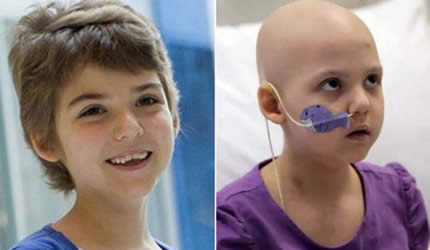
intensive chemotherapy treatment.
Doctors had exhausted all the traditional treatments as Emily could not remain in remission for long enough to attempt a bone marrow transplant. So Emily’s desperate parents, Kari and Tom, started looking at more radical options.
‘‘We made the decision that we needed to go somewhere else,’’ said Mrs Whitehead. We needed to try something new, different and cutting-edge.’’
So they turned to the Cancer Centre at The Children’s Hospital of Philadelphia, which is involved in testing a pioneering new therapy.
Doctors suggested they sign Emily up to a clinical trial that would use a disabled form of HIV to carry cancer-fighting genes into her T-cells (disease fighting cells). The hope was that this would reprogramme her immune system to recognise the cancer cells and start killing them.
Several adults had already been enrolled in the study at the Hospital of the University of Pennsylvania and had responded well but as it was so new that the treatment wasn’t without risks.
But time was running out for Emily, who is also known as Emma.
Mr Whitehead said: ‘‘We were told that we were down to 48 hours of making a decision or she could start having organ failure.’’
They comforted themselves with the knowledge that even if the treatment didn’t work, it would provide doctors with information that could help them save other sick children.
So on April 17, the then six-year-old became the first child to have the therapy known as CTL019.
All did not go smoothly at first. The family had been warned Emily could experience flu-like symptoms a few days after being infused with her reengineered T-cells.
However, Emily’s symptoms were far more serious than doctors anticipated.
She became critically ill and was admitted to intensive care at the children’s hospital. On April 24, doctors told her parents she had a one in 1 000 chance of surviving the night, but she pulled through thanks to their expertise.
Trial leader Dr Stephan Grupp and his team realised that the level of a certain protein had become very elevated as a result of the T-cells growing in Emily’s body.
This same protein is involved in rheumatoid arthritis, and there is a drug for that disease that turns off production of that particular protein.
The team administered the drug to Emily, with dramatic results. Her condition improved faster than anyone could have hoped for. Almost overnight, her breathing improved, her fever dropped and her blood pressure was back to normal.
Mrs Whitehead said Emily inspired them with how she coped.
‘‘She’s extremely smart and creative. She’s funny — she makes us laugh all the time. She never complains,’’ she said.
Emily is very creative according to her parents, and loves playing with her dog
Kira and Tom faced the agonising decision of whether or not to put their daughter forward for a clinical trial
Her husband added: “She told us from the beginning that she would continue to fight and do what we asked as long as we were there with her. We’ve stuck together as a team. She’s definitely our hero.”
Several weeks after her T-cell infusion, they were able to conduct a bone marrow test to find out if the therapy had worked.
“Three weeks after receiving the treatment, she was in remission,” said Dr Grupp. – Daily Mail.



 Online Reporter