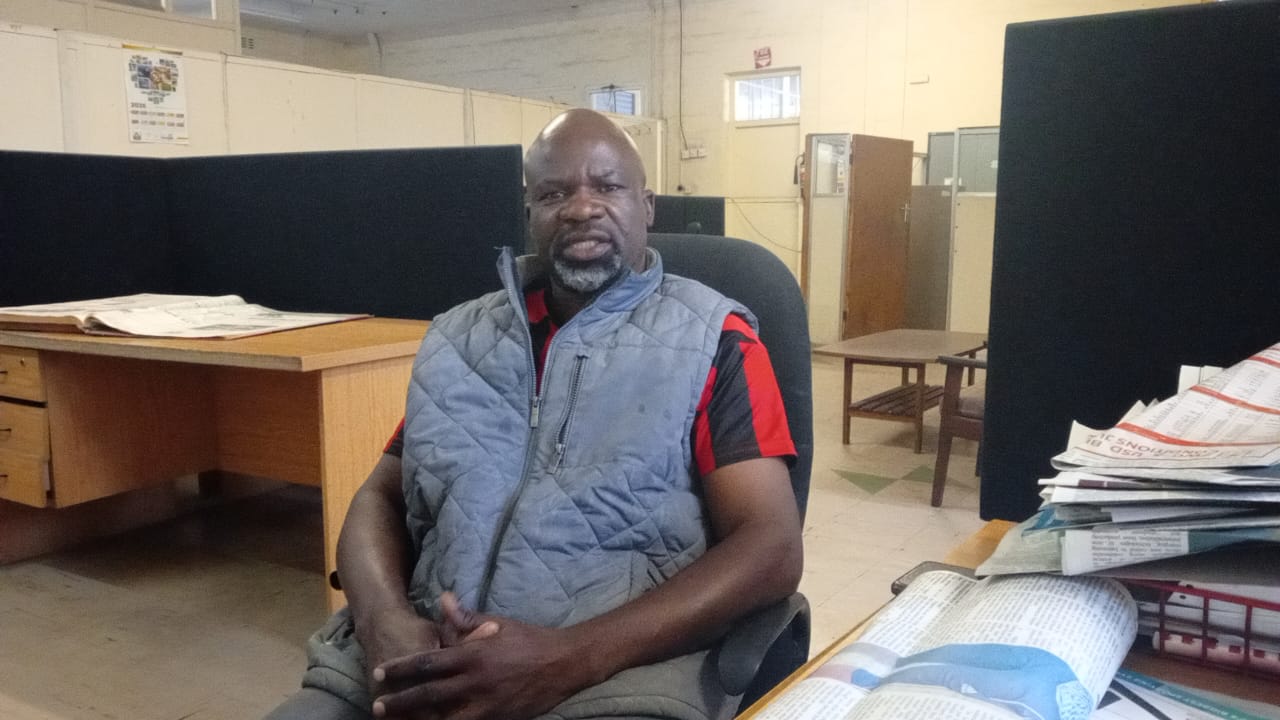
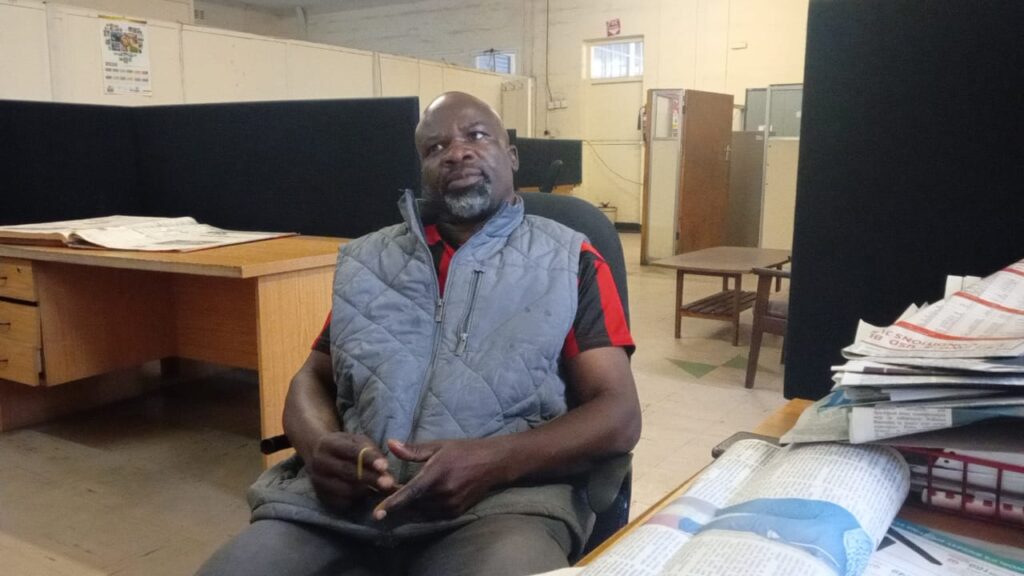
KEUTSEPILEMANG Ndebele, once Highlanders’ technical adviser at the age of 32, had a dream of becoming a top player but found himself at an early age seated in the dugout, pushing some of the best talents ever seen in this country.
He described it as an honour to have trained and played alongside great talents that Zimbabwe was proud of.
Some were players he grew up admiring, reading about or hearing on the radio.
Born at Manama Hospital in Gwanda District, Matabeleland South Province on 11 January 1969,
Ndebele attended Gungwe Primary School in Gwanda and went on to complete his junior education at
Usher Institute, where he played football as a striker.
He moved into goal as a Form One pupil at John Tallach Secondary School.
“I was a big boy, bigger than most guys, so I would pack hot shots and they called me Thunderboots. It was then that I started playing as a goalkeeper. I was the school team’s first-choice goalkeeper while in
Form One and played with former Bosso and Eagles winger Mandla Balanda and Griffiths Tshuma.
“I remember playing against Glad and Goodwin Jaravani, who went on to play lower division football.
They were at David Livingstone Memorial School and Gloag School. We could only play against two schools per year.
“One time we played Nkulumane High School and former Njube Sundowns striker Have-A-Look Dube beat one of our defenders and left him for dead amid cheers and screams of excitement from girls. He was on fire.
“After my four years at John Tallach, I continued playing football, where we had Nicholas Nyengerayi, he was our headboy, a striker with pace and a good dribbler, who packed hot shots — and Henry Chipongo, who later turned out for Zesa Munyati.”
After school, for a budding talent he thought he was, Highlanders became his destination, where he found himself among 11 goalkeepers, with a majority vying for recognition, while the likes of Peter
Nkomo, Smart Moyo, Pernell Mckop, Sydney Zimunya and Francis Muringayi were the more established of the pack, said Ndebele.
Musa Masango, the former Young Warriors goalkeeper, the late Reeves Sibanda, Lucky Siziba, Mandla
“Stilleto” Mpofu were also among those eager to make an impression.
“Muringayi stayed in my Waterford neighbourhood and we would walk to town through Mzilikazi and
Makokoba from Barbourfields after training. We caught the same transport home, he made me feel at home,” said Ndebele.
He trained at the National Railways of Zimbabwe as a diesel plant fitter, which saw him play tertiary football.
“While serving as an apprentice, I managed to play college football and in one tournament at
Barbourfields Stadium Grounds, I remember being beaten by a stinger on the near post and a guy came by and said to me, ‘Anonzi Tauya Murewa,’ “ before the Doctor became prominent,” said Ndebele, who during his school days played for teams like Air Zimbabwe and ZRP Stops Camp.
When efforts were made to revive Bulawayo Wanderers (Eagles) in 1994/95, he found himself trying his luck there under famed yesteryear talent identifier and groomer Ronnie Maseko.
Of his time with Highlanders, Ndebele said the legendary Peter Nkomo was very encouraging.
“For his profile, national team duties and cup wins, Nkomo was a good character on and off the field. He was a humble person, a good human being from whom I learnt a lot,” said Ndebele.
There were other big players who frequently occupied the “back in the era” spaces when on-form stars were mentioned.
“We had big players like Alexander Maseko, you would play with him in small-sided games and he would say at the top of his voice, ‘Ngu gore onjani lowu?’ And as a youngster, you would freak,” said Ndebele,
who admitted to playing just two 90-minute games against Matabeleland High City and East Rovers, who had the late Oscar Ncube pounding him with hot shots.
Ndebele remembers the late Mercedes Sibanda mocking him that he was a goalkeeper who worked at Bulawayo’s industries.
“I cycled to training and Rambo would poke fun at me about it, likening me to someone who works at the firms,” said Ndebele with a chuckle.
He said during his time at Highlanders, there were many big names to train with, such as Madinda Ndlovu, Dumisani Nyoni, the late Dumisani Ngulube, Willard Khumalo, Makheyi Nyathi and Adam Ndlovu.
Adam held himself in high esteem despite being humble.
“He was proud that he was the country’s Number Nine, he would talk about it whenever he returned from the Warriors and that motivated us. Oh, another great player was Benjamin ‘Matambanadzo’ Mpofu, a grafter and a thinker,” said Ndebele.
Ndebele says that while he had to work harder on his career to be among the best chasing the Bosso jersey, there were interruptions as he had to go for attachments at places such as Hwange, Dabuka in Gweru and Lonchinvar in Harare.
In 1994, he decided to attend a coaching clinic under Roy Barreto and Reinhard Fabisch alongside the likes of Bongani Mafu, Pernell Mckop, Godfrey Paradza, Dickson Mbazo, Morgan “Gazza” Dube, Jairos
Tapera, the late Benjamin Moyo and former Sunday News sports correspondent Tito Asani.
He also attended the second level of instruction with Charles Mhlauri and others before completing the
Advanced Level under German coach Horst Kriete.
He recounts a story where Amakhosi’s Cosmas Ndlovu was liked by Kriete because both wore Germany jerseys, but practicals brewed differences.
“We went out for practicals and seeing Ndlovu with a Germany top, he became a favourite of his. But when he failed to demonstrate something on the field, Kriete was angry and embarrassed over his new-found friend’s failure,” said Ndebele.
Ndebele’s chance to get into coaching came in 1995. He was doing light duties at one of the National Railways of Zimbabwe’s offices at Griffin Hall. He overheard people discussing forming a team to take part in the 1997 NRZ Centenary Celebrations.
“Their concern was that there was no one qualified as a coach to assemble a team. With his papers, he made himself available and drew up a blueprint on player identification within the system and how to affiliate with Zifa.”
General Manager Alvord Mabhena and other senior officials did not support this, preferring the Division Two route. They wanted a team in Division One and acquired the franchise of Blackboots, a ZRP Support Unit team based in Bulawayo.
Trials were held with players from Hwange, Dete, Victoria Falls, Gweru, Harare, Mutare — all over the system.
Walter Gopo, Kanjere Mbewe, Reenlet Chiguware, Mbunge Khumalo, Alexander Mwale, Chris “Shonhayi” Chitongo, Given Sakala, Talkmore and Lovemore Zhuwawo were identified.
They were relegated in 1996, but in 1997, with Ndebele and the late Ernest Mpala as co-coaches, they were allowed to scout beyond the system.
“We had Jimmy Phiri, Mayor Eric and Abraham Madondo, who later became manager, coming on board.
We bought the Blackboots franchise again with Max Tshuma as head coach in 1997 and we went on to gain promotion. We even won the Centenary Celebrations tournament, beating Highlanders 5-4 on penalties.”
Other arrivals included Godfrey Maphosa, Master Masiku, Tirivaviri Sithole, John Shambarume, Johnstone Shumbarume, Wisdom Sibanda, Thabani Sibanda, Simba Rusike, Timile Ncube, Arnold
Tsuro and Kelvin Maseko to strengthen the team for the 1997 Division One campaign, which they won.
Barry Daka was involved too.
Further additions to the team for the 1998/99 season included Admire Zingwe, Collin Nyambiya, Anderson Phiri, Mulenga Chewe, Charles Chilufya, Tennyson Zuze and Batsirayi Dliwayo.
One afternoon, Ndebele allowed Thandazani Zimbwa to interview him ahead of his trip to a coaching diploma in Brazil.
“Zimbwa had heard about my trip, so he came to ask to interview me at training. I was fired after that because they said I had not sought permission from NRZ and team management. After my return, I was able to rejoin Highlanders after their Sable de Batie debacle.”
“I became Highlanders’ technical adviser to Rahman Gumbo at 31, chasing 32. James Mangwana-Tshuma and Kennedy Ndebele were on the right path, recognising a rising coach with good exposure.
They wanted new concepts infused with philosophies of those like Rahman Gumbo, who had played and won at the highest level,” said Ndebele.
Prior to joining Highlanders, Ndebele had a tiny tots programme at the Zimbabwe International Trade Fair and his own academy.
At one stage, he had Keutsepilemang Academy playing in the Bulawayo Province Division Two League, assembling a team consisting of the Mujokoro brothers, Ranga and Farai.
Tired of the strain that coaching was giving him, with training times conflicting with his duties at NRZ, Ndebele quit coaching in 2002 and moved to South Africa, where he coached at Witbank Spurs and was able to complete his English FA badge from there.
Ndebele was impressed by Tirivaviri Sithole, Master Masiku, Thulani “Biya” Ncube, Dazzy Kapenya,
Thabani Masawi, Gift Lunga (Jnr), Alexander Phiri, Bekithemba Ndlovu and Sautso Phiri.
He credits hard work for having worked with great talents from a very young age.
Ndebele is now back in Zimbabwe and eager to get started. He has been living in South Africa for the past 23 years.