
Business Reporter
THE Zimbabwe Revenue Authority (ZIMRA) has identified structural vulnerabilities undermining Zimbabwe’s fiscal foundations, including preference of cash as a mode of transaction.
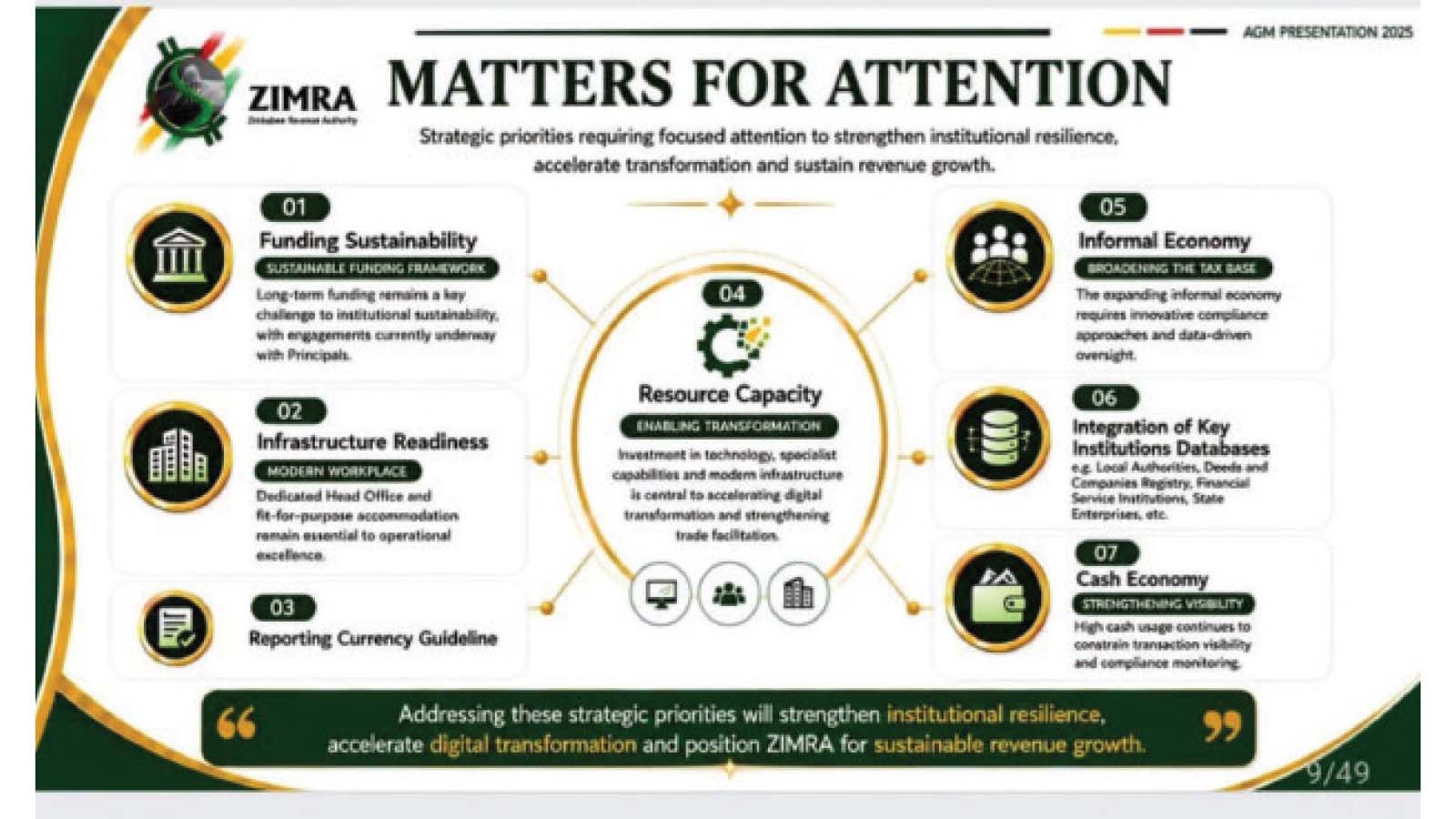
ZIMRA board chairperson Mr Antony Mandiwanza said the cash economy was a strategic priority requiring “focused attention to strengthen institutional resilience, accelerate transformation and sustain revenue growth”.
“High cash usage continues to constrain transaction visibility and compliance monitoring,” said Mr Mandiwanza.
The acknowledgment from the tax authority, which collects over 95 percent of Government revenue, signals deepening concern over the pervasive use of cash transactions as a vehicle for tax evasion and economic informality.
ZIMRA commissioner-general Ms Regina Chinamasa reported that 2025 witnessed the highest single-year growth in the 2021-2025 strategy cycle, with revenue collections growing by 67,8 percent from US$3,09 billion in 2021.
In 2025, ZIMRA collected US$7,65 billion, a 23,8 percent jump from US$6,18 billion in 2024.
Yet these impressive figures obscure a fundamental vulnerability.
Ms Chinamasa revealed that 73 percent of the 2025 collections came from just four tax heads: Value-Added Tax (VAT), Pay As You Earn, Excise Duty and Corporate Income Tax.
“Our revenue base remains concentrated in these four major heads, while continued broadening of the tax base remains important for sustainable domestic resource mobilisation,” she stated.
This concentration exposes the Government to significant fiscal risk as economic shocks affecting formal employment or consumer spending could have an outsized impact on national revenue.
Mr Mandiwanza sounded an urgent note on the informal sector, stating that the “expanding informal economy requires innovative compliance approaches and data-driven oversight”.
This acknowledgment confirms that ZIMRA views the informal sector not as a static challenge, but as a growing one that demands new strategies beyond traditional enforcement mechanisms.
The cash economy operates as the lifeblood of this expanding informal sector, enabling economic activity to occur outside the formal banking system and, by extension, outside the tax net.
ZIMRA’s placement of the cash economy alongside the informal economy as matters requiring attention indicates that the two challenges are inextricably linked.
Cash transactions facilitate the under-reporting of income, the under-declaration of sales and the avoidance of VAT obligations, all of which undermine the authority’s efforts to broaden the tax base.
The dominance of cash in Zimbabwe’s informal sector reflects a dual economic system in which a significant portion of economic activity occurs outside the formal banking and tax systems.
This duality creates an uneven playing field where formal sector participants bear a disproportionate tax burden while cash-based operators contribute significantly less, creating perverse incentives that reward informality and penalise formalisation.
Economic analyst Mr Kuda Mugova offers a sharp critique, arguing that the cash economy is not merely a compliance failure, but a rational response to policy choices.
“ZIMRA is right to worry about the cash economy, but this should not be framed only as tax evasion,” Mr Mugova said.
“It is also a rational response to the incentives in the economy. A prolonged 2 percent transaction tax makes digital payments and bank transfers costly, so formality itself becomes expensive.
“When every swipe, transfer or mobile transaction is taxed, cash naturally becomes cheaper, faster and more attractive.”
Mr Mugova points to Zimbabwe’s high dollarisation as a compounding factor, with over 70 percent of transactions reportedly being made in United States dollars (USD).
“In a dollarised economy, people prefer hard cash because it preserves value, gives pricing flexibility. But the price is heavy: Money moves outside banks and formal payment systems, weakening audit trails, deposit mobilisation, credit creation and domestic resource mobilisation.”
Mr Mugova explained that the cash economy has both push and pull factors.
“People are pushed into cash by transaction taxes, bank charges and low trust,” he said.
“They are pulled into cash by liquidity, control and USD value preservation.
“ZIMRA can improve enforcement, but Treasury must also fix the incentives. If formal transactions remain costly and confidence remains weak, informality will continue to look rational.”
Mr Mandiwanza highlighted ZIMRA’s significant investments in digital infrastructure, saying they are a direct response to the challenges posed by the cash economy.
He noted that technology-enabled revenue administration had made the revenue authority “more agile, efficient and future-ready”.
He further stated that AI (artificial intelligence) would mark a paradigm shift in identifying non-compliance and simplifying compliance.
“The Tax and Revenue Management System has delivered measurable results, with return filing compliance improving from 51,85 percent to 70, 56 percent.
“Automated VAT systems have yielded dividends, with 81 percent VAT taxpayer compliance overall and 99 percent among large clients.”
Stakeholder feedback pointed to “improved digital access and easier border processes”, indicating that digitalisation is seen by taxpayers as a key tool for reducing reliance on cash.
But Mr Mugova’s analysis suggests that digitalisation alone cannot overcome the incentive structures that make cash attractive.
The authority’s investment in AI and data-driven oversight addresses the supply side of tax administration, but the demand side — the willingness of economic actors to participate in the formal system — depends on factors beyond ZIMRA’s control.
Despite advances made, Mr Mandiwanza identified critical constraints.
He noted that “long-term funding remains a key challenge to institutional sustainability”, while a “dedicated head office and fit-for-purpose accommodation remain essential to operational excellence”.
These challenges come at a time when the authority is called upon to do more with less.
The proposed collaboration between ZIMRA and local authorities to track businesses that are “formal to city councils but informal to ZIMRA” represents one example of how data integration can identify cash-based operators.
The persistence of the cash economy reflects broader structural issues that cannot be solved by the revenue authority alone.
The cost of compliance, regulatory complexity and lack of access to formal financial services all contribute to cash preference.
Addressing these root causes requires a whole-of-Government approach that makes formalisation attractive, digitalisation accessible and compliance easy.
Mr Mugova’s analysis points towards specific reforms, including a review of transaction taxes to reduce the cost of formal financial participation, strengthening of financial sector trust and creation of incentives for formalisation.
Concentration of revenue in four tax heads, expansion of the informal economy and persistence of the cash economy all point to structural challenges that will not be resolved by ZIMRA alone.
Mr Mugova’s analysis offers a sobering reminder: “If formal transactions remain costly and confidence remains weak, informality will continue to look rational.
“The future of Zimbabwe’s economy depends on whether the broader policy environment can keep pace with ZIMRA’s modernisation agenda, creating a fiscal ecosystem where formalisation is not merely enforced but actively chosen.
“Without addressing the push and pull factors that drive cash preference, ZIMRA’s efforts to curb the cash economy will continue to face significant headwinds.”
Financial analyst Mr Wafa Kuchera said the cash economy has to be recognised as a survival response by ordinary citizens, arising from the country’s hyperinflationary episodes that left a huge trust deficit.
“To start addressing the underlying causes leading to the preference for cash, there is need to drastically reduce charges in the formal sector of the economy, especially in the financial services sector,” he said.
“Reduction of costs and more explicit guarantees on the value of deposits held by banks should be key focus areas. Current efforts continue to fall short in giving ordinary citizens the confidence to rely on the formal sector.
“That hesitation to use formal banking systems leaves both the ordinary citizens and ZIMRA vulnerable in similar ways, as cash has very little traceability and recourse. As ZIMRA turns its focus onto the cash economy, we urge them to be mindful of those who are still in survival mode and try to separate them from those who are wilfully evading taxes.”