admin
admin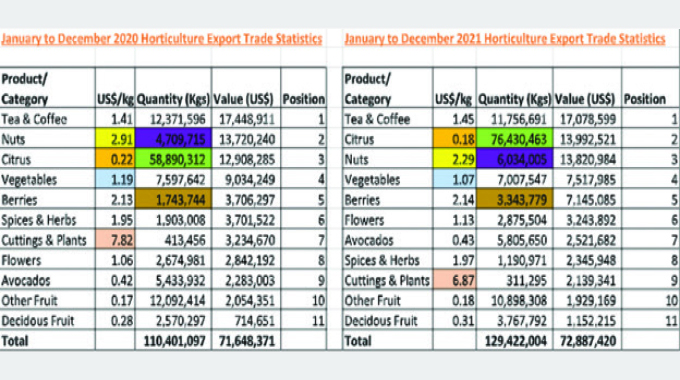
Edgar Vhera–Correspondent
GOVERNMENT’S various incentives to the horticulture sector have begun to pay off with the sector recording a 17 percent export growth in volumes in 2021 compared to 2020, giving impetus to the country’s march towards an upper-middle-class income society by 2030.
The introduction of various incentives such as duty-free importation of agricultural equipment, anchor farmer incentive, Value Added Tax (VAT) zero-rating of farming inputs and Foreign Currency Account (FCA) retention on incremental export receipts among others by Government has seen both production and export volumes grow.
The adoption of the National Development Strategy 1 (NDS1) has also helped address land tenure systems for horticulture, curb side marketing, enhance the ease of doing business, develop a distinctive competitive brand, boosted exports of value-added horticulture products, expand the production of blueberries, raspberries and macadamia nuts and joint ventures.
Additionally, the Government has also developed the Horticulture Recovery and Growth Plan (HRGP) to give impetus to horticulture growth by guiding and supporting the revival of the conventional horticulture industry as well as stimulating a transformative rural horticulture sub-sector.
The Horticultural Development Council (HDC), a non-profit membership-driven organisation was subsequently established to bring an interface between horticulture stakeholders and the Government with the ultimate aim of improving horticultural business efficiency and competitiveness in Zimbabwe.
The re-classification and categorisation of Zimbabwe’s exports depict that total horticulture exports grew by 17 and 2 percent in volume and value terms respectively in 2021 as compared to 2020.
The volume of horticulture exports rose from 110 million kgs achieved in 2020 to 129 million kgs in 2021 representing a 17 percent growth. On the other hand, realised horticulture earnings obtained a 2 percent rise from US$72 million in 2020 to US$ 73 million in 2021.
In volume terms, 17 percent is about half the horticulture growth rate of 30 percent achieved annually in the 1980s/90s period.
The HDC at the inaugural horticulture investment conference of 2021 set a horticulture export growth rate of 30 percent annually.
In value terms, the 2 percent increase is a meagre figure far from the hoped-for 30 percent horticulture annual growth if the country is to achieve a US$1 billion horticulture industry by 2030.
Tea and coffee maintained their pole position as the largest foreign currency contributor within the horticulture sub-sector for both 2020 and 2021 period with earnings of over US$17 million in each year. Citrus swapped positions with nuts to get the second spot in 2021 with the nut settling on the third. Vegetables and berries maintained their fourth and fifth slots in both 2020 and 2021.
Other fruits and the deciduous fruit category remain unchanged on the 10th and last spot under both years.
Berries exhibited the greatest bullish move by increasing export volume from 1, 7 million kg in 2020 to 3, 3 million kg in 2021 a whopping 92 percent.
On the earnings side, berries export receipts rose from US$3, 7 million in 2020 to US$7, 1 million in 2021, a giant 93 percent leap.
The average price of nuts dropped by 21 percent from US$2, 91 in 2020 to US$2, 29 in 2021, which resulted in the nuts being displaced from second to third spot.
The average price of citrus fell from US$0, 22 per kg in 2020 to US$0, 18 per kg in 2021.
However, increased export volumes from 59 million kgs to 76 million kgs ensured that citrus claimed the second spot in 2021.
Vegetables shed some cents with the price falling by 10 percent from US$1, 19 per kg to US$1, 07 per kg. Cuttings and plantings also traded in the red with prices falling by 12 percent from US$7, 82 per kg to US$6, 87 per kg.
Though citrus had the largest chunk of horticulture exports by volume at 59 percent, with tea and coffee at 9 percent, it only accounted for 19 percent of total horticulture earnings against tea and coffee that had 23 percent.
Nuts that only achieved 5 percent of horticulture export shipments by mass realised 19 percent in terms of earnings for 2021.
The tea and coffee sub-group exhibited the smallest variability of change while the berries sub-group displayed the widest positive changeability for both quantity and value.
Within the citrus sub-group, oranges (fresh or dried) accounted for 87 percent of the volume exported and 72 percent of the earnings realised with the average price of US$0, 15 per kg against the citrus sub-groups average of US$0, 18 per kg.
The quest for value addition of agricultural raw materials comes to the fore when one takes a close look at the case of citrus sub-group.
If the country exports raw oranges, without further processing an average price of US$0, 15 per kg can be realised.
Processing into frozen orange juice results in a 269 percent increase in price to US$0,56 per kg.
Further processing to a Brix value greater than 20 enhances the price upward to US$0, 62 per kg.
In addition to higher foreign currency export earnings, value addition has the added benefit of employment creation.
Citrus is a low-value, bulky raw agriculture product that is shipped to export destinations at low prices averaging US$0,18 per kg unlike cuttings and plants with average prices around US$7 per kg and airlifted to export destinations.



 Online Reporter