Online Reporter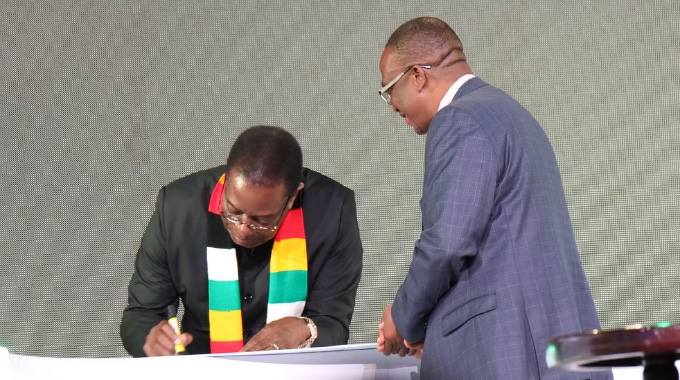
Stanford Chiwanga, [email protected]
WHEN President Mnangagwa praised Highlanders for their unbeaten run back in August 2023, we really should have known. The signs were right there, clear as the black and white stripes on a Bosso jersey. When he stood before thousands in Bulawayo and said, “. . . Highlanders . . . are doing very well this season with 17 games unbeaten in the league. Amhlophe Highlanders iBosso yiBosso. Congratulations Bosso,” he wasn’t just congratulating a football club — he was tilting the national compass towards a new footballing future.
Three years down the line, it is obvious those words were not merely political seasoning. They were a prophecy. They were the gentle footsteps of a football revolution that has since stepped boldly into the open. What once looked like a simple nod to Highlanders’ impressive form has matured into the clearest signal that investment, ambition and transformation were coming — and coming with force. In the wake of that rally, football in Zimbabwe stopped crawling and started striding; the terraces rediscovered their voice, and the boardrooms finally woke up to the realisation that the national game could become a national project.
You can read the country’s recent football history as a sequence of doors opening. Some are new, swinging wide with the certainty of eager debutants; others are old, returning to their hinges after years of neglect. Scottland arrived with that fresh first day of school energy. MWOS decided to join the conversation. Simba Bhora, disciplined and focused, quietly gathered momentum. Hardrock has entered with the grit suggested by its name. Each arrival felt like a new stanza in a poem we had forgotten to recite. These are not just football clubs; they are proof that belief has finally moved from rhetoric to reality.
At Highlanders, the shift has both a face and a wallet. Wicknell Chivayo has stepped in as chief benefactor, becoming part financier, part lightning rod and part declaration of intent. Money is flowing. Debts have been cleared. Buses have been bought. Salaries have stabilised. The impact goes far beyond the balance sheet; it has reshaped the club’s mood entirely, nudging Bosso out of survival mode and back into a position that feels genuinely forward looking.
The wider ecosystem around the giants has changed too. Sakunda’s sponsorship era had already shown what corporate muscle could achieve for the traditional heavyweights, injecting Dynamos and Highlanders with several million dollars’ worth of structure, kits, salaries and ambition across a multi season package. The partnership restored stability and pride to the clubs’ day to day operations — the kind of lift that shows in how a team travels, how it trains and how boldly it dreams. Even as contracts shifted and expired, the lesson held firm: serious investment could switch the lights back on in Zimbabwean football — and keep them on.
If the Bulawayo rally was the whisper, the shout arrived in Harare on March 4, 2026. There, in a packed auditorium charged with anticipation, President Mnangagwa unveiled the US$25 million Zifa Munhumutapa Challenge Cup — a tournament backed by US$5 million a year over five years. The announcement didn’t just land; it detonated, a financial and symbolic jolt that redrew the landscape of the domestic game. Its design was radical: more than a thousand teams across men’s and women’s football, lower leagues, Area Zones, five a side and beach soccer, collapsing the long-standing divide between centre and periphery. This was football reimagined not as a simple league table but as a nationwide ecosystem.
On the podium, administrators spoke with a renewed zeal: of inclusion, youth development, women’s football and sound governance. The message was multi-layered but unmistakable — a fragmented game would finally be stitched into a single, accountable structure. The numbers impressed, but the intent impressed even more. For a nation that treats football as a second religion, the Munhumutapa Cup feels like the long-awaited building fund finally arriving at the church door.
What these investments purchase, above all, is time — time for coaches to work without the constant hum of unpaid salaries, time for directors to plan beyond the next crisis, time for players to focus on their football rather than their rent. Time, too, for supporters to travel with hope. And hope has always been Zimbabwean football’s most abundant resource, even in its leanest years.
You could feel that hope in the air in Bulawayo that day in 2023. The President’s words wrapped the city in familiar comfort, but they also sharpened the sense of a future we had stopped imagining. At the time, it sounded like applause. In hindsight, it reads like a thesis.
And so, the Second Republic’s relationship with football becomes easier to describe using the language of the game itself. The Bulawayo rally was the first touch — controlled, deliberate and full of meaning. The surge of club investment was the run — bold, direct, and brimming with momentum. The Munhumutapa Challenge Cup was the finish — emphatic, definitive, the kind of strike you can still hear rattling off the crossbar. None of this guarantees football growth. But it does guarantee that the conversation has changed, that the game we love has shifted from a vocabulary of scarcity to one of scale.
In the end, football is not mere statistics. It is the father and son standing on the Soweto End at Barbourfields, the 15-year-old boy humming along to radio commentary, the vendor selling freezits on a hot Sunday and counting goals like blessings. It is the unteachable chemistry between a people and their team. The Second Republic did not invent that chemistry — it simply chose to nourish it. And since that day in Bulawayo, the nourishment has not stopped.
So yes, when President Mnangagwa praised Highlanders for their unbeaten run, we should have known investment in local football was set to take a new turn. We should have heard the knock. Three years later, the door is wide open, the house is lively again, and Zimbabwean football has stepped into the light with its shoulders back and its name firmly written in the national ledger of priorities. The prophecy became policy; the applause became architecture; the dream, at last, became funded.