

 admin
admin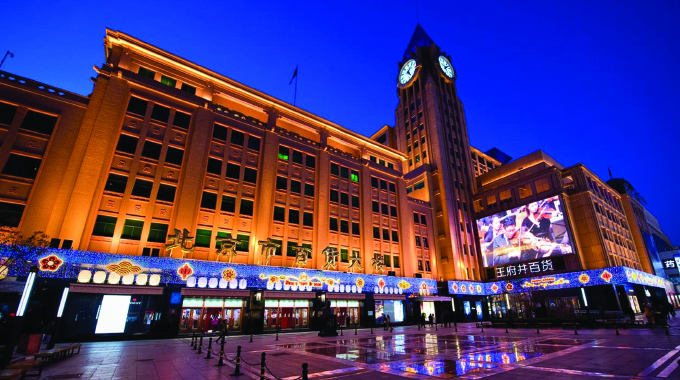
Ms G
Five days before China’s National Day in 1955, Wangfujing Street in Beijing gripped the nation’s attention with the opening of a new shop — Wangfujing Department Store. This is the first store of its kind opened in the capital city and the first department store built with government funds since the founding of the Peoples Republic of China in 1949. It was famed as the “No.1 department store of new China”.
At 10am on the day of its debut, eager customers thronged through its nine doors. By the time of its closing, two large baskets of random shoes lost by customers were said to have been found. Up until the 1980s, the store remained a fantasy world to many, both shoppers and the staff members.
It was the days of serious shortages in China. In 1955, the year the store opened, China started using coupons for daily necessities such as food items, yarn, bedsheets, and shoes.
There was always public excitement when Wangfujing Department Store received supplies. If someone wishes to buy a TV set, he or she would have to start queuing for a coupon the night before. Some counters at the store had iron fences to keep from being overrun by customers. For the salespersons manning the counters, the job was nothing short of sacred. They worked with full devotion and diligence.
One of them actually made his name as the one of the nine must-see sights in Beijing, with the other being the likes of the Great Wall and Xiangshan Mountain.
He was Zhang Binggui, a candy salesman. Having to deal with winding lines of customers everyday, Zhang kept polishing his skills in order to serve as many as possible.
After years of practice, he was able to pick up with bare hands the exact kilos of candy demanded by a customer. His mental calculation was so fast that no sooner had a customer asked for various kinds of candy in different amounts than he gave the total amount to be paid.
While his hands were busy picking up candies for one customer, he was already inquiring another about what he wanted and saying hello to the third. In 1988, a year after Zhang passed away, his bronze bust was erected at the entrance to the department store to honour all those who serve the people with their whole heart. But little did he expect that the store that made him so proud was soon to be eclipsed by new competitors.
Starting from the 1980s, the Chinese economy began to grow by an average of 9,87 percent for 20 years. Coupons were gone. Waiting lines were no more. Everything was in abundant supply. New, bigger and more modern shopping malls were opened across the country.
Wangfujing Department Store, which changed its name into Beijing Department Store in 1968, found itself drifting away from public attention.
Reform was in order.
At first, attempts were made to access foreign investment for expansion and refurbishment. But foreign investors invariably wanted to do an overhaul on the old wing. This was unacceptable to the management. They were adamant that the store should not lose its culture and history.
The store then turned to set up the shareholding system, which brought in 90 million RMB in financing in only one year.
Members of the board and staff and retired employees all subscribed their own shares. In the two months following the creation of a modern corporation, the store broke the record by selling over 100 million RMB of goods, up by 60 percent and 70 percent from the previous year.
Riding on the momentum, the store continued to grow in two directions, modern and vintage. As it hosts more leading global luxury brands, it has also reconstructed a small part of Bejing’s old town on one of its underground floors, where shoppers get to reminisce about the days half a century ago in the old hutongs (narrow city streets formed by traditional courtyard residences), grocery stores and butcher shops.
This place has become a great attraction for the residents of the capital city and those visiting from around the country. Today, the department store remains an iconic place for consumers looking for quality products and visitors hoping to have a special cultural experience.
The story of Beijing Department Store is one of hard work, reform, and loyalty to one’s own identity. The same can be said for the rest of China in the past decades. I guess for stores and nations alike, the secrets to sustained progress are not that different.
Work hard, reform your way forward and never forget who you are.



 Online Reporter