


 Chronicle Editor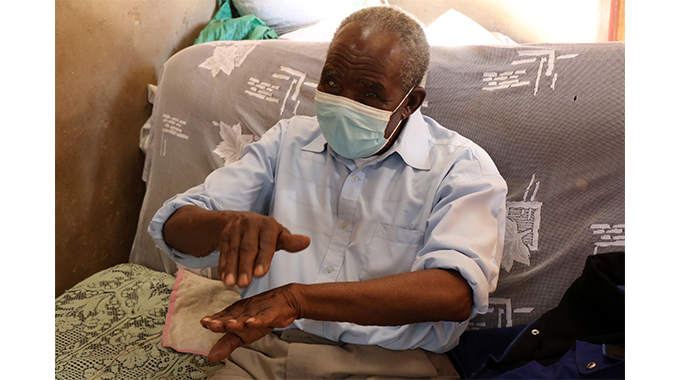
THE fight for Zimbabwe’s Independence attained in 1980 had many players, some of them non-combatants who also played a crucial role in the success of the liberation struggle.
Non-combatants cooked for the guerillas, provided intelligence while some sourced food and clothing for the combatants at camps in Zambia, Mozambique, Tanzania and Botswana. One of the people who played that role during the armed struggle is Cde Stephen Topani who is commonly known by his family name of Siphuma. Cde Topani, turning 93 on 2 October this year has since retreated to the rural Gwanda District in his home province of Matabeleland South.
He lost his eyesight six years ago and on Thursday he had a conversation with our Assistant Editor Mkhululi Sibanda (MS) at his homestead near Makwe Business Centre where he spoke about how he started his political activities in Gwanda Town, a then small urban settlement with revered nationalists such as the late Samuel Munodawafa and Sikhwili Khohli Moyo. Cde Topani, a musician of note in his hey days also spoke about his band used music as a political organising tool to mobilise the masses against the colonial regime.
He speaks of how proceeds from music shows they held were channeled towards the political activities of nationalists involved with parties such as the Rhodesian African Congress and National Democratic Party (NDP). Cde Topani later moved to Zambia where he continued playing a crucial role in sourcing logistics for the combatants in camps. Below are excerpts of the interview. Read on . . .
MS: Khulu may we start by you giving us your background. Where and when were your born?
Cde Topani: I was born on 2 October 1928 and the second name on my National Identity card is Topani. I come from the Siphuma family, which is of Sotho origin while mother was a Venda. I was born and grew up at the Siphuma Farm near Todds, an area after West Nicholson along the Bulawayo-Beitbridge Road.
I started my schooling at the local Mabheka School named after a local white farmer, Baker, who was a neighbour to our farm. I then moved to Matter School koMike for Standard One after Mabheka was closed. From Matter I went to Kwakwe near Gwanda Town for Standard Two and Three. I then continued my education through correspondence with the Union College of South Africa up to Standard Five.
I could not continue up to Standard Six as I was then married and had a child. By that time, I had got a job as an office boy at Horn Mine owned by Samuel Wyle. However, he travelled to Scotland his home country where he died. I then worked koBen Lewis who owned Mt Cazalet Hotel. I worked in the bottle store section where I used the opportunity to get a driver’s licence. That was in the 1940s.
MS: Then when did you become involved in politics?
Cde Topani: It was while I was still in Gwanda that I started getting involved in political activities but in a subtle way, we were not open about it. That was the time I met Samuel Monodawafa who was later on to become the National Chairman of Zapu and we were to work together in Zambia during the armed struggle. When I met Monodawafa he was working at Gwanda Hospital. Others I met during that time were now National Hero, Sikhwili Khohli Moyo, Munyuki and others. I can’t remember Munyuki’s first name though, but these are the people I worked with. As for our political activities we hid under what we called tribal dancing where we formed dance groups, which we used as platform to meet.
During that time, we were demanding that we have voting rights as black people because only the whites were allowed to vote. So, what we used to do was that we will organise dancing sessions where dances and songs from different tribes would be on offer. There were Ndebele dances such as ingquzu and so on while from the Shona side we were treated to Jerusalema and mbakumba. We also had Venda dances as well, in fact the dances were from across the tribes, there was no discrimination along tribal lines during those days. We enjoyed our diversity. There was also the tsabatsaba dance.
It was during that time that I learnt how to play the guitar. We were to become members of the African National Congress. During our time in Gwanda we attended meetings addressed by big political figures such as Joshua Nkomo and Simon Muzenda. I was to leave Gwanda and relocate to Bulawayo and it was during the period of the Federation of Rhodesia and Nyasaland. The Federation was between 1953 and 1963. In Bulawayo I worked at the Main Post Office where I was a post-man and then driver. It was during that time when I became fully involved in politics while I was staying in Mpopoma where I had acquired a house. We were then made to sign forms that if caught involved in politics we would be arrested and thrown into prison.
MS: That time you were now very active politically.
Cde Topani: Yes, I was also doing a lot of fundraising for our political cause through music as proceeds got from the shows would be channelled to the political parties to finance their activities. By then I was a member of the Rhodesian African National Congress, National Democratic Party (NDP) when it was formed.
MS: You talk of using music to fight the colonial system, did you have a band?
Cde Topani: When I got to Bulawayo, I joined a band called the Block Birds which belonged to one John Randall. I was to form my own band called the Golden Rhythm Crooners and among members of the band was the well-known Sinametsi and one Banda. My band should not be confused with the Cool Crooners. It was his band that went on an overdrive to hold shows and organise shows and in Bulawayo the venue was usually the Stanley Hall in Makokoba which also hosted a lot of political activities.
We did not restrict our shows to Bulawayo as we also moved around mines holding the shows. We went as far as places like Wankie (Hwange) and Gwelo (Gweru). I had sold my cattle to buy instruments for the band and a car as well which was used to transport members of the band.
To be continued next week


 leeroy
 Online Reporter