Chronicle Editor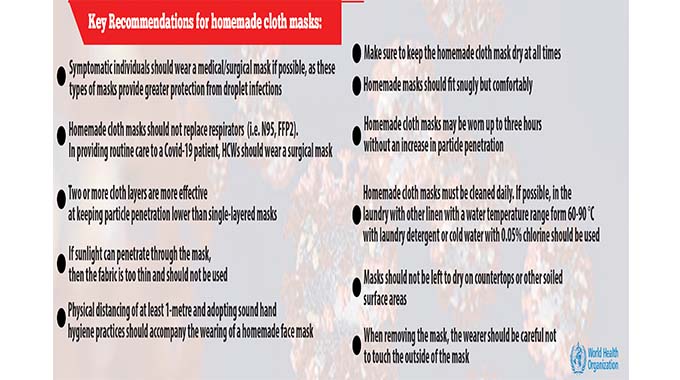
Thandeka Moyo-Ndlovu, Health Reporter
IF your face mask does not have more than one layer of fabric it may expose you to Covid-19 infection, according to World Health Organisation (WHO) guidelines on home made masks.
Also, anyone who wears a single mask for more than three hours increases chances of infection.
Unlike medical masks which are produced for hospitals, handmade masks yield higher infection rates caused by droplets and airborne micro-organisms.
Studies have shown that multi layered masks offer more protection and single layer cloths masks are riskier.
Cloth masks, become magnets for the virus when they get wet, even due to vapour from breathing in and out.
WHO points out that homemade masks become less effective if they are not used in conjunction with other Covid-19 prevention measures like social distancing and hygiene.
Masks, the organisation advises, should be washed using hot water in a basin with laundry detergent and if hot water is not available, cold water with 0.05 percent chlorine should be used.
They should be soaked for 30 minutes and then be rinsed with water and laundry detergent.
Low resource countries will have to rely on the handmade cloth masks to contain Covid-19 which has so far infected 292 people in Zimbabwe and killed four.
Globally, more than 7 million have been infected and deaths top 400 000.
Local manufacturers and tailors have ventured into mask making after Government made it mandatory for everyone to wear a mask in public spaces.
A majority use just any cloth in single layers.
Police have been arresting people spotted without face masks after the law was enacted, effective May 4.
WHO says cloth masks should not replace respirators and should never be used by healthcare workers in health institutions.
“Homemade cloth masks may offer marginal protection from droplet and airborne infections from asymptomatic persons by reducing the number of respiratory droplets from them to others,” read the statement from WHO.
“Homemade cloth masks can be assembled from many different materials readily available within the community. Yet, preliminary data shows that masks made up of two or more cloth layers are more effective at keeping particle penetration lower than single-layered masks.”
The guidelines also recommended that in providing routine care to a Covid-19 patient, health care workers should wear surgical masks.
“Make sure to keep the homemade cloth mask dry at all times. Even moisture from exhaling could potentially make the fabric more prone to transmitting infection,” said WHO.
“Homemade cloth masks may be worn up to three hours without an increase in particle penetration and they must be cleaned daily.”
WHO also emphasised the need for physical distancing of at least 1-metre and adopting sound hand hygiene practices in addition to wearing masks.
Chronicle caught up with some local producers who said they were not aware of the revised WHO guidelines on home-made masks.
Mrs Nomvelo Ncube who makes masks in Mpopoma suburb said any mask was effective as long as it covers the nose and mouth.
“I’ve been selling single layer cotton masks without a problem and I believe what is necessary is to have the essentials covered,” she said.
She was shocked to learn that her masks were not recommended.
Ms Sandra Kaliyati, who owns Kaliyatikouture Clothing Line, said she was not aware of the guidelines but has been making double layer pleated masks because she knows their advantages from a clothing designer’s point of view.
“I have been making masks way before the President made it mandatory to wear one after they were becoming a fashion statement. I chose to use cotton fabric in my layers as I know it provides the perfect ventilation so that my customers can breathe easily when putting them on,” said Ms Kaliyati.
She said it was, however, worrying to see people wearing dirty masks which was a sign that they are not being properly cleaned.
“I would like to remind members of the public that these masks are useful and that we should never share them as it increases our risk to infection.”
Another supplier Mrs Sisa Nkala-Maposa said she had opted to make masks for children as they seemed to be missing out in the whole drive to fight Covid-19.
“Our Lilwonderland range specialises in kids’ events like parties. Since our industry was hit hard hence, we had to find income generating projects. No one was paying particular attention to the kids and we decided to educate our followers on how to make kids adjust to the new normal and introduced the kids to face masks,” said Mrs Nkala- Maphosa.
Ms Loveness Khumalo from Dees Apparel Designs said she had followed specifications from the Centre for Disease Control in making her masks.
“When wearing of face masks became mandatory in the country to curb the spread of Covid-19, I saw an opportunity to create revenue. I started by sewing masks for voluntary purposes, which helped me market my product and get customers,” said Ms Khumalo.
“I use Polycotton and lining that are sewn together and have an elastic attached to them or Velcro as elastic may cause pain on the ears.”
Contacted for comment, Dr Solwayo Ngwenya said masks should be worn all the time when going out as per the lockdown regulations.
“They should cover the mouth and nose always and social distancing measures should continue as people feel safe with masks and get too close to one another. Members of the public should also avoid touching their masks unnecessarily as it can be a source of infection. They must wash hands with soap and alcohol-based solutions before touching anything or even after removing the mask,” said Dr Ngwenya. @thamamoe



 Online Reporter