Prosper Ndlovu recently in MOSCOW, Russia
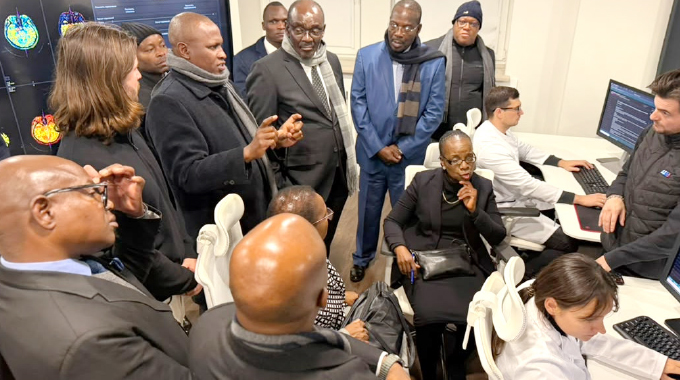
THE tour of a humming, high-tech manufacturing factory in St Petersburg and the medical imaging centre in Moscow last week by Vice President Cde Kembo Mohadi did more than showcase Russian technology.
It confirmed Zimbabwe’s readiness to move from signing agreements to implementing them, offering a tangible lifeline for improved access to medical care to all Zimbabweans.
From pharmaceutical manufacturing lines to centralised radiology hubs where a doctor in the capital diagnoses a patient thousands of kilometres away, Zimbabwe has seen its health future.
This is economic diplomacy in action, exactly as President Mnangagwa has demanded of all Zimbabwe’s embassies.
The working visit by VP Mohadi, accompanied by Deputy Minister of Health and Child Care, Sleiman Kwidini, Ambassador of Zimbabwe to Russia Mark Grey Marongwe, and technical experts from the Ministry of Health, comes hot on the heels of President Mnangagwa’s strategic engagement at the recent Russia-Africa Summit, where he made it clear that Zimbabwe seeks partnerships that deliver tangible transformation, not mere political solidarity.
The health sector has emerged as the new frontier of that solidarity. For years, Zimbabwe and Russia have enjoyed excellent political relations, rooted in liberation history. What the VP Mohadi mission has done is translate that political capital into social and economic capital.
Zimbabwe is already modernising its health system through an ambitious telemedicine rollout aimed at connecting remote clinics to central hospitals. What the delegation saw in Moscow is a working model at scale.
Russia’s unified radiology network links dozens of medical facilities, allows images taken in remote regions to be read instantly by specialists in Moscow and uses Artificial Intelligence to prioritise urgent cases.
It is a model that directly speaks to Zimbabwe’s challenges – specialist shortages in rural areas, long distances to referral hospitals and the need to cut diagnostic delays.
VP Mohadi, who led the delegation through both the pharmaceutical plant in St Petersburg and the imaging centre in Moscow, said the visit was about practical learning and localising modern systems for sustainable impact.
He reiterated that Zimbabwe and Russia were not just political friends, but partners who want to learn from each other and implement tangible deals. Russia is one of the leaders in global technology development and that shows it is possible to have world-class healthcare technology serving even the most remote citizen. In particular, Zimbabwe is focused on domesticating production of critical drugs, embracing Russian technology, decentralising key health services and trimming medical tourism costs.
That is exactly what President Mnangagwa wants for Zimbabwe under Vision 2030 where health cooperation must deliver results for the ordinary Zimbabweans such as the already-running
Helidrive Air Ambulance model, which was implemented through Russia support and has cut critical patient transfer delays but 90 percent, according to Cde Kwidini.
This means health collaboration with Russia is not about paperwork but about ensuring that a mother in Binga, Murambinda or Ndolwane in Bulilima can get a scan read by a specialist in
Harare, or Bulawayo, and that hospitals have affordable medicines made through joint ventures.
The focus on implementation resonates with President Mnangagwa’s recent directive to all diplomats — that embassies must be economic hubs with set targets for investment, trade and technology transfer, not just ceremonial outposts.
Reflecting on this earlier, Ambassador Marongwe, whose mission has been instrumental in organising the high-level technical tours, said the embassy is now operating on a new mandate.
He explained how the Second Republic has changed the way diplomacy is done with a focus now on the economy and delivering tangible development results. During the recent Russia-Africa Summit
President Mnangagwa emphasized that Africa does not want handouts, but partnerships that build capacity and industrialise economies. The health sector fits perfectly into that broader vision.
As such, a joint venture in pharmaceutical manufacturing with Russia would cut Zimbabwe’s huge drug import bill, save foreign currency, create skilled jobs and make Zimbabwe a pharmaceutical hub for the region — directly feeding into Vision 2030’s goal of an upper-middle-income economy anchored on value addition and import substitution.
Deputy Minister Kwidini, who was part of the technical leg of the delegation, said what they have observed is directly applicable to Zimbabwe’s ongoing health reforms.
He explained that although Zimbabwe has started telemedicine on a lower scale by connecting a number of clinics with hospitals, the Russian visit has shown how to scale this up with a centralised command centre, with AI-supported diagnosis and with full integration of imaging. This will drastically reduce referrals and allow Zimbabwe to manage patients from where they are, said
Deputy Minister Kwidini who also separately met Russia’s Health Minister, Mikhail Albertovich Murashko.
“The most thing, which was discussed was knowledge exchange. We don’t want the situation as a country to keep on buying, buying without having us producing locally,” said Kwidini.
“We have agreed that in those areas where they are good we can send our own people to come and learn as a knowledge transfer.”
On equipment, he said Russia has donated mobile laboratory equipment to support diagnostic services pending construction of local facilities.
Talks also covered prospects for Russian firms to manufacture in Zimbabwe, regulatory alignment with the Medicines Control Authority of Zimbabwe and direct procurement linkages with Government now prioritising areas for implementation.
Kwidini said the lessons will inform procurement and training with positive impacts across the whole healthcare ecosystem – the software, the training of radiographers, the maintenance system and the data protection. The ultimate aim is that when fully implemented, such strides will be a big boost to achieving Universal Health Coverage, which is central to Vision 2030, said Deputy Minister Kwidini.
Technical staffers in the delegation, who included De Agness Mahomva, Public Health Advisor to the President and Cabinet, echoed the same sentiment, noting that Zimbabwe’s strong base of qualified health professionals makes technology absorption easier.
They noted that the Russian system is impressive as it solves the exact problem Zimbabwe faces — how to give a rural district hospital the diagnostic power of a quaternary hospital.
With Zimbabwe accelerating fibre rollout and the digitalisation agenda under the Ministry of ICT, the country has the foundation to replicate this.
What makes the Zim-Russia health collaboration crucial is that it provides a template for broader economic diplomacy.
Hence President Mnangagwa’s Vision 2030 is not just about GDP growth; it is about quality of life, human capital development and sovereignty in critical sectors like health. Covid-19 taught Zimbabwe and all of Africa the cost of over-reliance on imported medicines and diagnostics.
By anchoring health cooperation with a global technology power like Russia, Zimbabwe is investing in health security, which is economic security. VP Mohadi mission, therefore, is not an isolated trip.
It is a follow-through mechanism. Whereas President Mnangagwa went to the Russia-Africa Summit to set the strategic direction, the Vice President operationalises it with technical ministries, and the Embassy led by Amb Marongwe becomes the permanent implementation secretariat.
If this model is sustained — from labs in Moscow and Zimbabwe to clinics in Tsholotsho, Gwanda and Mudzi, from drug plants in St Petersburg working with local firms to shelves in Mpilo and
Parirenyatwa —then Zimbabwe will have proven that economic diplomacy is not a slogan, but a delivery system.
As for the villager who will soon get an X-ray in his district and have it read instantly by a specialist hundreds of kilometres away, the friendship between Harare and Moscow will no longer be history in textbooks. It will be life-saving technology in his hands.