

 admin
admin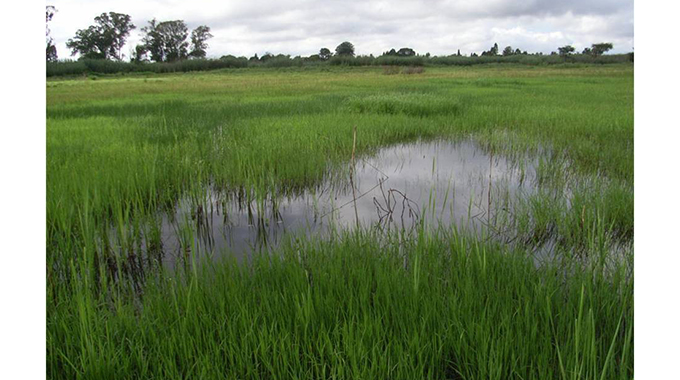
Sam Matema-Herald Correspondent
THAT climate change impact cuts across many sectors, is a fact and physical planning, with respect to settlements, is no exception.
Population growth means new settlements in both rural and urban settings.
The rate of urbanisation and rural industrialisation is growing faster than the capacity of local authorities and municipalities to keep pace with that growth to the extent that land barons and corrupt council officials appropriate themselves the role of town planners outside the normal channels.
This has seen mushrooming of unregulated settlements risking the excesses of climate change.
Invasion of wetlands and rangelands is rampant in both rural and urban settlements.
We have made errors of both commission and omission in responding to the population growth and human settlements, and in the process upsetting the Ecosystem Services (ES), worsening human vulnerability, and we have unwittingly become threat multipliers.
The Ramsar Convention
The mission of the Ramsar Convention is “conservation and wise use of all wetlands through local and national actions and international cooperation, as a contribution towards achieving sustainable development throughout the world”.
Zimbabwe is a signatory to the Ramsar Convention and we are obligated to work within the prescriptions of the convention with respect to the preservation and protection of wetlands. Zimbabwe has been a part to the Ramsar Convention on Wetlands beginning May of 2013. The 2006 Environmental Management Act and the Environmental Assessment and Ecosystem Protection Regulations of 2007 are clear in terms of their provisions and prescriptions with respect to wetlands protection, and they show the commitment of the Government to make good their obligations.
It is the enforcement of the same, where we are found wanting.
Local and national actions to conservation of wetlands towards sustainable development speaks to the need for all of us to be responsible stewards so that we bequeath to posterity a healthy environment. We should take care of the environment, especially wetlands with the regulating and provisioning services in mind.
Ecosystem services
These are the direct or indirect natural capitals that are provided to facilitate for a quality human well-being.
There are three major services that ecosystems provide, that is the regulating service, provisioning service and supporting services.
Climate change impacts all the three ecosystem services. With respect to the regulating service, wetlands act as a sponge and buffer, they take up excess water and retain it.
They are, in most cases, sources of rivers and it therefore means that human settlements in those areas should be avoided at all costs, so that there is no interference with their natural state and the ability to self-regulate and self-correct via the natural feedback loops.
Ecosystem services with respect to provisioning, speak to providing food services to all creatures as it relates to forest services.
Forests in their natural state provide food services and they self-regulate and provide a balanced ecosystem.
In light of the foregoing, land clearing and human settlements must be done in a way that does not upset the capacity of the natural environment to sustainably support in terms of forest services.
Degraded environments do not have the capacity to deliver on all the three dimensions of the ecosystem services, and therefore settlements in both urban and rural areas should be properly planned from a physical planning standpoint.
Sea rise, flooding and sinking cities
Because of rising temperatures in sympathy to the increase in greenhouse gas emissions, the melting of glaciers is taking place at an alarming rate.
This is why the sea waters are rising at levels that are unprecedented. It is because of that reason and development that we have disappearing cities and nations across the globe. Cities are sinking in the rising sea waters. New Orleans, Shanghai, Guangzhou, Solomon Islands and Tuvalu, are some of the cities and countries that are fast disappearing in the rising sea waters.
When Cyclone Idai hit Manicaland, it became apparent that some areas were at high risk on account of how far they were from areas susceptible to rock falls, landslide, potential river bank bursts and flooding.
Settlement planning
Planning of settlements should be done in such a way that it is sensitive to the ecosystem services and how they are affected by climate change shocks.
It should reflect the geomorphological and fluvial considerations of specific and targeted areas.
We need to adapt in an anticipatory manner and fashion with respect to spatial planning and the physical structures themselves.
Physical planners should not interfere with our wetlands, river banks and to some extent our forests in a haphazard manner. Any form of development must be preceded by an Environmental Impact Assessment (EIA) report, and therefore its findings and recommendations.
The same applies with our traditional leaders in the rural areas.
Flooding that is now a perennial problem in parts of Chitungwiza, parts of new Belvedere and Budiriro in Harare, precisely because some houses were built on wetlands.
Land degradation is a negative trend in land condition, caused by direct or indirect human-induced processes, including anthropogenic climate change, expressed as long-term reduction or loss of biological productivity, ecological integrity or value to humans with respect to forest and non-forest land and services.
Reduction of biological productivity or ecological integrity or value to humans can constitute degradation (Olsson et al, 2019).
Errors of commission and omission
Authorities such as the Environmental Management Agency (EMA), traditional leaders and Rural District councils and municipalities through their physical planning department must call everyone to order when there are transgressions.
However, it is these people charged with bringing order to human activities and settlements who have aided and abated the transgressions by not enforcing that which is provided for by the statutes, for example the Environmental Management Act of 2006. By not acting and enforcing, they become part of the problem.
Carbon sinks have deteriorated and continue to deteriorate at alarming rates, with respect to depletion of vegetation cover and serious siltation of water bodies due to anthropogenic activities in the watershed and catchment areas.
We have not exhibited discipline in carrying out our developmental activities as provided for and prescribed by the statutes and the conventions that we are signatories to.
That we must correct, and the correction should happen yesterday, as we transition to sustainable cities in a green economy, society and green environment hinged on green justice and environmental democracy.
Sustainable cities and settlements
In view of the sinking and disappearing cities like New Orleans in the US, Shanghai in China and indeed in view of the persistent flooding in parts of Budiriro and Chitungwiza in Harare, it is pertinent that our physical planners show sensitivity to the threats posed by climate change and its shocks.
The physical structures that physical planners should allow going into the future, should reflect the threats posed by climate change in terms of design reflecting the threats from flooding and pollution as an example. Do we continue to build low lying houses in areas susceptible to flooding or we go up?
Responsible stewards
Climate change is discriminatory in terms of impact because it affects the vulnerable groups more.
It punishes less those contributing more to greenhouse gas emissions while punishing more the developing nations that are contributing less to the destruction of the ozone layer.
We need to be responsible stewards of the God-given natural resources as charged right from the genesis of mankind, “The Lord God took the man and put him in the Garden of Eden to work it and take care of it” (Genesis 2:15).
We are charged not of working the land only, but taking good care of it as good stewards. This we must do so responsibly holding it in trust for future generations in a reformist, adaptive, sustainable and transformative manner.
The risk, if we do not act responsibly, of an environmental overshoot are real and upon us.
We need to act decisively so that we conquer climate change, otherwise it will conquer humankind.
The Speaker of the Parliament of Zimbabwe, Honourable Jacob Mudenda, could not have captured it any better in his remarks at COP28 as captured in the IPU COP28 report, “Climate change must not conquer humanity, Humanity must conquer climate change decisively”.
And the United Nations Framework Convention on Climate Change (UNFCCC) Head of Legal Division, Madam Christine Adam characterised, at COP28, climate change as an existential threat to humankind.
History will judge us as responsible stewards on account of how we interface with the environment with respect to how we plan our human settlements, alive to the threats posed by climate change shocks and impacts.
Sam Matema is the MP for Buhera Central Constituency and writes here in his personal capacity.


 Peter Tanyanyiwa
 Online Reporter