Online Reporter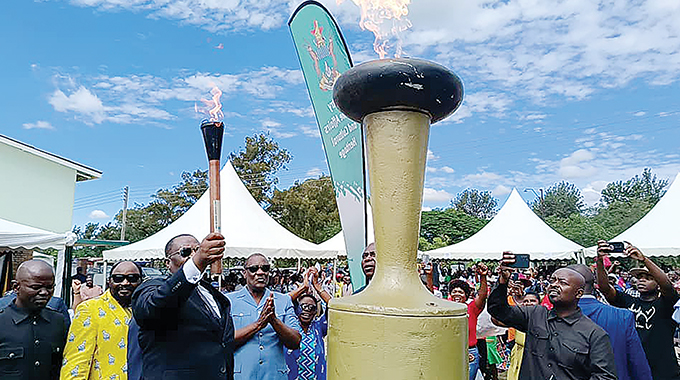
Patrick Chitumba, [email protected]
VICE-PRESIDENT Constantino Chiwenga yesterday officially lit and handed over the Independence Flame to the Midlands Province, marking a significant milestone in the build-up to the 45th national Independence Day celebrations.
The symbolic ceremony took place at the historic Mtapa Hall in Gweru’s Mtapa suburb, drawing hundreds of people.
The Independence Flame will now tour districts across the province — including Mberengwa, Zvishavane, Shurugwi, Kwekwe and Gokwe — before arriving at Nembudziya Open Grounds for the main celebrations on April 18.
This year’s commemorations are being held under the theme: “Zim@45: Devolve and Develop Together Towards Vision 2030.”
VP Chiwenga was accompanied by senior Government officials, among them Minister of Home Affairs and Cultural Heritage Kazembe Kazembe, Minister of Sports and Recreation Anselem Sanyatwe, Minister of Veterans of the Liberation Struggle Monica Mavunga and Midlands Provincial Affairs and Devolution Minister Owen Ncube.

In his keynote address, VP Chiwenga described the Independence Flame as a lasting symbol of Zimbabwe’s struggle, sacrifice, triumph and national spirit.
“We gather at this significant site — Mtapa Hall — the venue of the inaugural Zimbabwe African National Union (Zanu) Congress held from May 21 to 23, 1964,” he said.
“But let us not forget that the party had been formed earlier on 8 August 1963 in Highfields, at the home of the late Cde Enos Nkala, following the split from Zapu.”
VP Chiwenga emphasised that the formation of Zanu, followed by the later unification with Zapu under the Unity Accord of December 22, 1987, was instrumental in the country’s path toward independence.
“It is only in unity that we uphold the idealism of a unitary state — one that embraces all people from the north, south, east, and west as one nation,” he said.
VP Chiwenga described the 1964 Zanu Congress as a pivotal moment in Zimbabwe’s history, the turning point where the decision to take up arms against colonial rule was made under the banner: “We are our own liberators through the barrel of the gun.”
The Congress elected key founding leaders of the liberation movement, including Cde Ndabaningi Sithole (President), Cde Leopold Takawira (Vice-President), Cde Robert Mugabe (Secretary), Cde Herbert Chitepo (National Chairman), Cde Enos Nkala (Treasurer), Cde Michael Mahwema (Organising Secretary) and Cde Edson Zvobgo (Deputy Secretary General), among others.
VP Chiwenga said these comrades played crucial roles in the liberation struggle. “Today’s ceremony provides a rare opportunity to reflect on the significance of that Congress. We recall and celebrate the contributions of those who came before us, both the living and those resting in marked and unmarked graves in Zimbabwe and neighbouring countries, their sacrifices towards our liberation,” he said.
VP Chiwenga noted that among the delegates at the 1964 Congress was President Mnangagwa, then a young nationalist recently trained in China. Another one was Cde Shadreck Chipanga, a former CIO Director-General, who had been released from Wha Wha Prison after being detained for civil disobedience and acts of sabotage.
“They later escaped for training in Ghana after Zanu was banned in September 1964,” he said.
The Vice President said the Congress helped shape the collective vision of the liberation movement, rekindling national resolve and a desire for self-determination.
“Change chiri chitsidzo chekudeurwa kwe ropa kuti nyika isununguke (It was a commitment to launch the armed struggle towards national independence),” he said, highlighting the depth of commitment required for independence.
VP Chiwenga stressed that the 1964 Congress also laid the foundation for alliances with other African nationalist movements and international organisations, a vital step in gaining support for the liberation war.
“More importantly, it marked a turning point in Zanu’s relationship with colonial authorities, as the leadership adopted more radical and confrontational tactics,” he said.
“It was here, at Mtapa Hall, that the commitment to armed struggle gained prominence. It defined Zanu’s ideology and objectives, centred on achieving freedom and social justice for the people of Zimbabwe.”
“Lest we forget that Zanu and Zapu, now Zanu-PF, and only Zanu-PF liberated Zimbabwe. Let no one ever attempt to vulgarise and rewrite that history which no person or any party for that matter can ever take away.”
VP Chiwenga said as the nation prepares to celebrate 45 years of independence, it is vital to look back at the 1964 Congress, which demonstrated unity and solidarity among Zimbabwe’s nationalists, paving the way for a co-ordinated effort against colonial rule.
This Congress, he noted, established connections with other African nationalist movements and international organisations, crucial for securing the support needed for Zimbabwe’s liberation struggle.
“More importantly, the 1964 Congress marked a turning point in Zanu’s relationship with colonial authorities, as the party’s leadership began to adopt more radical and confrontational tactics. It was here, at Mtapa Hall, that the commitment to armed struggle gained prominence,” said VP Chiwenga.
“I am pleased to note that an exhibition has been mounted in this hall to honour the iconic participants of the 1964 Congress whose personal sacrifices and lasting legacies we shall continue to cherish as a nation.”
VP Chiwenga said the decision to take up arms against the oppressive regime was not taken lightly, as it was a response to the persistent denial of basic rights and the overwhelming injustices faced by the Zimbabwean populace.
“As we celebrate Independence Day, let us remember the bravery of our freedom fighters, the wisdom of our leaders, and the sacrifices of our people. We must continue to honour their memory by working towards a brighter future for all Zimbabweans,” he said.
“As we move forward, let us draw inspiration from our history and heritage, striving to build a nation that is just, equitable, and prosperous for all,” he said.
VP Chiwenga said the Independence Flame represents the spirit and undying hope which guided the struggle for freedom.
The Flame, he added, symbolises the resilience and determination of the Zimbabwean people, including their resolve to win and defend their sovereignty by all means necessary.
“As we celebrate 45 years of Independence, we acknowledge our progress as a people, and challenges that remain. It embodies the promise that, despite the challenges we face, our commitment to upholding the ideals of our liberation will never waver,” said VP Chiwenga.
The Independence Flame also represents the spirit of unity, hope, and determination that has fuelled our journey as a nation. This flame serves as a guiding light, illuminating our path forward and reminding us of the values we cherish: freedom, dignity and respect for our sovereignty,” he said.
VP Chiwenga urged Zimbabweans to recommit to the values and principles that defined the liberation struggle.
“Let us strive to build a brighter future for ourselves, our children, and generations to come. May the Independence Flame burn brighter in our hearts and throughout our great nation,” he said.