admin
admin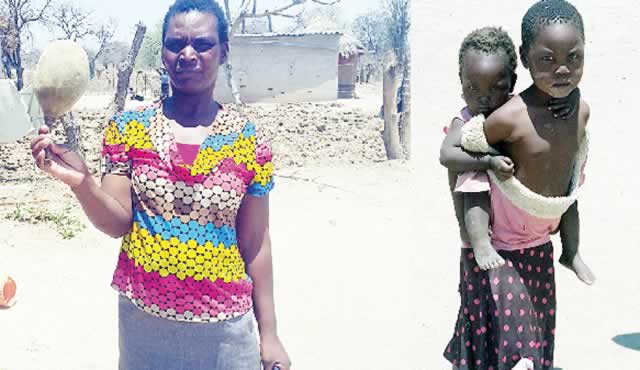

Patrick Chitumba Midlands Bureau Chief
DROUGHT has conspired with the global fall of cotton prices to “steal” the childhood of most children in Gokwe North and South.
The children have been turned into “food gatherers” as they spend time searching and collecting wild fruits.
Their mothers are now “married widows” after most men in some parts of Gokwe South district deserted their families due to the biting effects of drought.
Lifestyles have taken a plunge with most households struggling to provide a single decent meal per day for their children.
Hunger is stalking the villagers.
Nowhere in the two Gokwes are the harsh effects of drought felt as in Takavata Village under Chief Nemangwe’s area.
Six-year-old Tinotenda Matemavi’s day kicks-off with a trip to a forest 10km away in search of wild fruits.
While most children of her age in towns are in school pursuing grade one lessons, the poor kid is mastering the art of helping provide for the family.
She has to strap her two-year old sibling on her back for the 10km fruit-search trip at times.
The wild fruits are the two minors’ main meal as well as that of three other siblings and their mother.
Tinotenda has vague memories of the day her father decided to abandon them at the beginning of the year after a failed cotton crop.
The five Matemavi siblings have not known a proper meal since then. Their mother, Mirirai, says the children’s health is deteriorating due to starvation.
When The Chronicle arrived at the Matemavi homestead, Tinotenda and her little sister had just returned from gathering Baobab fruits. Their mother was coming from Chief Nemangwe’s homestead where she had gone to ask for food for the family.
“I’m coming from the chief’s homestead where I had gone to look for food. We’re starving. My children are hungry. They’re now used to eating one meal a day. In the morning they eat baobab fruit and later in the afternoon, towards evening, I cook sadza for them to take them to the next day,” said Mirirai.
The poor woman is not alone in begging for grain from the chief.
On a daily basis, scores of villagers make a bee-line for Chief Nemangwe’s homestead to ask for food.
Said Mirirai: “One has to visit the chief’s place in the morning to beat the queue. There are so many villagers who throng the chief’s home for food. We’ve no other option, hence our going there in numbers.”
Nemangwe village – about 40km out of Gokwe Town along the Gokwe- Chitekete road – is widely known as a cotton growing area.
Most villagers are abandoning growing cotton following the tumbling of the white gold prices on the world market.
Some diverted to tobacco while others are growing cash crops like maize.
However, for the past three seasons, villagers in this area have failed to harvest anything due to successive droughts.
Women are suffering in Nemangwe village as they struggle to feed their families while child labour has taken centre stage.
Older children are leaving school for either gold panning, vending or taking up menial jobs to enable them to provide for their younger siblings.
Mirirai says the villagers’ only hope was for the government to intervene with food aid.
They are also praying to God that He opens up the heavens so that they have a fruitful cropping season.
“Our hopes are that we receive above normal rains so that we have food and pastures for our livestock,” said Mirirai.
The Matemavi family is one of many families under Chief Nemangwe that have been abandoned by their fathers.
Most men are abandoning their families on the pretext of looking for work.
“They never return after leaving to search for work in towns. Sadly, most children are now destitute and the children wear tattered clothes as the mothers are failing to take care of them in the absence of the fathers.
“Most of the children walk barefooted and are dropping of school,” said Mirirai.
Mirirai is Shona for waiting but it appears more like the Nemangwe women are waiting for the rain: they don’t know when their husbands will return, or if ever they will.
Tinotenda’s 14-year-old sister, Nyasha, is a Form 1 drop out despite passing last year’s grade seven examinations with 11 units.
Mirirai can hardly afford to buy food for the children let alone pay their school fees.
Her son, 11-year- old Patson, is also out of school.
The children’s elder brother, George, who is an adult, also deserted the family in March just like his father.
George is said to be in Shurugwi panning for gold but has not communicated with his family ever since.
Mirirai’s kitchen hut had no food in it save for about three medium sized platefuls of mealie-meal.
She said the father of her children, Alfred, abandoned them after a failed cotton crop.
Mirirai said her husband has not communicated with her ever since he left.
“I need a man, this homestead needs a man. The huts are cracking; the fields haven’t been attended to in preparation for the coming cropping season. The children are no longer going to school. As for Nyasha, there is nothing left for her except to get married. What can she do now after failing to proceed to Form One?” said Mirirai, tears rolling down her cheeks.
Another hunger-stricken family abandoned by their father is the Paradzai family. There are three children and their lonely mother.
The quartet, just like the Matemavi family, is living in abject poverty.
They no longer have livestock or even chicken at their homestead. The animals were either taken by creditors or sold by the family to raise money for food.
Chief Nemangwe told of how his people were starving.
He said the villagers were turning to him for food assistance but he could not manage to feed all of them.
The traditional leader said Zunde Ramambo/Isiphala Senkosi had failed to produce anything because of recurrent droughts.
“Everyday I’ve villagers at my homestead coming to ask for food. We’ve orphans, widows and some women who’ve been abandoned by their husbands. At times I give them if I’ve something,” said Chief Nemangwe.
He called on the government to swiftly move in with food aid to avert starvation in his area.
The chief said while the government had availed about 544 tonnes of maize to five constituencies including his area in the last month, the maize had not yet cascaded down to villagers.
“We were made to write down the list of villagers in need of food aid. The list is there but the food is still to come. So we’re waiting patiently hoping that no one is going to starve. The situation is quite pathetic I tell you,” said Chief Nemangwe.
He said children were finding it difficult to walk the long distances to school on empty stomachs forcing most of them to drop out.
“A lot of children are dropping out of school because of hunger. Some are eating only one meal. It becomes difficult to concentrate in school under such conditions,” said the chief.
Midlands Minister of State for Provincial Affairs, Cde Jason Machaya, said he was setting up a team to investigate the delays in delivering grain to villagers.
He revealed that the government had delivered 544 tonnes of maize to Gokwe South GMB depot.
Cde Machaya said there was urgent need for the food situation to be addressed as a matter of urgency.
“We’ve a list of people who need food aid in Gokwe South. The government is aware of the situation and has already sent 3,000 tonnes for the vulnerable group as of October. We know that a lot of villagers want food aid and more maize will be sent there,” he said.
Cde Machaya said maize would also be made available to villagers in Mberengwa, Zvishavane, Kwekwe as well as Shurugwi. He described the situation in all the rural districts of the province as dire and expressed concern over the failure of children to attend school.
Cde Machaya said it was government policy that children who fail to pay fees remain in school and are not chased away.
In that light, he said, parents should strive to make sure that their children are in school always.
Cde Machaya implored families to value education as it was key to breaking the poverty chain.
“Basic Education Assistance Module (Beam). The programme is in arrears but new pupils are being considered. The government has categorically stated that no child should be chased away from school, therefore we urge parents in Gokwe South to send their children to school so that they’ve a better future,” he said.
Cde Machaya promised to divert some of the maize to schools so that it can be used to prepare meals for the children.



 Online Reporter