Chronicle Editor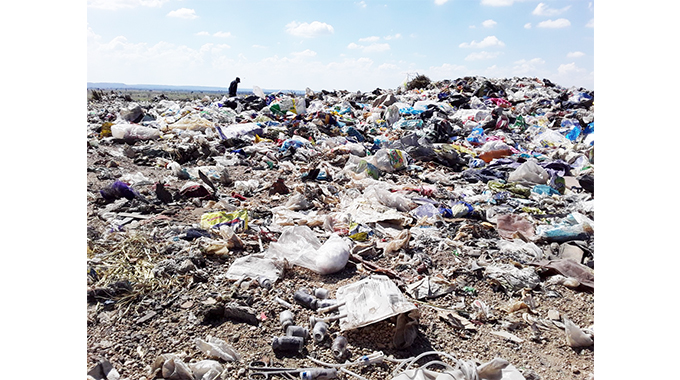
Judith Phiri, Business Reporter
THE Hwange Local Board (HLB) has carried out a Solid Waste Characterisation study, with the assistance of the Environmental Management Agency (EMA), as part of its efforts to eradicate rampant solid waste dumping in line with the national and regional standards.
The study which will feed into the Country’s Waste Management Plan also encourages the local authority to embrace waste management and various service delivery initiatives.
In an interview, HLB acting Town Secretary, Mr Paulos Mabhureni said solid waste management has become a major concern both to the natural environment and society virtually in all suburbs.
“As a local authority we are mandated to provide community and social services and refuse (waste) collection is one such service. Recently with the assistance of the EMA we carried out a Solid Waste Characterisation study, which will feed into the Country’s Waste Management Plan,” said Mr Mabhureni.
He said three years back they also conducted a Waste Characterisation, Quantification and Management study to ascertain the type and amount of waste generated in their area of jurisdiction, while the study was used to formulate an Integrated Solid Waste Management (ISWM) plan.
Mr Mabhureni said the study informed them that an individual in their area of jurisdiction generated 0.23 grammes of waste a day, while everyone had a right to a clean environment as enshrined in the Environmental Management Act, the Public Health Act and in the Constitution of Zimbabwe, there were cases where some residents tended to violate others’ rights through dumping litter at undesignated areas.
“We have been encouraging residents to embrace the reducing, reusing and recycling concept through our Housing, Health and Community Services’ Department, as well as through various other mediums of communication, which include social media platforms. Not all waste should be discarded, so as to reduce the amount needed to be sent to landfills, as well as allowing products to be used to their fullest extent.
“However, one challenge we have is that there are no recycling companies within our area of jurisdiction and as such the amount of plastic litter generated is always accumulating. There are a few individuals that move around picking cans for reuse or for sale in Bulawayo,” he said.
He said their collection efficiency has not been as they would have liked it to be, thus it was very difficult for them to measure precisely the residents’ participation in solid waste management at the moment.
Mr Mabhureni said they appreciated that as a council they were supposed to collect refuse, but there was a need for residents as well to also embrace integrated solid waste management through practicing the concept of reducing, reusing and recycling waste.
He said modern trends demanded the sustainable management of solid waste through waste minimisation, material recovery, full collection and sanitary disposal of waste.
Zimbabwe generates an estimated 1,65 million tonnes of waste annually and 90 percent of the waste is either reusable, recyclable or biodegradable, meaning only 10 percent of waste generated in the country is destined for landfilling.
The National Development Strategy 1 (NDS1) highlights issues of pollution and waste management as key emerging issues that need immediate attention for the country to attain Vision 2030.


 Online Reporter