Online Reporter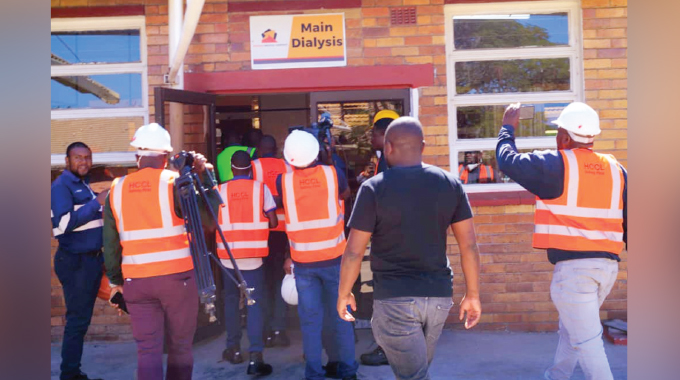
Rutendo Nyeve recently in Hwange
HWANGE Colliery Hospital is undergoing a major transformation into a state-of-the-art specialist medical facility equipped with advanced technology and expanded services, in a development set to redefine healthcare delivery in Matabeleland North Province while complementing Government efforts to improve access to quality health services across the country.
The US$500 000 upgrade, spearheaded by Hwange Colliery Company Limited (HCCL), includes four newly installed dialysis machines, advanced ambulances and other critical equipment. It forms part of the mining company’s restructuring programme under the newly established Hwange Medical Company, a subsidiary of HCCL, aimed at closing longstanding gaps in specialised healthcare for chronic and life-threatening conditions
This development comes as the Government is also constructing the Lupane Provincial Hospital, a flagship healthcare project that will serve as the main referral centre for the province. Together, the two facilities are expected to considerably reduce the need for residents to travel to Bulawayo or Harare for specialist treatment.
During a recent media tour led by the Minister of Information, Publicity and Broadcasting Services, Dr Jenfan Muswere, journalists toured the upgraded Hwange facility, which is on track to become a centre of excellence in oncology, dialysis, ophthalmology and other specialist services.

HCCL Administrator Mr Munashe Shava said their vision is to bring top-level medical expertise closer to communities.
“What we are building is a separation of business units at Hwange Colliery Company Limited. We now have a medical company, which we are developing into a centre of excellence, including an oncology centre,” he said.
“We are well advanced in this endeavor, with great partners from India. Our ultimate goal is to ensure that specialists come to Hwange to perform procedures here, rather than patients having to travel all the way to India.”
The dialysis unit, a critical addition to the hospital, is already operational with four machines and can expand to 12.
“Before this unit was established, patients had to travel as far as Bulawayo and Harare for dialysis, as there were no facilities nearby. We identified this gap and moved to close it,” said Mr Shava.
Specialist services are also expanding to include monthly ophthalmology clinics and other key areas, providing convenient access to care for the population of Matabeleland North.
“We have specialist units for eyes and arrangements with major specialists who conduct monthly clinics in Hwange.
This means the population of Matabeleland North no longer needs to travel to Bulawayo or Harare for specialist care; they can access it here,” said Mr Shava.
He said the growing range of services at the hospital is already attracting patients from across Matabeleland North.
“This is probably one of the nicest hospitals, very clean and professional. Many of the patients we see here are from the surrounding communities, coming to receive quality medical attention,” said Mr Shava.
Dr Muswere commended the HCCL administration for modernising healthcare infrastructure while improving worker welfare. He said such private sector-led initiatives were a practical example of working hand-in-hand with the Government to modernise and decentralise healthcare.
“The administrator has done an extremely good job, supported by teamwork from management, executives and employees. This includes modernising health facilities, ongoing recruitment, and capacitating health institutions while diversifying business units,” he said.
Dr Muswere noted improvements in employee conditions, saying the institution has moved from owing workers millions of dollars pre-2017 to now implementing equitable payment policies.
“The top 20 percent of earnings now go to workers, alongside recapitalisation and health institution upgrades. With more than four dialysis machines and other facilities, HCCL is ensuring the safety and health of its employees while boosting coal production,” said Dr Muswere.
HCCL is now inviting partners to invest in high-impact healthcare ventures such as a regional Oncology Centre of Excellence, retail pharmacies, air ambulance services, affordable radiological diagnostics (PET, CT, MRI scans), telemedicine, pharmaceutical manufacturing, cardiac and haematology care centres, occupational health services and mobile clinics for rural outreach.
These initiatives align with the Government’s broader agenda to improve healthcare access, particularly in underserved areas, while HCCL’s partnership with Indian healthcare providers highlights the potential of international collaboration in strengthening the country’s medical infrastructure.
Zimbabwe has made significant strides in improving the provision of healthcare services to all citizens over the past four years, as enshrined in the National Health Strategy (2021-2025).
The country’s health sector strategic focus is guided by the overall Vision 2030 that seeks to transform Zimbabwe into a middle-income economy by 2030 and the National Development Strategy 1.