Online Reporter
Fairness Moyana, [email protected]
STUDENTS at Hwange College of Education are turning classroom knowledge into practical innovations, harnessing indigenous resources and local culture to develop products that have the potential to reach commercial markets.
The institution’s student-led projects are increasingly focusing on value addition, recycling and product development in line with the heritage-based Education 5.0 model, which emphasises innovation and industrialisation alongside teaching, research and community service.
Among the standout initiatives are tamarind juice, instant porridge, cakes, jam and baobab coffee production. Students are also experimenting with detergent and liquid soap production using locally available resources such as jatropha, while others are venturing into textile manufacturing, producing gowns, work suits and innovative tracksuits.
The institution is also reviving soap production and expanding beadwork ventures that have already attracted buyers at trade fairs.
Principal of Hwange College of Education, Mr Royal Ntini, said the projects are part of efforts to implement the heritage-based curriculum, which encourages institutions to draw from indigenous knowledge systems.
“Our curriculum is anchored on Education 5.0, which introduces innovation and industrialisation as key pillars. Institutions like ours must come up with innovations that can transform the economy,” he said.
“We are therefore tapping into our indigenous knowledge systems and natural resources to produce goods that can eventually be commercialised.”
Mr Ntini said one of the flagship projects involves processing the locally abundant tamarind fruit, popularly known in Tonga as busika, into juice and other products.
“In Binga District, there is a fruit called busika, which can be processed into many products. One of the products we are currently producing is tamarind juice and we are hoping to register the process so that ultimately it can find its way onto supermarket shelves,” he said.
Beyond tamarind products, the college is also producing detergents, liquid soap and bead-crafted handbags that have proven popular with customers.
“We are still at the early stages as a small and relatively new college, but the long-term goal is to commercialise some of these products,” said Mr Ntini.
The institution is also developing learning materials aligned with the heritage-based curriculum, particularly for languages such as Tonga and Nambya, whose textbooks are scarce.
Head of the college’s life skills and entrepreneurship department, Mrs Simiso Gumbo, said the innovations are deliberately designed to draw from the community’s natural resources and cultural heritage.
“We are looking at tamarind, which is locally available and part of our heritage. Our students are using it to produce jam, biscuits, cake ingredients and juice,” she said.
“This helps students realise that their environment is part of their education and that they can benefit from what is locally available rather than relying only on imported or exotic products.”
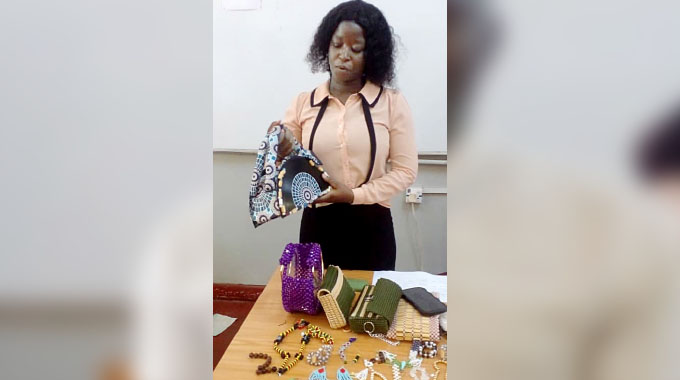
Mrs Gumbo said students are also producing beadwork, including bangles, necklaces and handbags, using locally sourced materials.
“We are also mixing beads with wood from our environment to produce pendants and necklaces. Some students have also come up with innovations such as a solar-powered fan, dartboards made from recycled boxes and textile innovations like all-weather tracksuits and work suits fitted with safety lights,” she said.
For final-year student, Ms Tackler Wamutshilani Ncube, innovation meant redesigning workwear to suit Hwange’s hot climate.
“I realised that the normal work suit does not suit the weather here, so I designed a lighter summer work suit. You wear a T-shirt first and then the suit, which is unique and stylish,” she said.
Ms Ncube also created a winter version and a two-in-one tracksuit that can be converted into shorts using zips, allowing wearers to adapt it to different weather conditions.
Third-year student, Miss Natasha Ndlovu, has taken a sustainability approach by transforming waste materials into fashionable accessories.
“With these bags, we used old discs instead of throwing them away. We also used card boxes and beads to make the designs more attractive,” she said.
Miss Ndlovu added that the project was inspired by cultural traditions where jewellery such as bracelets, earrings and necklaces were historically made from beads.
“We are now collecting materials from our local environment to make earrings, bracelets and necklaces while also recycling waste,” she said.
Another student innovator, Mr Nkatazo Munkuli, has focused on value addition to tamarind by producing jam from fruit sourced from communities in Binga.
“I realised it is important to learn how to prepare products from resources that are locally available. Tamarind is natural, nutritious and helps boost the immune system while also helping with conditions like high blood pressure,” he said.
Mr Munkuli said the project has also strengthened collaboration between the college and the surrounding communities that collect the fruit for processing.
Beyond product development, the college is exploring technological solutions to local challenges.
Mr Ntini revealed that the college has signed a memorandum of understanding with the National University of Science and Technology to develop a technology-driven solution to human-wildlife conflict in the district.
Students are also working on an electric or solar-powered fish-drying oven aimed at replacing coal and firewood drying methods used by fishing communities.
The Government has encouraged institutions to push such innovations towards commercialisation.
“I urge you to align with the commercialisation agenda — shifting prototypes to the market and strengthening the institution’s third income revenue stream,” said the Minister of Higher and Tertiary Education, Innovation, Science and Technology Development, Dr Frederick Shava, during a recent visit to the college.
The college has already introduced bridging courses, textile production lines and beadwork ventures as part of efforts to strengthen its third income streams while empowering students with practical industrial skills.