malvernmugadzikwa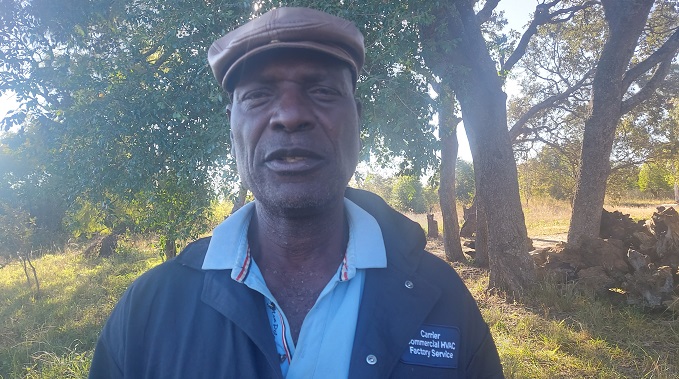
THE fight against white minority rule was not just a political cause for CDE DENIAS MARUFU but it was deeply personal as well. This week, he recounts to our Features and Arts Editor PRINCE MUSHAWEVATO some of the injustices that prompted him to join the war of liberation
****************
Q: You can start by identifying yourself.
A: My name is Denias Marufu. I was born on August 24, 1958, in Dorowa, Buhera. I did my primary education at Holy Family Primary School before going to Daramombe High, a Christian boarding school. I completed my secondary school studies in 1975.
In 1976, while waiting for my results, I travelled to Bulawayo.
I wanted to go for an apprenticeship, so I looked for temporary work at a company called Robin’s Construction. When my results finally came, around March, I applied for enrolment at the Bulawayo Polytechnic. Within a week, I got a response.
I got a card for a call-up.
There was a rule that prevented enrolment in institutions of higher learning without completing a mandatory call-up — essentially military training for the Rhodesian government.
This presented a moral dilemma for me. Attending the college meant potentially serving in the enemy’s army, something I could not reconcile with my beliefs. Resultantly, I made a difficult choice. I informed my nephew about my decision to return to the rural areas.
It was my view that attending college and potentially being called up was helping the enemy fight against the comrades.
I understood the reason several gallant sons and daughters were sacrificing their lives in the struggle; thus, I went back home.
Q: How were you introduced to African nationalism?
A: When I got back home, the struggle came to our doorstep. Freedom fighters addressed us, highlighting the purpose of the struggle and how we could be part of it. After that, I, together with four others, was recruited. It was easy for me to join the struggle because my sister was the first one to cross the border into Mozambique in 1975.
She was then followed by my younger brother the following year.
Also, at school, I used to meet other learners from different parts of the country who talked about comrades and oppression.
I had witnessed oppression first-hand at a mine in Dorowa, which served as a constant reminder of exploitation. My parents were stripped of their land without compensation and their pain fuelled my deep resentment towards the white minority rulers. I was a troubled man.
I hated the white man because I knew he was cruel. There were several other atrocities by the colonial government that led me to join the struggle. Our parents always told us that we were never going to be free unless we dislodged white minority rule.
Personally, I knew that even if I was going to go to work, I would never enjoy anything or succeed in life because of the conditions that marginalised us.
Q: Can you briefly take us through your journey to Mozambique?
A: We travelled from Dorowa to Majengeta before going to Bocha.
From Bocha, we went to Mukuni division and later proceeded to Melsetter (now Chimanimani) via Bhinya Road. From there, we crossed into Mozambique through a place called Rutanda. Along the way, the comrades would periodically tell us to stop while they conducted certain errands.
After covering some distance, we met the camaradas. A tractor was organised to ferry us to Chimoio.
When we got there, we went to a transit camp that was in town.
We spent close to three weeks there before we left, headed for a camp that was in Chimoio. In 1977, we were recruited for training but there was a selection process that took place. We were told that they wanted comrades who would be medics, while others would specialise in education. The selection was done based on academic qualifications.
I was seconded to the education division and trained at Takawira.
There were two groups — medics and education. Life in Mozambique was difficult, but we remained resolute because we knew the motive behind the struggle. Besides, we got good orientation about the revolution, which made us even more determined to liberate the country.
Comrade Josiah Tongogara was among the leaders who addressed us.
Q: You can carry on.
A: After training, following the Chimoio attack, we were transferred to Doroi (Base 5). I stayed there for about six months. I then went to a camp called Budzi in Sofala and stayed there for close to two weeks before moving to Tete, Mafudzi, where I trained as an educationist from 1978 to 1979.
We had an education division because there were children who were dropping out of school and joining the struggle.
We had to teach them while they waited for the appropriate time to join the warfront. We also had injured comrades who wanted to go for training in education, and there was a small college that trained teachers — we had adult and infant education.
However, I had a rough brush with some of our commanders just after training.
Q: What happened?
A: I was so eager to go to the warfront but after training, as I indicated earlier on, I was told to stay in Mozambique under the education department — a decision that did not go down well with me. When I challenged the decision, insisting on being deployed back home, I found myself under scrutiny.
The security department, ever vigilant, suspected my motives, fearing I might be collaborating with the enemy.
The leadership asserted their authority.
I was told that I did not have the right to self-assign.
Because of my academic background, I was seen as the perfect candidate for a training assignment.
Thus, in 1977, after completing training, I was deployed to the rear, which was a non-combat role.
Q: You can continue.
A: Children were trained but they would not be deployed. They became part of the reserve army. While there, they would undergo proper classes in the camps, and we got assistance from the United Nations International Children’s Emergency Fund.
Classes were at times conducted in the bush, under trees. The Rhodesian armed forces often disturbed us as they would periodically bomb our camps. So, we used to wake up as early as 5am, leave camp and go into the thicket for our lessons.
That way, we were safe. We only returned to the camp at night to eat and sleep. It was the same routine every day.
We also did some training so that we stayed fit.
External instructors frequently came through to teach us new tactics for us to stay abreast with developments.
The military school was two-sided.
We did academics, as well as military training.
I only returned to the country after independence.
Q: Do you still remember names of some of the comrades you worked with?
A: During the struggle, I worked with the likes of Cde Huruva, who was our base commander; Cdes Madhadha and Zebra (who was part of the security team). In Mafudzi, I worked with the likes of Cdes Machoto and Che Guevara.
Q: Briefly take us through your journey after independence.
A: After independence, I returned to the country through Nyamapanda.
I was posted to Mutoko and stayed there for some months before opening a comrades’ school in Shamva — Camp Haven. We opened a place called the Chindunduma Youth Academy. There was also a secondary school called Chiruma.
During that time, there was another recruitment that required comrades with Ordinary Level passes.
I was seconded to the Zimbabwe National Army, as they wanted to form a department for adult education.
We were supposed to educate comrades who had joined the army but without proper academic qualifications. I was then posted to the Tongogara Camp in Chipinge. I stayed there for about six months before I was integrated into the Air Force, where I trained from 1980 to 1981, but this had nothing to do with education. I trained as a technician.
We encountered a lot of racism during the time, which led to serious clashes with whites in the force.
A disciplinary board was set up and I and seven others were identified as the troublemakers.
I was then transferred, and we went to the army headquarters and told them about the racism issue.
However, they told us then that there was little they could do because they did not have pilots since the white man dominated the division. That is how I was transferred to the department of army education in 1982. I was posted to Inkomo Barracks.
I started at primary school, before I was reassigned to the department of adult education.
Later on, I was reassigned to the paragroup from 1984 to 1989.
I served in several other divisions in the army until I retired in 1996.
My sister is still alive, but my younger brother died in a helicopter crash after independence during the Matsanga issue in Mozambique.


 Online Reporter