

 Chronicle Editor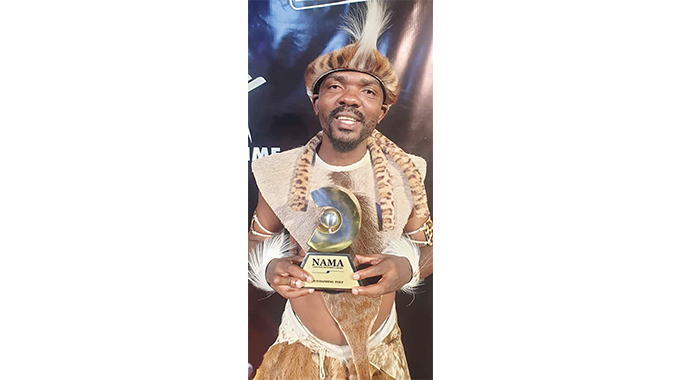
Angela Sibanda, Showbiz Correspondent
RENOWNED poet Obert Dube has added a tenth award to his collection after scooping the Outstanding Poet Award at the National Arts Merit Awards (Nama) held in Harare over the weekend.
Ever since his entry into the poetry industry, Dube, known as the African Poet has built a reputable name and become one of the most sought-after poets in the SADC region where he has been getting invitations to perform.
The recent award becomes his third Nama following another win last year and his first in 2015. The latest award was to honour him for his poetry album “Gadla” which was released last year. It was the first to feature more than 10 poets including Awa Khiwe, Albert Nyathi, Sithandazile Dube and Desire Moyoxide.
In an interview, Dube said the awards he has won are a sign that his history in Zimbabwean poetry will not be erased.
“In any field, it’s wise to create an avenue for rising team players and with my contributions to poetry, both locally and regionally, I think I’ve come close to being called a poetry legend. I, however, still consider myself an amateur because I still want to achieve more,” Dube said while adding that he wants to shift his attention to other awards so as to leave room for up-and-coming artists to participate in the Namas.
He said he is humbled by the latest win as he did not see it coming.
“I feel humbled and I’ve God to thank for everything. For this one, I really had self-doubt. Even the nomination came as a shocker and winning the award was the least of my expectations.
“I’m a prayerful Christian and because I’m not perfect in any way, I feel this is a sign that God is with me, listens to my prayers and answers them the way he sees fit. And for all that, I’m just grateful,” he said.
Apart from focusing on building himself, Dube has been identifying and grooming up-and-coming poets whom he has been assisting to record their first poetry albums.
“I’m one person who doesn’t like sounding the horn for helping people, but I’ve been grooming young poets, especially those who do indigenous poetry. One of the projects that I’m proud of includes an album of a 14-year-old Tonga poet from Binga whom I groomed.”
In trying to assist the youngsters, Dube has been faced with resistance as some recording companies have apparently barred him.
“In trying to help other young poets, I sometimes get blocked by some recording companies that claim ownership of those certain individuals,” he said.
Dube also said it can be challenging to groom up-and-coming poets because some of them believe they have arrived before achieving anything.
“Poetry took time to be recognised as a commercial art because it has always been known to be a traditional practice among Africans. So, for a poet to succeed and gain recognition in this already saturated industry, they have to work extra hard.
“Our young poets don’t understand some of these things and sometimes when you try to correct, advise or guide them, they respond in a rebellious way and see you as competition. I’ve attempted to assist some and the reaction has been negative so I instead focus on helping those that seem to be willing to learn,” he said.
He also emphasised that the use of indigenous languages in poetry is what makes great poets as compared to trying to adopt the English language which does not give enough room for one to express themselves.
“If one is an indigenous poet, it’s very important that they pay attention to their outfit as their presentation is what attracts audiences and clients for bookings. It doesn’t make sense to many for someone to perform an indigenous language poem in a formal suit,” added Dube
However, he said he is looking forward to grooming at least 10 or more indigenous language poets before his retirement from the industry.


 Blessing Chizhande
 Online Reporter