


 Sundaymail Editor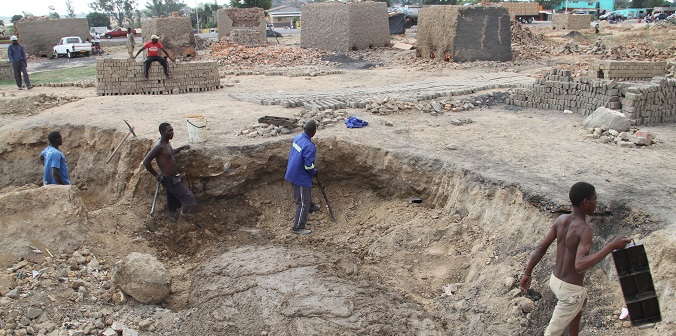
Tendai Chara
A SUDDEN downpour forced a group of illegal brick moulders in Hopley, Harare, to frantically cover their freshly produced bricks.
Using plastic rolls, they hurriedly shielded part of the pile, leaving a significant portion exposed to the rain. The uncovered bricks were ruined.
Throughout Zimbabwe, illegal brick moulders are causing significant problems for the authorities.
“Farm bricks”, banned by most urban councils, are still being illegally used to construct residential and commercial properties.
Mhundwa village, located on the outskirts of Chitungwiza, has a high concentration of illegal farm brick producers. The bricks they make are primarily purchased by Chitungwiza residents.
Nicholas Mhundwa, the local headman, is concerned about the destruction caused by these brick moulders.
“They cut down trees, destroy anthills and damage roads. They are supplying substandard bricks to the residents,” notes Mhundwa.
This occurs despite Chitungwiza’s ban on farm bricks. Brick moulders have also occupied other areas in Harare’s dormitory town, including the banks of Manyame River.
In Harare, farm brick moulders operate in settlements such as Ushewokunze, Southlea Park, Churu Farm and Tanaka.
These bricks are reportedly being used in surrounding areas like Glen View and Glen Norah. Their activities cause extensive land degradation and environmental pollution.
Information gathered from Harare residents reveals that some houses in Southlea Park and neighbouring suburbs were constructed using banned farm bricks.
“Very few houses were built with standard bricks. Even shops and other commercial buildings used farm bricks. Very few people in this area can afford standard bricks,” said Marvelous Mwashata, a Southlea Park resident.
Farm bricks are also produced and widely used in Domboshava, Hatcliffe and Goromonzi. Most of the country’s urban councils have banned these bricks.
Chinhoyi, Hwange and Mutare, among other councils, have prohibited the use of these substandard building materials. Illegal brick moulders have caused massive land degradation in the Hwange Local Board area.
Reports from Hwange indicate that the moulders are exposing themselves to waterborne diseases by using sewage water in their operations.
The City of Mutare has also banned farm bricks for commercial, industrial and residential construction, complying with a directive from the Environmental Management Agency (EMA). However, some residents in these areas defy the order, with a section of council building inspectors being accused of taking bribes to approve the projects.
Environmental degradation
Farm brick production contributes significantly to environmental degradation, including the destruction of anthills and disruption of the soil ecosystem. The excavation of clay soil, the primary material for farm bricks, causes serious land degradation and environmental pollution. EMA banned the use of farm bricks to protect the environment, citing their destructive impact.
Rampant deforestation is another major consequence of brick moulding, as large quantities of firewood are used in the process. Environmental experts identify farm brick production as a key driver of deforestation in Zimbabwe, alongside its damage to soil ecosystems. Mark Chiwanga, an environmentalist, explained: “The production of red farm bricks destroys anthills, which are home to decomposers and a vital part of the natural ecosystem. The bricks are dried using firewood, which is cut down from trees.”
Affordability
The affordability of farm bricks compared to cement bricks and other types remains a major point of contention.
A total of 1 000 farm bricks are sold for approximately US$45, while the same quantity of standard industrial red and prime bricks costs around US$100. In 2021, Chinhoyi residents petitioned the council to postpone the deadline for the farm brick ban. The measure was subsequently delayed until 2023. Residents argued that the ban would drastically increase building costs, citing the accessibility and affordability of farm bricks. They also emphasised that farm brick moulding provides valuable employment opportunities.
EMA spokesperson Amkela Sidange clarified that local authorities are responsible for activities involving the extraction of natural resources.
“Basically, the allocation of such land use and economic functions rests with the planning authorities and they regulate such through their local by-laws. We urge local authorities to ensure that any activities involving the extraction of natural resources are conducted in a regulated manner, minimising environmental harm,” said Sidange.
Allegations of corruption have surfaced, with residents claiming that some errant Harare council officials are illegally approving buildings constructed with farm bricks.
Harare council’s head of corporate communications Stanley Gama requested time to investigate these claims.
“I need time to check with the relevant departments. I will come back to you once I get to the bottom of the matter,” he said.
Zimbabwe has introduced new construction standards that promote the use of cement bricks to enhance the resilience of homes against extreme weather.
These standards and policy recommendations are outlined in the Zimbabwe National Human Settlements Policy, approved in 2020.
The policy encourages a shift away from traditional building methods that rely heavily on timber and soil. Despite the ban on farm brick production and use, the business appears to be thriving.
Alternative building materials
In South Africa, the most common building material used as a substitute for the brick is the concrete block. The blocks are widely adopted due to their affordability and durability, making them a popular choice for low-cost housing construction compared to traditional clay bricks.
Besides bricks, other alternative building materials include concrete, bamboo, rammed earth, hempcrete, straw bales, reclaimed wood, recycled steel, timber, cork, recycled glass, sheep wool, mycelium (fungus-based material), and rigid plant-based polyurethane foam. Precast concrete is also a sustainable building material.
Many of these materials are considered more environmentally friendly than traditional bricks. Examples are bamboo due to its fast growth; hempcrete, given its low environmental impact; and rammed earth, because of its good thermal mass value.
Some alternatives like cork, straw and wood are derived directly from nature, offering a renewable resource. Options like recycled steel and recycled glass contribute to waste reduction by utilising previously used materials in construction. Materials like straw bales and cork can provide good insulation for buildings.



 Online Reporter