Chronicle Editor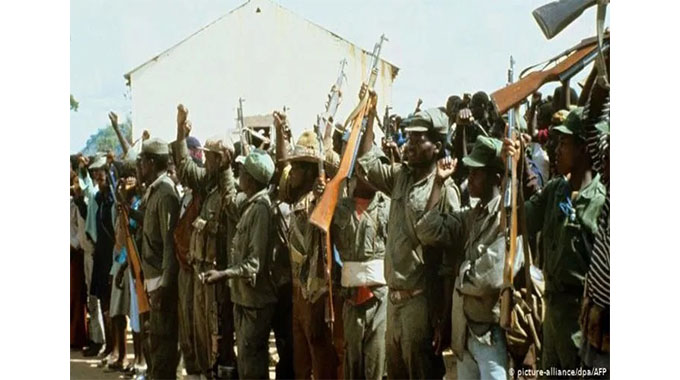
Phatisa Nyathi
AS the curtain comes down on the writings about the liberation struggle, I could not help observing the dearth of information on the nationalist side of the struggle.
In the beginning the struggle was advanced and prosecuted by nationalists through political activism and agitation. They challenged the political status quo.
From the early 1930s when the Native Congress under the leadership of Aaron Jacha was inaugurated through assistance and guidance from TT Jabavu of the African National Congress of South Africa nationalist dominance was palpable.
At that stage the nationalist movement was not truly national. It was at various times led by the likes of Reverend Thompson Samkange, Enoch Dumbutshena and Joshua Nkomo.
The first truly national black political movement was formed on the 12th of September 1957 through the inspiration of Ghana which had attained her independence in the same year.
Joshua Nkomo assumed the presidency of the new political movement. The new party, the Southern Rhodesia African National Congress (SRANC) had not assumed the name Zimbabwe. That came during the days of the National Democratic Party (NDP) which came into existence on 1 January, 1960 following the proscription of the SRANC in February 1959 when the Edgar Whitehead-led government promulgated the Emergency Regulations and the Unlawful Organisations Act.
Even at that stage the struggle was 100 percent political with no recourse to the armed liberation struggle. African colonies began to attain independence. White political opinion radicalised. The emerging political scenario led to the adoption of the armed liberation struggle from 1962 onwards.
As pointed out in earlier articles, training camps then were located in countries such as Egypt, Ghana, Tanzania, China and North Korea.
That marked the emergence of the double pronged approach to the struggle for independence. The nationalists were still wielding political power and leading the civil struggle while the armed struggle was still in its infancy. The nationalists were in charge even then. Within ZAPU the external wing, the Special Affairs Department, was led by James Robert Dambaza Chikerema, ZAPU’s Vice-President.
The bifurcated nature of the struggle began to emerge as the armed struggle received more attention and was perceived as the viable option to remove the Rhodesians from power. That was happening at a time when the nationalists were in detention camps.
That led to the emergence of a rift between the nationalists who directed the struggle through remote control and those who had been assigned roles outside the Rhodesia who included the likes of Chikerema, Jason Ziyapapa Moyo, George Silundika and Edward Ndlovu.
At ideological level the gulf widened as the externals, the guerrillas and a section of nationalists assumed Marxist-Leninist Ideology which the nationalists did not adopt and inculcate. There was physical and political distancing. As the armed struggle accelerated at a time when southern Africa was getting under the grip of the Eastern bloc countries as witnessed through the independence of Mozambique and Angola in 1975 the emerging gulf deepened.
Political strategists and advisors in the Western world, propelled by the cut throat competition between the West and East within the context of the cold war seized the opportunity to accentuate the gulf between the nationalists and the guerrillas.
The release in December 1974 of the nationalists from detention was not out of love for the incarcerated nationalists.
It was part of a political scheme calculated to drive a wedge between the two groups. While that was going on the guerrilla leaders who were perceived as too close to the Soviet Union and China were eliminated. Some guerrilla leaders, notably ZPRA commander Nikita Mangena were scandalised and where some people failed to perceive the grand political scheme believed in political falsehoods that Nikita Mangena was selling out. It was part of the scheme and the politically incredulous fell into the trap.
Our thrust in this article is to highlight the developing gulf between the home-based leaders and the externals. The nationalist leaders flocked out to Zambia when their unfortunate engagement with the Smith regime in 1975 failed to yield positive results.
Dauti Salatiel Mabusa whose biography I penned this year draws attention to the emerging hierarchy of perceived importance. The nationalists were then in two groups, those who had relocated to Zambia and those who remained within the country. They were no longer well coordinated and functioning as a well-oiled electioneering machine.
The internals included the likes of Mabusa, Abel Tabona Siwela, and Sidney Malunga, among others. These had become celebrated jail birds who continued to languish in detention camps and prisons such as Whawha, Marondera and Bulawayo.
In a close down article we shall capture the impressions of one such nationalist, Joseph Bingo Malunga, a brother to Sidney, who was a member of Guta Ra Mwari. He wrote to the congregation from Grey Prison and again when he was at Whawha where he and colleagues were detained.
Mabusa, in his biography, “Dauti Salatiel Mabusa: Enduring Memories of the Struggle for Zimbabwe’s Independence” gives fairly detailed accounts of their stay at Grey Prison, their transportation to Whawha and the conditions in the latter. In fact, he gives a rendition of conditions at many incarceration places such as Khami Prison where he was together with incumbent President Emmerson Mnangagwa, Mishek Velaphi and others, Marondera, and Gwanda Prison where he served two stints for political sedition emanating from his political activities in Gwanda.
While the nationalists who relocated to Zambia were the seniors, their divorce from political events within Rhodesia meant they were not thoroughly au fait with the situation on the ground. They had somehow struck some understanding with the guerrilla leadership returning from Zambia.
Besides, it was now a leadership in whose appointment they had played a role. To some extent, they had asserted their leadership over the guerrilla movement. At the same time, there were guerrillas who had stayed within the country without going back to Zambia. They were instrumental in internal recruitment. However, their divorce from the externals meant they were no longer on par with them. The apparent divisions were apparent.
Be that as it may, what then emerged after independence in terms of documentation of the course of the struggle for independence somewhat sidelined the nationalists. I concentrated on ZPRA’s liberation struggle, so did Professors Terence Ranger, Jocelyn Alexander and JoAnn MacGregor.
Further, the Sunday News, through its Assistant Editor Mkhululi Sibanda, equally gave prominence and space to the ZPRA guerrillas culminating in the publication of the volume, “Lest We Forget.” Retired Brigadier General Abel Mazinyane equally gave some rendition of ZPRA’s role in the struggle. The nationalists have thus not received equal attention when it comes to the documentation of ZAPU’s role in the struggle for independence.
Of the numerous political biographies that I have penned only that of Dauti Salatiel Mabusa captures the part played in the struggle by one who was a nationalist and it thus gives a fresh dimension which had not hitherto received due attention and recognition.



 Online Reporter