admin
admin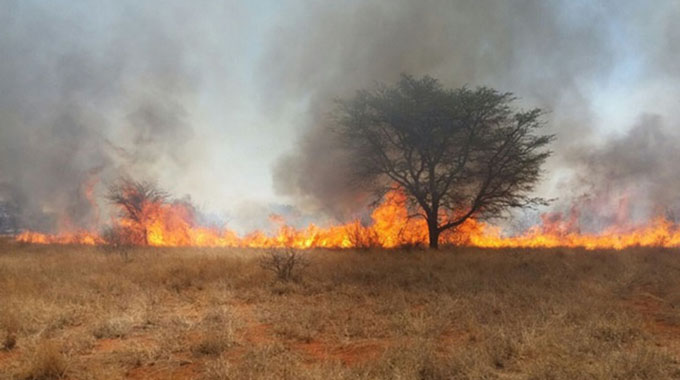
Obert Chifamba
Agric-Insight
IN Greek mythology, a Titan named Prometheus stole fire from his god and master, Zeus, in heaven and brought it to earth. And for over 400 000 years after the incident, humans have been using fire for various purposes.
Suffice it to say the intentions behind Prometheus’ thievery might have been inspired by many reasons — both good and evil — but man has since deployed fire to accomplish various missions for personal gratification.
Fire is naturally known to consume, warm and illuminate, but can easily be a source of pain and death, hence its symbolic meaning varies wildly depending on the context of its use.
Many cultures view fire as a symbolism of wisdom and knowledge.
It, however, seems that once Zimbabwe’s fire season sets in from July 31 every year to the end of October and even slightly beyond, all the good about fire ceases to be, with rampaging veld fires consuming vast expanses of farming land, pastures and even forests.
The clear and present danger this time around is that following the normal to above normal rains received in the 2020/21 rainy season, the latest veld fire risk predictions for 2021 is that an estimated 89 percent of the country is lying in the high to extreme high risk to veld fires, compared to a meagre 34 percent in 2020, meaning that even areas that are traditionally not prone to veld fires are at risk this year.
The Environmental Management Agency (EMA) made the prediction using satellite imaging on the backdrop of a realisation that there has been a significant record increase in biomass across the country that fires can easily use as fuel.
It is also important to realise that Cabinet has since approved EMA’s veld fire management strategy for 2021, given the degree of risk to veld fires for the country.
EMA’s environmental education and publicity manager Amkela Sidange has revealed that the country is generally in the high risk category of 65,2 percent to extreme risk category of 24,7 percent to veld fires owing to last season’s good rains.
Provinces like Mashonaland West, Mashonaland East, Mashonaland Central and Manicaland Provinces are at extreme risk, while this time around, Matabeleland North, Matabeleland South, Midlands and Masvingo provinces are also at high risk to the veld fires, up from the traditionally low to medium risk.
Uncontrolled veld fires have easily become the most threatening factor to Zimbabwe’s forests, pastures, crop lands, property, infrastructure, food security and even animal and human lives.
This fast emerging reality has seen Cabinet approving the 2021 Fire Season Veld Fire Management Strategy to reduce veld fires.
This has led to the adoption of the initiatives that include conducting a farm level fire awareness blitz, and sensitise farmers and communities on the environmental provisions on veldt fire management, carrying out of farm level inspections to monitor compliance to fire preparedness protocols, intensifying fireguard construction, hay baling, thatch grass cutting and combining for sale for the provisioning of feed and biomass reduction.
Local authorities are also required to come up with plans for veld fire management.
It is good to note that EMA has set in motion an accelerated fire management awareness blitz both at farm and village level, targeting all areas at risk to veld fires this year.
Areas such as Chikomba, Wedza and Mudzi in Mashonaland East, Makonde, Hurungwe, Zvimba and Chegutu in Mashonaland West, hot spots in Binga and Hwange in Matabeleland North, Makoni and Nyanga in Manicaland, Mangwe, Bulilima, Insiza and part of Matobo in Matabeleland South; and Bindura, Shamva, Mbire and Muzarabani in Mashonaland Central have already been covered.
The blitz has facilitated the formation of fire committees and fire-fighting teams, training on fire prevention and firefighting, demos on fire guard construction and biomass reduction, drawing up local fire management plans and issuing of fire prevention orders to remind land owners, users and tenants including communities to put in place fire guards before the onset of the dry season.
The National Fire Week was launched during the second week of May, in line with the Fire Management strategy and implementation plan of 2006, running under the banner, ‘veld fires and food security-protect the harvest.’
Some of the areas that have already been covered under the blitz include Chikomba in Mashonaland East, Makonde, Zvimba and Chegutu in Mashonaland West, Binga and Hwange in Matabeleland North, Makoni and Nyanga while over 1 000 farmers were accessed at tobacco auction floors in Manicaland.
The thrust of the programme is to build capacity among farmers, landowners and users on fire management strategies such as fireguard construction, biomass reduction through hay baling and thatch grass harvesting; as well as training and equipping of fire committees.
During the same programme, farmers, landowners and users are being served with environmental protection orders, to remind and compel them to construct fire guards around their properties before the onset of the fire season.
EMA is also assisting communities in biomass reduction projects through hay baling and thatch grass combing in fire prone areas.
But for EMA’s strategies to be effective there is need for a strong buy-in from various stakeholders in the environmental, agricultural and policy enforcement categories. Environmentalists, farmers, traditional leaders, Government and the police must work hand in hand with EMA to make sure the strategies metamorphose from just being scripts on paper to action on the ground.
Farmers in rural communities usually find it hard to implement most of the strategies individually, which calls for them to join forces and work as groups, committees or even villages to implement strategies such as fire guard construction.
Special mention will at this point go to a group of farmers in Matabeleland North who at one point constructed a 12-kilometre fire guard, which shows that it is doable.
Besides this, farmers can also do harvesting of grass and biomass that usually serves as fuel to the veld fires.
They can cut the grass using sickles and make hay bales that they can later feed to their cattle or even sell surplus to earn the extra dollar.
On the one hand, people should just develop a sense of responsibility and avoid starting unnecessary fires or put in place measures to contain fires in the event that they cannot avoid starting them. It is a good thing that police have also been roped in to make arrests of people causing veld fires but it is the sentence that needs to be deterrent enough to keep offenders away from the crime.
Traditional leaders should also work closely with their subjects to protect their areas from wanton fires.



 Online Reporter