admin
admin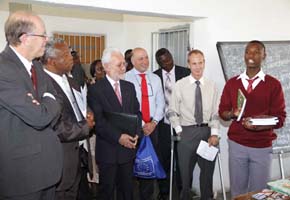
by parents as they are discriminatory and is already working on transitional mechanisms.
This came out at a roundtable discussion between the European Union (EU) delegation and representatives of different sectors at the National Arts Gallery in Bulawayo.
Lack of development of infrastructure and marginalisation of Matabeleland region also took centre stage as participants raised concern that there was no proportionate distribution of resources on national programmes.
The EU delegation, comprising United Nations Children’s Fund (Unicef) representative Dr Peter Salama and other officials led by Ambassador Aldo Dell’Ariccia, is on a four-day visit to the Matabeleland region where it would visit health and education facilities, disadvantaged communities, projects and wind up by handing over the EU Corner at the Bulawayo Public Library.
Responding to questions at the discussion, the permanent secretary in the ministry, Dr Stephen Mahere, said the incentives were discriminatory and not sustainable and ultimately disadvantaged rural teachers.
Although the idea of scrapping teachers’ incentives was mooted some months ago, Dr Mahere said his ministry was working towards outlawing the system but needed some time before the employer gives better salaries to the sector.
A representative from the residents associations in Bulawayo had suggested that the EU and Unicef pay teachers a retention fee to augment their meagre salaries.
The residents’ representative urged the Government and the EU to work together to monitor the situation and conditions of teachers in schools.
“The incentives came about because of the economic situation between 2007 and 2009. They are not sustainable and have many disadvantages. As a ministry we now want to outlaw payment of incentives and we are working on modalities of doing so logically while ensuring the employer pays better salaries,” said Dr Mahere.
“Once the Government starts paying teachers better salaries then we would withdraw the circular which authorised payment of incentives.”
He said the discriminated against were rural teachers who were not able to get incentives because of the environment they work under.
He said the situation at the moment was exerting pressure on pupils and parents.
“To have donors pay teachers salaries or incentives is not a solution. It is not permanent because they could be there for say three or five years and eventually go leaving teachers stranded again. The permanent solution to this problem is to have the employer giving a good salary so that the burden is removed from the child,” he said.
On monitoring schools, Dr Mahere said Unicef had donated vehicles which were being used by district education officers to visit schools for inspection and appealed for more vehicles.
Participants raised concern over several issues concerning drugs and medicines in health institutions, and challenged the donor community to expedite distribution, saying sometimes they get wrong drugs and it takes time for them to receive the ones they require for their services.
They said there was a need for donor intervention to make sure there was user-friendly equipment and infrastructure at public institutions.
There was a general feeling that the Matabeleland region was undermined in terms of funding from national projects.
Nust lecturer Dr Lawton Hikwa said there was a need to reconsider national projects when it comes to Matabeleland than to have the region share with other regions so as to develop infrastructure.
Some said there was a need to profile social services indicators in the region and suggested that policy makers take advantage of the census later this year to have an informed geographical distribution of infrastructure and beneficiaries of different programmes in the region.
Participants also appealed to the delegation to assist in equipping teachers with knowledge of the Information Communication Technologies (ICTs), saying teachers were behind because they were using outdated methods of teaching yet pupils now use Internet on their phones.
Earlier in the day, the delegation visited Magwegwe Council Clinic and Lobengula Secondary School to assess its projects in the health and education sectors.
Also joining the delegation on the tour were Minister of Education, Sport, Arts and Culture David Coltart, Dr Mahere, Bulawayo provincial education director Mr Dan Moyo, his Matabeleland South counterpart Mrs Tumisang Thabela and Bulawayo City Council director of health services Dr Zanele Hwalima.
Briefing the delegation, Dr Hwalima said funds from EU had gone a long way in improving the health sector in Bulawayo but lamented shortage of human resource.
She appealed for more funding to be able to lure health personnel and acquire equipment.
Minister Coltart said the EU played a major role in improving the education sector through provision of books under the five-year strategic plan for the education sector.
He told the delegation that the Government was trying its best to revive the education sector.
“We want to strive again for excellence and our key components are our teachers. The Government is doing its best in addressing teachers’ legitimate concerns.
“What we need the teachers to do right now is to continue providing excellent services to the education sector, particularly to children,” said Minister Coltart.
Ambassador Dell’Ariccia said the EU was committed to assisting the country in different sectors to improve the lives of ordinary citizens.
Today the delegation would visit projects and schools in Matabeleland South before having a roundtable discussion with the private sector in the afternoon.



 Online Reporter