

 admin
admin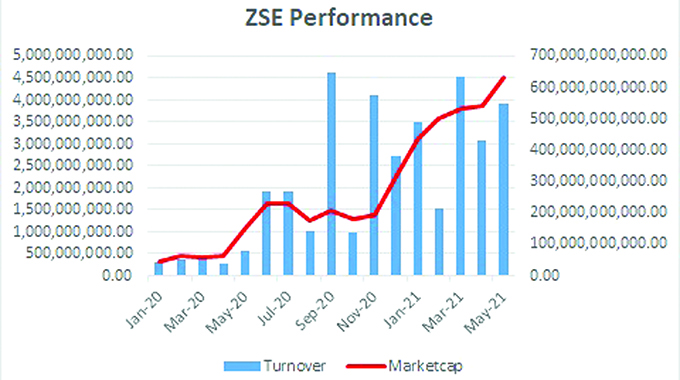
Kudzanai Sharara
The Zimbabwe Stock Exchange’s report card for the first five months of the year came out on Monday this week and I must say, on average, so far so good for investors. It’s always good to say “on average” because not everyone is a winner on the stock market.
Even when the market has a positive overall performance, its very common that they would be some investors cursing their luck. They could have bought when a share priced peaked and panicked when it started coming off and sold at a loss.
They could have also bought when the price peaked, but soon after the share price came off and has not recovered to that peak again. Though they have not sold yet, their portfolio value is in the negative.
A good example is the Old Mutual Top 10 Exchange Traded Fund (ETF). The ETF’s unit price peaked at $2,16 sometime in February, but has traded below that peak price since.
An investor who bought at peak is smarting in the negative if they still hold. However, overall and on average, the ZSE has been positive, beating both inflation and exchange rate depreciation.
By the close of May 2021, the bourse’s overall market capitalisation had gained 99 percent to $634 billion.
The ZSE’s market gain is ahead of year-to-date inflation of just 16,2 percent. This means the investor can buy whatever they could have bought at the start of the year and be left with some change to spare. For example, if at the start of the year, an investor had foregone buying something costing $1, they can now buy that item at $1,16 after accounting for inflation, but still be left with $0,83 extra after accounting for the ZSE’s 99 percent gain.
Interest in the stock market was also very strong in the first 5 months of the year. A total $16,5 billion in turnover has found its way to the market. March had the highest turnover of $4,5 billion, while May had the second highest of $3,9 billion.
In terms of gains, May with a gain of 17,25 percent was the second strongest month after January with an average return of 37 percent.
With all these gains, one of the frequently asked question is: should I sell now?
What is the right time to sell?
Its a valid question indeed. A lot of investors struggle with this one. After all, it’s hard to let go of an asset that is making you money.
When the market is bullish as it has been so far, greedy drives actions. The common fear is that: what if I sell and the market keeps rallying? Many fear missing out on major gains if the share price continues to rally.
In some instances, these are valid fears, the market can even double post your sale. But in some cases, the expected upward trajectory might just stop and share prices will start coming off. One would have missed an opportunity to sell at peak.
Should one hold on to shares in anticipation of a continued market rally, but risk missing an opportunity to sell at peak?
What does one do?
Since I am not an investment adviser I will not tell you what to do, but I will tell you what I would do.
To make that decision, there are a few things I consider.
Target Price
Every time I buy shares, I buy with a target price and by extension an expected return in mind. So basically I am saying I want to make a certain amount of return and when that is achieved I sell and look for another cheaper stock to buy. But this is not a concrete rule. As the market gets closer to target price I always try to review the company’s fundamentals.
The idea is to look for any fundamental changes that might warrant a higher target price than I initially thought. If there are no changes, then I sell at the targeted price. Once perfected this trading strategy removes emotions and greedy from the decision to sell or not to sell when my target price is reached.
Trading Volume
Another aspect to look at is the trading volume. If a share price is rallying and the volumes are still high, chances are that the share price might continue to rally beyond my target price.
But if I start seeing lower volume than before, it might be a sign that demand is waning and the share price might start coming off. It’s basically a sell signal if my target price had already been reached.
Sometimes I don’t have to wait for my target price to be achieved for me to sell. If company fundamentals change negatively, it might be time to consider selling if I don’t think it will recover or if I think the recovery will take time and is not in line with my investment objectives.



 Online Reporter