admin
admin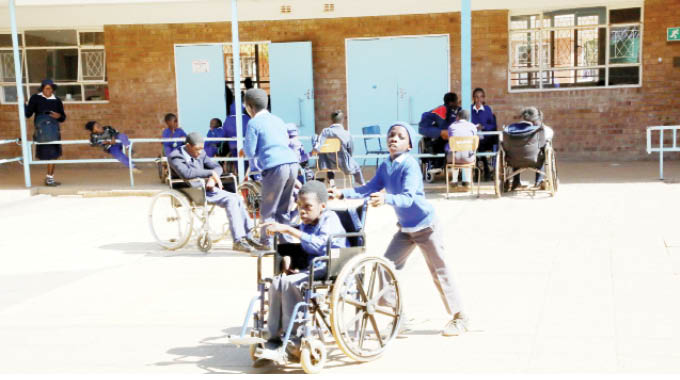
Kudzai Chikiwa, Features Reporter
THE world we live in has no special street for people living with disabilities.
Those who use wheelchairs find their way through the pavements, the visually impaired cross roads with their walking sticks. They go about their business just like everyone else.
So why should some learners be quarantined and have special schools for those living with disabilities only?
Does that not create a drumbeat of an “us” versus “them” narrative? If they spend 15 years from Early Childhood Development (ECD) to Advanced Level as a small community of special needs learners, how are they going to cope with the able bodied at tertiary level or in the community in general? A visit to King George V1 (KGV1) Memorial School in Bulawayo came as an eye-opener on how cardinal it is to bring all learners, despite physical challenges, in a classroom. The bell rings as a thrilling reminder that the long awaited moment to mingle with friends has finally arrived. It’s break time. After a busy morning, learners at KGV1 are screaming, jumping and hopping about as they make their way to different break time spots.
Unlike the ‘usual’ school set up, one can tell that KGV1 is more of a big family where everyone is a brother’s keeper. Able bodied learners are seen pushing their physically challenged classmates in wheelchairs, carrying their satchels and providing support for those who can’t walk on their own. They are seen chatting using sign language.
“This is not just a school but a home of siblings with differences and we accept and accommodate each other as we are,” said Tatenda Mundangepfupfu, the head boy who uses a wheelchair. The Form Four pupil who was being pushed around by his friend said it is more enjoyable to learn in an inclusive set up than going to a special school where physically challenged learners are “quarantined”.
“Having special schools where pupils like me are made to learn on their own under special conditions is discriminatory. We should share the same class and get to understand our differences,” said Tatenda who is also a former junior council member. The pupil who was learning in Mutare before enrolling at KGV1 however said learning at conventional schools that are not fully inclusive is a challenge to pupils living with disabilities.
“Although I didn’t experience much discrimination at my former school, what I realised is that learners living with disabilities are taken as second class citizens. They’re discriminated against. School times become torturous,” he said. For Jimmy Dotito a Form One pupil with a hearing impairment, KGV1 is a home where everyone seeks to understand his language.
“It’s very interesting to mix and mingle with peers who can hear and speak. My teachers and friends now can use sign language. I don’t want to go to a special school where I’m separated from other learners. When I come back home, I’ll be feeling inferior to others who can hear and talk,” he said, his teacher interpreting.
KGV1 Memorial School is one of the few Government schools in the country that have fully embraced inclusivity.
Inclusive education is when schools put up facilities and infrastructure that allow learners with special needs and those without to learn together. Although the Ministry of Primary and Secondary Education advocates for inclusivity at all mainstream schools, many schools are far from being inclusive as they lack user-friendly infrastructure. KGV1, which was opened in 1957 has created a conducive environment for learners living with disabilities and the able bodied from ECD to secondary school. It has 449 learners who are able bodied and those living with disabilities.
“At primary level there are 136 learners living with disabilities and 90 non-disabled, while at secondary there are 45 living with disabilities and 90 non-disabled. At secondary there are 53 hearing impaired and at primary there are 82,” said an official.
The school official said under inclusive education, both teachers and learners create a conducive environment for both able bodied learners and those living with disabilities.
“This is the best education system. Instead of quarantining learners and making them learn on their own, we try to bring them together with their able bodied counterparts. This way children appreciate others at an early stage,” said the official.
The school official said teachers, learners and non-teaching staff are taught sign language for easy interaction with those with hearing impairment.
During assembly, there are interpreters to help those with hearing impairment while choruses are also sung in sign language.
The school official said inclusive education however comes with challenges.
“There’s a shortage of teaching material to take learners to the standard that we want to. We don’t have interactive boards and other equipment,” she said.
A parent, Mrs Nothando Ndlovu who has two children, one living with a disability and another who is able bodied commended inclusive education saying many parents are still ignorant about its value. “Separating children makes the other one feel inferior. I have a child who is wheelchair bound but I can’t separate him from his siblings. I can’t have a special plate or room for him but I make sure they mix and accept each other. Inclusive education brings siblings together at the same school,” she said.
Mrs Ndlovu however said inclusive education becomes bad when schools are not user friendly for learners with special needs. “Let everything be inclusive from infrastructure to learning material. The reason why parents end up opting for special schools is that the mainstream schools won’t be user friendly,” she said.
Progressive Teachers’ Union of Zimbabwe president Mr Takavafira Zhou said inclusive education is crucial as it allows learners with different abilities to interact. “Being physically challenged doesn’t make these pupils inferior and it’s pointless to quarantine them and create a special school for them. We want a scenario where every learner despite their challenges can come together and accept each other’s differences,” he said.
Mr Zhou however said most schools in the country are inclusive on paper but exclusive in operation. “Many schools are not user friendly. For example, they have double storey structures which automatically discriminates those who use wheelchairs. These schools are incapacitated from infrastructure to learning material,” he said.
Mr Zhou said inclusive education is important because it brings a sense of society integration where everyone is treated equally and can share ideas at the same level. He added that although having special schools is a good idea, they make learners with disabilities feel discriminated against and unequal to their counterparts. “In society, people live together and there’re no special communities for those living with disabilities so why have special schools for physically challenged children?” Mr Zhou challenged Government to improve mainstream schools to become inclusive in nature.
“According to Government, all schools are inclusive but we challenge it to improve these schools. There should be pavements for those with wheelchairs, computers and everything. The sports fields are not user friendly for learners living with disabilities.” He said teachers are disadvantaged because they do not have multi-skills to enable them to teach visually impaired pupils for example.
During a community outreach programme for Bulawayo Central district schools recently, the district’s schools inspector, Mrs Nozipho Ngulube revealed that her district is faced with a shortage of special needs schools, which has resulted in some pupils living with disabilities failing to access education. She said out of 31 schools in the district, 20 primary schools and 11 secondary schools, only five cater for special needs. These statistics show how fundamental it is for Government to push for inclusive education rather than forcing parents to scramble for limited places at special needs schools. Schools that accommdate special needs pupils in Bulawayo include Simanyane Special Care School, Sir Humphrey Gibbs, St Francis and John Slaven Primary School.
Ministry of Primary and Secondary Education statistics show that a total of 61 946 learners with disabilities – 34 749 males and 27 197 females – were enrolled in 2018. The statistics show that out of all the 61 946 learners with disabilities, those with visual impairment constitute 10,82 percent. The statistics further shows that only 40 schools are either specifically for the visually impaired learners or have resource units that accommodate these learners.
Deputy Minister of Primary and Secondary Education Edgar Moyo said Government recognises the unique needs of learners with visual impairment and other disabilities and has provisions to address their special educational requirements.
“For example under the 2030 vision of our ministry, no one should be discriminated in accessing education. The ministry established the National Braille Printing Press (NBPP), with support from its partners and organisations for the visually impaired. This facility exists to provide adaptive teaching and learning materials in the form of Braille, enlarged print and audios as well as tactile learning aids for the benefit of visually impaired and teachers,” he said. He said his Ministry is not spared by economic challenges which sometimes derail inclusive infrastructural development. – @tamary98


 Online Reporter