Online Reporter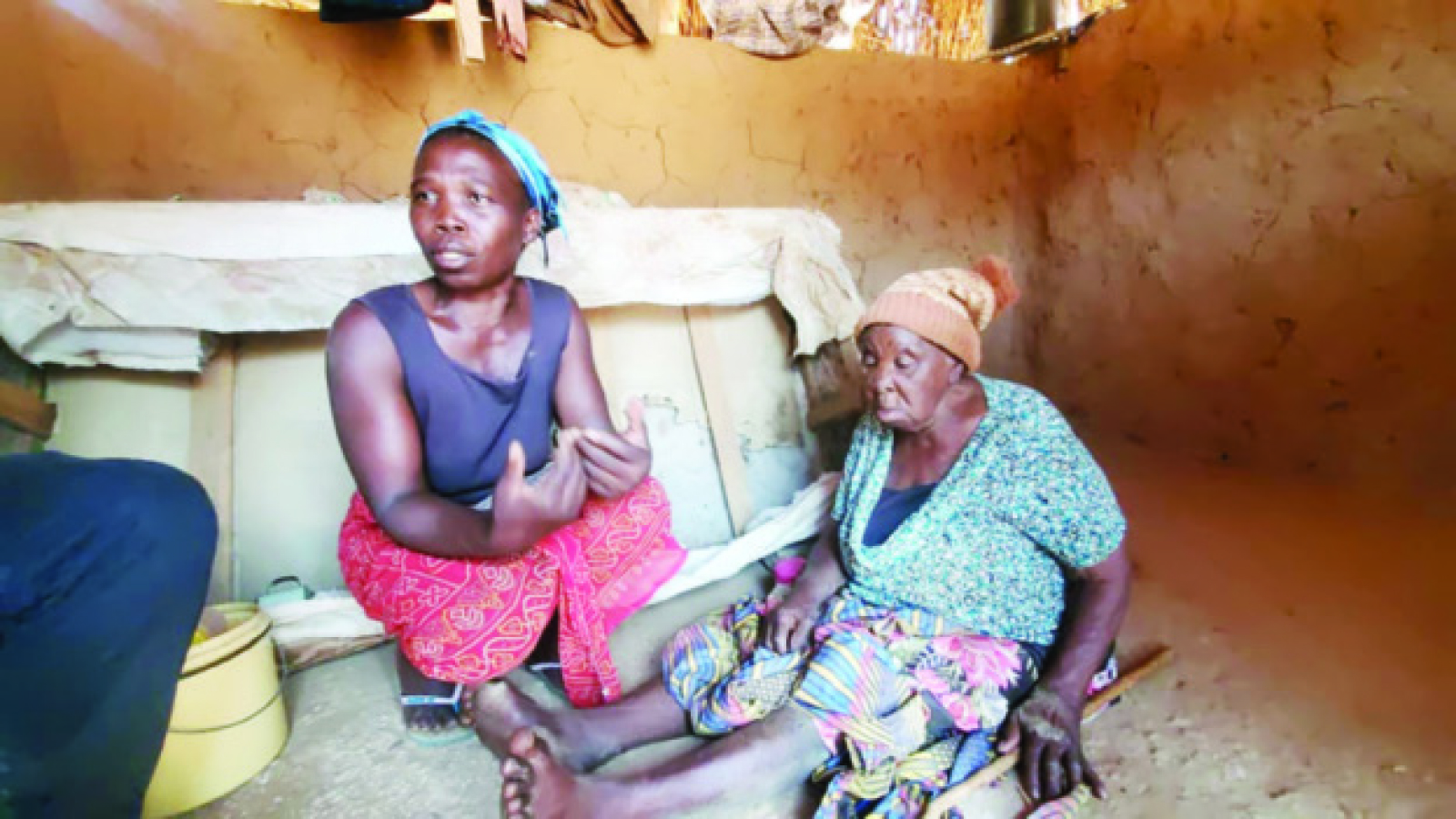
Theseus Shambare
Features Writer
BEFORE the sun bakes the red soils of Binga into dust, 99-year-old Mwembe Nyoni is already awake.
Her day begins the same way it has for more than two decades, with struggle.
Inside her small thatched hut in Chemba Village, the elderly woman braces herself, pushing her large, heavy frame forward with both hands.
Mwembe was a farmer, a mother and a market trader who often travelled between Gokwe in the Midlands Province and Binga in Matabeleland North Province.
But in 1998, a road accident shattered her life, leaving her permanently disabled.
Now, she lives with her son and daughter-in-law, Lungile and Lute Mumpande, in a mud-walled hut far from the nearest tarred road — far, too, from many of the rights most people take for granted.
Binga District, on Zimbabwe’s north-western frontier along the Zambezi River, is a region rich in culture and natural beauty, yet historically vulnerable to climate and geographical challenges.
Once part of the Tonga homeland affected by the creation of Lake Kariba, Binga has faced development challenges over the years, which the Government is steadily addressing through targeted infrastructure and community support initiatives.
The 2025 Zimbabwe Livelihoods Assessment Committee (ZimLAC) report estimates poverty prevalence in Binga at over 80 percent, compared to a national average of 38 percent.
While Zimbabwe continues on its path of national development, Binga’s remoteness presents unique challenges that are being steadily addressed through targeted rural development and social support programmes.
Its people face multiple deficits in terms of water, food, sanitation, healthcare, mobility and communication.
For Mwembe, those deficits define her life.
Because of her disability, she has not walked in 27 years.
Each day, she drags her heavy body across the dusty ground to move from her sleeping mat to the doorway or to relieve herself outside.
To Mwembe, a wheelchair is not a luxury but a basic need and a matter of dignity.
“Sometimes, the soil burns her skin,” said Lute, her daughter-in-law.
“She cries, but she still crawls — she has no choice.”
Mwembe’s thickened palms bear the scars of decades of friction against sunbaked clay.
Age has weakened her arms and she now depends completely on Lute — for bathing, eating, dressing and toileting.
Lute herself cannot work, tied to full-time care-giving.
“I want to join other women’s projects,” she said, “but if I leave her alone, who will help her?”
Their story reflects the silent burden of unpaid care work and the gendered inequality of disability in rural Africa — issues Zimbabwe’s National Disability Policy (2021) seeks to address.
For years, Mwembe’s disability forced her to use the open bush as a toilet, which is degrading and unsafe.
Snakes, heat and exposure made every attempt a risk.
According to UNICEF Zimbabwe (2024), one in four rural Zimbabweans still lack access to basic sanitation.
But in Binga, the open defecation rate stands at 80,1 percent, the highest in the country.
Behind that statistic lies humiliation — the loss of a fundamental human right: the right to dignity.
In 2024, change finally arrived through the Government’s Climate Smart Resilience (CSR) Project, implemented by the Zimbabwe Red Cross Society (ZRCS) with support from the Finnish and Danish Red Cross.
The project constructed an inclusive toilet at Mwembe’s homestead, fitted with ramps, handrails, and a raised seat designed for people with disabilities.
“When she used it for the first time, she smiled,” Lute recalled.
“She said, ‘Now I am like other people again.’”
It was not just a structure. It was a restoration of dignity and equality.
Water scarcity defines life in Chemba Village.
The nearest borehole lies five kilometres away, forcing women and girls to walk long distances daily.
For Mwembe, that distance might as well be an ocean.
“She cannot fetch water,” said Lute. “Sometimes we go without washing.”
The ZimLAC 2025 report shows that only 35 percent of Binga’s households have access to safe drinking water within one kilometre, compared to 78 percent nationally.
Without clean water, hygiene and health deteriorate, exposing residents to diarrhoea, skin infections and cholera outbreaks.
The right to health, protected under Section 76 of Zimbabwe’s Constitution, remains aspirational for many here.
The nearest clinic is 12 kilometres away and transport costs exceed what the family earns in weeks.
“When she’s sick, we wait,” said Lute.
“Sometimes the sickness passes. Sometimes it does not.”
Erratic rainfall and climate shocks have deepened hunger in Binga.
The Famine Early Warning Systems Network (FEWS NET) projects that over 60 percent of households in Matabeleland North will face food deficits during the 2025 lean season.
For the Mumpande family, survival depends on casual labour.
Lungile works as a part-time builder, earning sporadic income.
But in a district where most homes are made of pole and thatch, construction work is rare.
Without access to irrigation, land ownership, or social protection, the right to food, guaranteed by Section 77 of the Constitution, remains beyond reach.
Even as digital connectivity transforms much of Zimbabwe, Binga remains offline.
Network coverage is patchy, with frequent blackouts that isolate entire villages for days.
According to POTRAZ (2024), only 46 percent of rural households in Matabeleland North have reliable mobile access, while internet penetration remains below 30 percent.
For Mwembe and her family, this means no mobile money, no online health advice and no emergency contact when crises hit.
“When my mother-in-law falls ill, I cannot even call the clinic,” said Lute.
“We just pray.”
Universal Declaration of Human Rights (Article 19) which guarantees the right to communication sometimes is meaningless where there is no signal.
Disability is not just a physical condition but a social and political issue.
According to the World Health Organisation (2024), people with disabilities are three times more likely to experience poverty and twice as likely to lack access to healthcare or education.
In Binga, where disability intersects with gender, age and geography, exclusion multiplies.
“People with disabilities are the poorest of the poor,” said Zimbabwe Red Cross Society district field officer for the project, Spiwe Sibanda.
“When we design interventions, we must start with them — not add them last.”
The CSR Project, now in its third year, is one such model — building inclusive toilets, accessible water points and climate-smart gardens that empower marginalised households.
So far, it has reached over 3 000 households across Binga and Hwange districts, blending humanitarian aid with human rights-based programming.
Zimbabwe is a signatory to the United Nations Convention on the Rights of Persons with Disabilities (CRPD), committing to accessibility and participation.
Yet, implementation gaps remain wide.
As climate change intensifies, rural communities like Chemba find themselves at the intersection of environmental crisis and deprivation.
Still, stories like Mwembe’s offer hope — proof that even small acts of inclusion can transform lives.
“They brought back her dignity — and mine,” said Lute, gazing at the small brick toilet that changed everything.
As the sun dips behind the Zambezi escarpment, Mwembe smiles faintly.
Her life remains fragile, but she is no longer invisible.
For her, the promise of rights is no longer theory; it stands behind her home in brick and cement — practical, accessible and hers.
In her struggle lies a lesson for the world: Dignity is not a privilege. It is a right. Every ramp, every borehole, and every act of inclusion that restores it is a victory for humanity.