Chronicle Editor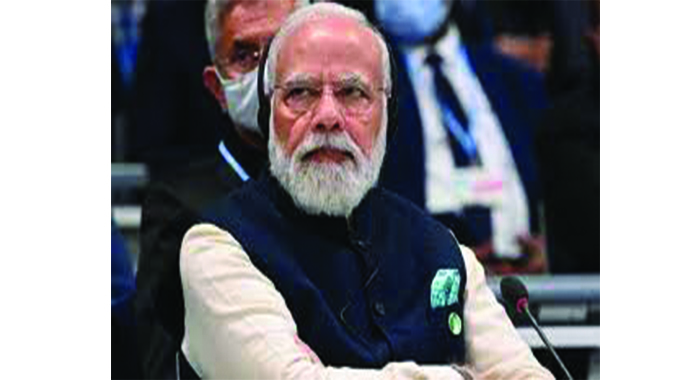
India has announced plans to cut its emissions to net zero by 2070 – missing a key goal of the COP26 summit for countries to commit to reach that target by 2050.
Prime Minister Narendra Modi made the pledge at the Glasgow conference.
This is the first time the country has made such a commitment. Net zero, or becoming carbon neutral, means not adding to the amount of greenhouse gases currently in the atmosphere.
In contrast, China has announced plans for carbon neutrality by 2060, while the US and EU aim to hit net zero by 2050.
India is the world’s fourth biggest emitter of carbon dioxide after China, the US and the EU.
But its huge population means its emissions per capita are much lower than other major world economies. India emitted 1.9 tonnes of CO2 per head of population in 2019, compared with 15.5 tonnes for the US and 12.5 tonnes for Russia that year.
Mr Modi made the pledge as one of five commitments from his country.
They include a pledges for India to get 50% of its energy from renewable resources by 2030, and by the same year to reduce total projected carbon emissions by one billion tonnes.
While the 2070 net zero target may have disappointed activists and experts in Glasgow, Mr Modi seems to have impressed people back home.
The BBC’s Vikas Pandey reports that the prime minister appears to have found the middle ground for his base – he is seen as being serious about climate change but without compromising India’s economic potential.
Most headlines are using words like “big” and “major” to describe the announcement, our correspondent reports.
Meanwhile, the world is at “one minute to midnight”, having run down the clock on waiting to combat climate change, Prime Minister Boris Johnson has said.
He was speaking as world leaders arrived for the landmark COP26 climate change conference in Glasgow.
Speaking to the BBC, Mr Johnson said leaders needed to move from “aspiration to action” to slow global warming.
He added the summit was a “critical” moment for him, and said an ambitious outcome was still “in the balance”.
For the first time, Mr Johnson also confirmed he did not want to see a controversial proposed coal mine in Cumbria go ahead.
“I’m not in favour of more coal,” said the prime minister. “But it is not a decision for me, it is a decision for the planning authorities.”
The government has been criticised for not stopping the mine project going ahead.
This is the strongest statement the prime minister has yet made on the subject – and could help negotiations, because persuading nations to phase out coal is one of the central goals the UK government has set for the crucial UN conference. — BBC news


 Online Reporter